

Fargo fights for its life

Advertisement
Read this article for free:
or
Already have an account? Log in here »
To continue reading, please subscribe:

Digital Subscription
One year of digital access for only $205*
- Enjoy unlimited reading on winnipegfreepress.com
- Read the E-Edition, our digital replica newspaper
- Access News Break, our award-winning app
- Play interactive puzzles
*First annual payment billed as $205.00 + GST for one year. This annual subscription will automatically renew at $233.00 + GST every 52 weeks (10% off the regular annual price of $259.35). Offer available to new and qualified returning subscribers only. Cancel any time.
To continue reading, please subscribe:
Add Free Press access to your Brandon Sun subscription for only an additional
$1 for the first 4 weeks*
- Enjoy unlimited reading on winnipegfreepress.com
- Read the E-Edition, our digital replica newspaper
- Access News Break, our award-winning app
- Play interactive puzzles
*Your next Brandon Sun subscription payment will increase by $1.00 and you will be charged $17.95 plus GST for four weeks. After four weeks, your payment will increase to $24.95 plus GST every four weeks.
Read unlimited articles for free today:
or
Already have an account? Log in here »
Hey there, time traveller!
This article was published 26/03/2009 (6348 days ago), so information in it may no longer be current.
FARGO — The reality of 43 feet could be seen all over Tim Corwin’s face.
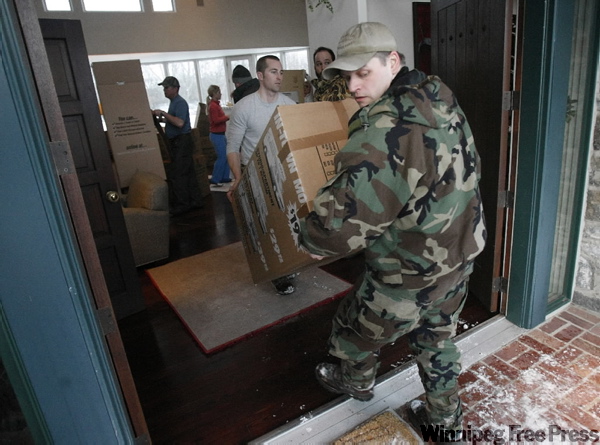
Corwin, who owns a palatial brick home on the west side of the Red River in Fargo, was frantically emptying his home. Clothing still on the hangers, family heirlooms including a painting of his great grandfather, were being hustled out of the front door into waiting pick-up trucks and vans.
Corwin is working against time. In a few hours, the road in front of his house will be turned into a secondary “contingency” dike. Earth movers and dump trucks will build a two metre clay wall that will cut off all of the waterfront homes in the upscale River Road neighborhood.
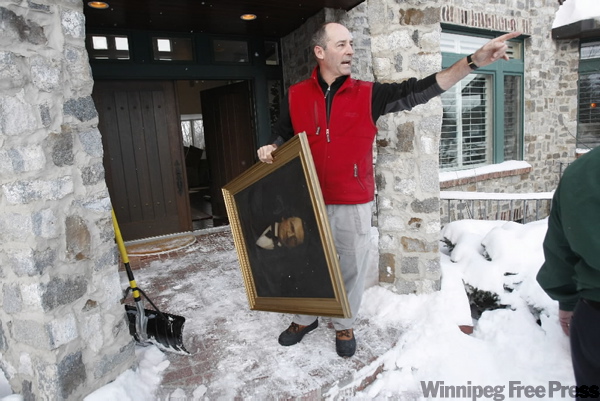
“We’re preparing to evacuate,” the car dealership owner said with firm emphasis on the ‘preparing.’ “We don’t want to leave, but we’re going to have to be ready for anything now.”
Now that the Red River is approaching a record crest, the whole city of Fargo is ready for anything.
The most recent flood forecast estimates the river will crest at between 41 and 42 feet. However, there is a chance that precipitation and tributary flow could push that to 43 feet. Quite frankly, there was a time in this city when 43 feet was considered crazy talk.
The mighty Red River, the waterway that dictates fortunes for those who live in its precarious flood plain, had always threatened this bustling prairie city with levels of 35 feet, or perhaps 37 feet. The city’s flood protection system had been geared for that level.
The reality of 43 feet — the potential level of the crest that is supposed to flow through downtown Fargo-Moorhead sometime on Saturday — was only just starting to hit home Thursday.
A persistent winter storm blanketed the city in a low, claustrophobic greyness. The flashing lights of emergency vehicles could be seen on every major thoroughfare. Traffic on 1-94 South, the only route still open, was jammed with people trying to get home.
At the Fargodome, the bunker-like indoor football stadium on the campus of North Dakota State University, hundreds of grimy volunteers raced to fill the 2.5 million sandbags required to protect the most vulnerable ares of Fargo-Moorhead. The cavernous arena throbbed with the music of the Rolling Stones (Start Me Up) and James Brown (I Feel Good) as an unseen disc jockey tried to keep spirits high.
The conditions are stifling; dust from the thousands of tons of sand mix with the acrid exhaust of a small legion of bobcats, forklifts and earth movers that are needed to move the sandbags from filling stations to pallets and out to the front lines of the flood fight.
David Daws wipes a sweaty paw across his forehead, and chokes down the last of a foam bowl of chili provided by the Salvation Army. Daws, who lives in a part of south Fargo that could be vulnerable if the magic 43-foot mark arrives, took Thursday and Friday off to fill sandbags.
Daws said he expected the spring thaw to cause some flooding, but it wasn’t until he saw a National Guard convoy racing up 1-29 past his neighborhood to coordinate flood protection measures that he realized they were in for a fight of their lives.
“I saw those National Guardsmen, and the police cars escorting the sand trucks, and I thought holy bucket, this is really going to happen this time,” said Daws.
The element of surprise is not, however, an excuse for the lack of permanent flood protection in this city. In 1997, it was Grand Forks that took the brunt of the spring flooding; Fargo was threatened but left relatively unscathed. As a result, local, state and federal officials couldn’t seem to come to a consensus on exactly what should be done to this community, which is bisected by the Red River.
There was a diversion constructed in West Fargo to protect against the ravages of Cheyenne River flooding. Some levees and permanent dikes were raised, but only to handle a river level of 37 or 38 feet. As a result, the most vulnerable areas have been sandbagged and re-enforced with temporary clay dikes.
In some of those most vulnerable areas, the dikes sit at maximum height of 43 feet, four inches, leaving less than half a foot between salavation and disaster.
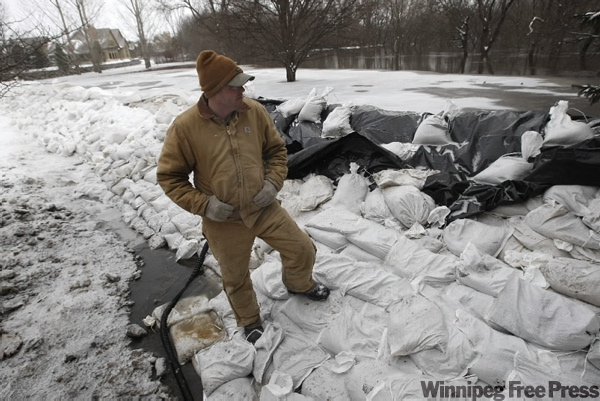
Kevin Molony is only too aware of the razor thin margin of error in this battle with the Red River. Standing behind a dike at the rear of his riverfront home, Molony can only look on with amazement at the creeping influence of the river.
Owner of a scenic, 3/4 acre lot that backs onto the Red, the water has now crept within 30 feet of his back patio. The normal river bank is more than 150 metres away, far enough that it’s almost impossible to see the edge of the tree line in the fading evening light.
The flood fight has been a moving experience for Molony and his family, who have welcomed volunteers from all over North Dakota, and states as far away as West Virginia, Oklahoma, Nebraska and Missouri. “There’s really been too many to count,” he said.
For the next week or so, Molony will watch his dike, and the dikes built behind his neighbors homes, and hope they do not fail. A failure in just one backyard could kick off a chain reaction that could claim the entire neighborhood, and large tracts of the entire city.
Will it be enough to withstand a crest of 43 feet?
“I don’t know,” Molony said. “It has to be.”
The city of 92,000 unveiled a contingency evacuation plan Thursday afternoon but at least four nursing homes already had begun moving residents by then.
"A few of them said they didn’t want to go. I said I’m going where the crowd goes," said 98-year-old Margaret (Dolly) Beaucage, who clasped rosary beads as she waited to leave Elim Care Center.
"I’m a swimmer," she said, smiling.
"But not that good a swimmer."
Officials in Moorhead earlier called for voluntary evacuations for several hundred homes on the city’s south side.
The sandbag-making operation at the Fargodome churned as furiously as ever, sending fresh bags out to an estimated 6,000 volunteers who endured temperatures below 20 degrees in the race to sandbag.
"I was skeptical as far as volunteers coming out today, but they’re like mailmen," said Leon Schlafmann, Fargo’s emergency management director.
"They come out rain, sleet or shine."
Gov. John Hoeven, heading into a planning meeting in Fargo, urged residents not to let up.
"We know they’re tired but we need to hang in there and continue the work," he said.
Hoeven was calling for 500 more National Guard members to join 900 already part of the effort.
Walaker, the mayor, said he was shocked by the new forecast.
"Is this a wakeup call? People can’t take many more wakeup calls," he said.
But Walaker also said the forecast didn’t seem to match what he had seen in the Red’s tributaries earlier in the day.
"This is the worst-case scenario," he said.
"Right now, I’m going to stick with 41 (feet)," he said.
As in Fargo, sandbagging was under way in Moorhead, where some homes in a low-lying northern township had already flooded. The city was setting up a shelter at its high school for displaced residents and those who heeded the call for voluntary evacuation.
Moorhead Mayor Mark Voxland told WDAY-TV the city would just have to raise its protection another 30 centimetres.
"The problem is we don’t have that much time. Every day is a day closer to crest and now we’re looking at 36 hours to cresting – we don’t know if we have time to add another foot to all of our dikes."
As the struggle continued in Fargo, the threat in the state capital Bismarck was receding. A day after explosives were used to attack an ice jam on the Missouri River south of the city of 59,000, the river had fallen by 76 centimetres. At least 1,700 people had been evacuated from low-lying areas of town before the river began to fall.
Crews were rescuing stranded residents in rural areas south of Fargo. On Wednesday, 46 people were rescued by airboat from 15 homes and Cass County Sheriff Paul Laney said early Thursday he had received 11 more evacuation requests from homeowners.
In Fargo, the southern parts of the city, mostly residential areas, were seen as most vulnerable and the city was building contingency dikes behind the main dike in some areas. The river was a bit over 12 metres Thursday evening. The Red hit 12 metres in 1997 and the record is 12.2 metres in 1897.
Dick Bailly, 64, choked up as he looked out over his backyard dike at the river.
"It was demoralizing this morning," Bailly said, his eyes welling.
"We got a lot of work to do. People have the will to respond but you can only fight nature so much and sometimes nature wins."
On a sandbag line behind another house near the river, 65-year-old Will Wright, a veteran of Fargo floods, helped stack bags as water began to seep through his homemade dike. Like others, he said he was confident the dike would hold – for awhile.
"The big concern I have is the river crest staying three to five days and it testing the integrity of these sandbags," Wright said.
In Moorhead, both entrances to the Crystal Creek development were flooded, leaving Deb and Scott Greelis thinking about how they and their kids – ages six, two and six months – could get out if things get much worse.
"We are pretty much stuck in here," Deb Greelis said.
But she said they could haul the kids in a sled to a nearby highway on higher ground if they need to evacuate.

with files from The Associated Press
Dan Lett is a columnist for the Free Press, providing opinion and commentary on politics in Winnipeg and beyond. Born and raised in Toronto, Dan joined the Free Press in 1986. Read more about Dan.
Dan’s columns are built on facts and reactions, but offer his personal views through arguments and analysis. The Free Press’ editing team reviews Dan’s columns before they are posted online or published in print — part of the our tradition, since 1872, of producing reliable independent journalism. Read more about Free Press’s history and mandate, and learn how our newsroom operates.
Our newsroom depends on a growing audience of readers to power our journalism. If you are not a paid reader, please consider becoming a subscriber.
Our newsroom depends on its audience of readers to power our journalism. Thank you for your support.
Dan Lett is a columnist for the Free Press, providing opinion and commentary on politics in Winnipeg and beyond. Born and raised in Toronto, Dan joined the Free Press in 1986. Read more about Dan.
Dan’s columns are built on facts and reactions, but offer his personal views through arguments and analysis. The Free Press’ editing team reviews Dan’s columns before they are posted online or published in print — part of the our tradition, since 1872, of producing reliable independent journalism. Read more about Free Press’s history and mandate, and learn how our newsroom operates.
Our newsroom depends on a growing audience of readers to power our journalism. If you are not a paid reader, please consider becoming a subscriber.
Our newsroom depends on its audience of readers to power our journalism. Thank you for your support.
Related Articles
Red Cross opens special family line Perfect storm Roseau River evacuees arrive in Winnipeg
Advertisement Advertise With Us
Advertisement Advertise With Us