

Good design can save lives
An art so critical, yet so often unnoticed

Advertisement
Read this article for free:
or
Already have an account? Log in here »
To continue reading, please subscribe:
Monthly Digital Subscription
$1 per week for 24 weeks*
- Enjoy unlimited reading on winnipegfreepress.com
- Read the E-Edition, our digital replica newspaper
- Access News Break, our award-winning app
- Play interactive puzzles
*Billed as $4.00 plus GST every four weeks. After 24 weeks, price increases to the regular rate of $19.95 plus GST every four weeks. Offer available to new and qualified returning subscribers only. Cancel any time.
Monthly Digital Subscription
$4.99/week*
- Enjoy unlimited reading on winnipegfreepress.com
- Read the E-Edition, our digital replica newspaper
- Access News Break, our award-winning app
- Play interactive puzzles
*Billed as $19.95 plus GST every four weeks. Cancel any time.
To continue reading, please subscribe:
Add Free Press access to your Brandon Sun subscription for only an additional
$1 for the first 4 weeks*
- Enjoy unlimited reading on winnipegfreepress.com
- Read the E-Edition, our digital replica newspaper
- Access News Break, our award-winning app
- Play interactive puzzles
*Your next Brandon Sun subscription payment will increase by $1.00 and you will be charged $17.95 plus GST for four weeks. After four weeks, your payment will increase to $24.95 plus GST every four weeks.
Read unlimited articles for free today:
or
Already have an account? Log in here »
Hey there, time traveller!
This article was published 30/05/2017 (3267 days ago), so information in it may no longer be current.
‘Everything you use from the second you wake up, from your alarm clock in the morning to the first app you check out, has been designed by somebody,” says Darren Stebeleski, an artist and graphic designer who teaches at Red River College.
“Design really is all around us. It’s completely pervasive, to the extent that we don’t even think about it anymore.”
But even as many of us take design for granted, it has a profound effect on the quality of our daily lives. Far from being a fancy add-on, it is fundamental in the shaping of our homes, our technology, our city and our world.
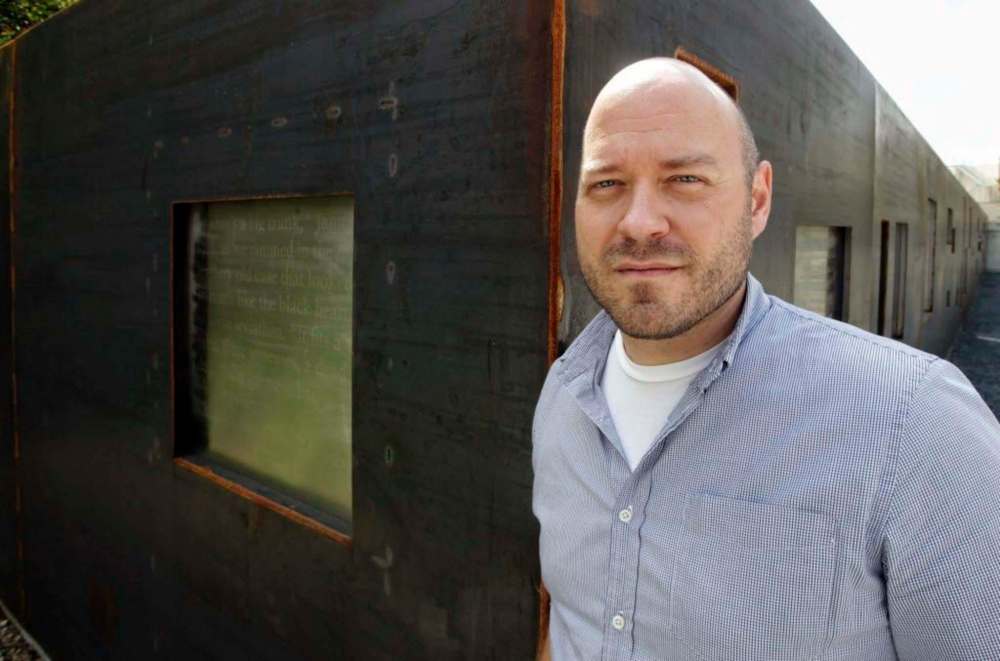
At this month’s First Friday Art Talk/Art Walk, Stebeleski — who received his fine arts degree from the University of Manitoba’s School of Art before going on to take a masters in graphic design at the University of Edinburgh — will talk about what separates good design from bad.
Sometimes poor design is a relatively trivial matter. The snafu at this year’s Oscars, with the wrong winner being announced, was essentially a graphic-design problem. But sometimes the line between good and bad design can mean life or death.
“My students sometimes wonder, is this a career where lives are on the line?” Stebeleski says. Sometimes the answer is yes, whether that involves hard-to-navigate software used to track patients in the health-care system, highway signs that become illegible in rough weather or poorly designed labels on prescription pill bottles.
“The key is empathy,” he suggests. The complete rethinking of Target’s prescription labels, for example, was sparked by a design student whose grandmother had suffered a medication mishap because she couldn’t read the bottle.
“It used to be you had to know how to draw,” Stebeleski explains. “Now that’s unnecessary.
“You don’t have to know how to draw whatsoever. But you do need a keen sense of empathy and a sense of curiosity.”
Good design doesn’t have to be complex. One of Stebeleski’s favourite design objects is the shoehorn — simple, elegant, suited to its purpose. And the best design is often invisible, he believes.
“You’re not supposed to notice it. I’m probably a modernist in that sense, or a neutralist,” Stebeleski says. “I don’t think a designer should put their personality into a work. It should be about the work itself. You should think about the user.”
While excellent design often goes unnoticed, one thing that does get people talking is typeface. Now that computers allow users to choose from dozens of fonts, even non-designers are getting in on the arguments. Stebeleski prefers Helvetica, a popular, clean-lined, mid-20th-century design. “I know that’s a boring answer, but it’s so useful,” he says.
Misapplied, a typeface can get in the way of your message. In the last federal election, the Liberals used Comic Sans in some of their “Real Change” signage and it was not a good look, according to Stebeleski. “When I ask my students about their associations with (Comic Sans), they say, ‘elementary school notices, emails from my mom, church basement bake sales.’ ”
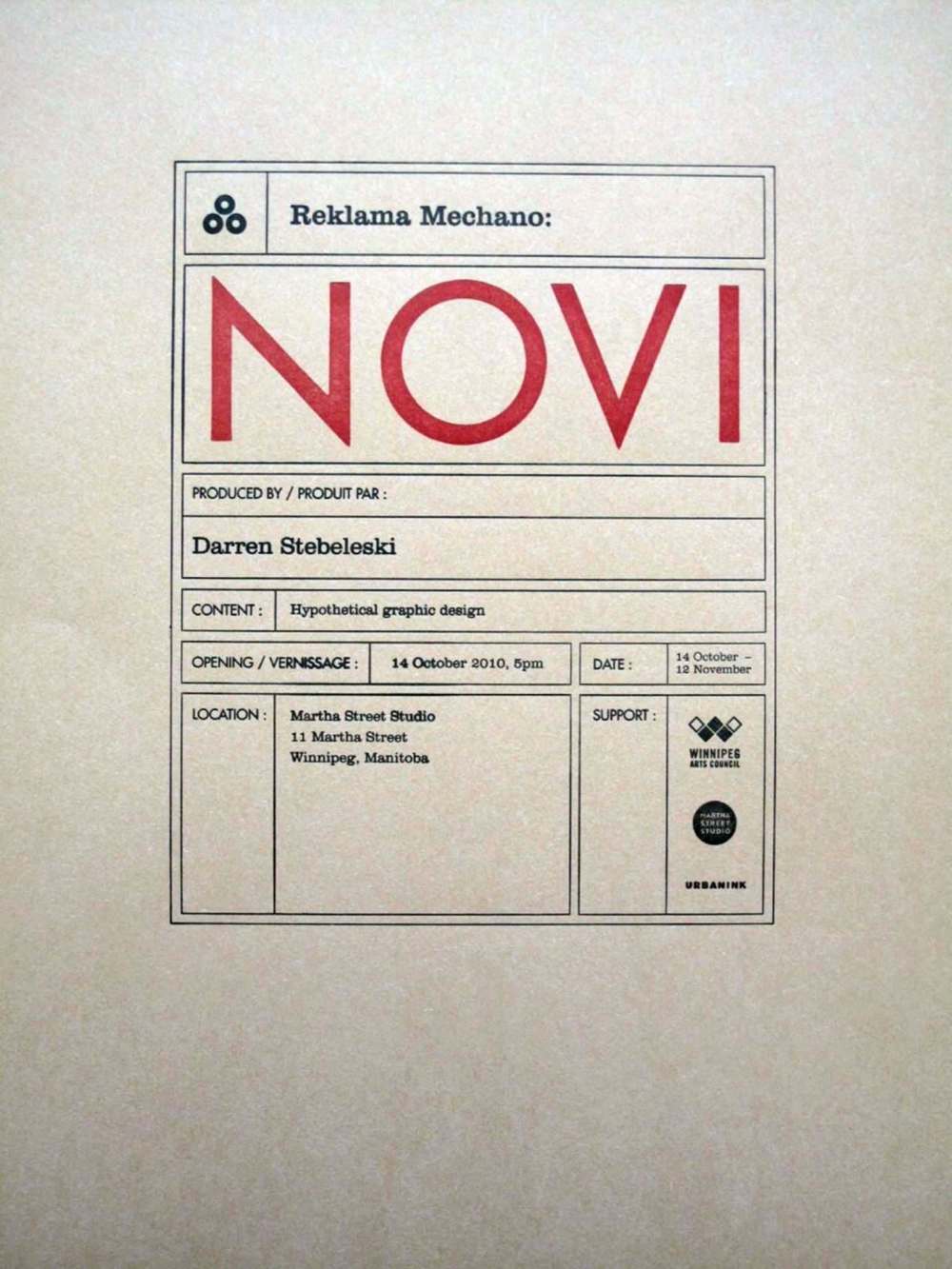
Stebeleski also brings his design sensibility to his art projects. Reklamo Mechano: Novi, a 2010 exhibition at the Martha Street Studio, was an example of what he calls “hypothetical graphic design.” It involved a series of posters for an imaginary utopian society.

Sentinel of Truth, a public art project for the Millennium Library completed in 2012, uses a wall of weathering steel to protect text passages taken from censored books.
“Freedom of speech is a very big deal to me, and the cornerstone to that is a free and accessible library,” Stebeleski says.
“The library is that weathered husk sitting over the truth underneath, which is always in danger.”
For Stebeleski, the message comes out in the design of the piece. “Any art project I’ve ever done I consider a design project.”
We’ll be discussing good design and why it matters with Darren Stebeleski at First Friday’s Art Talk at the Free Press News Café at 6 p.m. Call 204-697-7069 or email wfpnewscafe@gmail.com to reserve tickets, which are $20.
Studying at the University of Winnipeg and later Toronto’s York University, Alison Gillmor planned to become an art historian. She ended up catching the journalism bug when she started as visual arts reviewer at the Winnipeg Free Press in 1992.
Our newsroom depends on a growing audience of readers to power our journalism. If you are not a paid reader, please consider becoming a subscriber.
Our newsroom depends on its audience of readers to power our journalism. Thank you for your support.
Studying at the University of Winnipeg and later Toronto’s York University, Alison Gillmor planned to become an art historian. She ended up catching the journalism bug when she started as visual arts reviewer at the Winnipeg Free Press in 1992.
Our newsroom depends on a growing audience of readers to power our journalism. If you are not a paid reader, please consider becoming a subscriber.
Our newsroom depends on its audience of readers to power our journalism. Thank you for your support.
Advertisement Advertise With Us
Advertisement Advertise With Us