

Famous last words
Eulogy not always the best tool for tributes, author argues
Advertisement
Read this article for free:
or
Already have an account? Log in here »
To continue reading, please subscribe:
Monthly Digital Subscription
$1 per week for 24 weeks*
- Enjoy unlimited reading on winnipegfreepress.com
- Read the E-Edition, our digital replica newspaper
- Access News Break, our award-winning app
- Play interactive puzzles
*Billed as $4.00 plus GST every four weeks. After 24 weeks, price increases to the regular rate of $19.95 plus GST every four weeks. Offer available to new and qualified returning subscribers only. Cancel any time.
Monthly Digital Subscription
$4.99/week*
- Enjoy unlimited reading on winnipegfreepress.com
- Read the E-Edition, our digital replica newspaper
- Access News Break, our award-winning app
- Play interactive puzzles
*Billed as $19.95 plus GST every four weeks. Cancel any time.
To continue reading, please subscribe:
Add Free Press access to your Brandon Sun subscription for only an additional
$1 for the first 4 weeks*
*Your next subscription payment will increase by $1.00 and you will be charged $16.99 plus GST for four weeks. After four weeks, your payment will increase to $23.99 plus GST every four weeks.
Read unlimited articles for free today:
or
Already have an account? Log in here »
Hey there, time traveller!
This article was published 10/06/2017 (3221 days ago), so information in it may no longer be current.
In a linked set of essays, Toronto writer Julia Cooper dissects the eulogy form in The Last Word, exploring the art of eulogizing from Facebook to Freud.
As the subject for an essay collection, the eulogy is a risky, slippery, mournful topic. If no one wants to talk about death, will anyone read about it?
The Last Word is a postmodern mix of highbrow and popular culture. It’s typically postmodern in both its ambition and execution. In the essay The Amateur’s Art, for example, Cooper veers dramatically from Cher to philosopher Jacques Derrida.
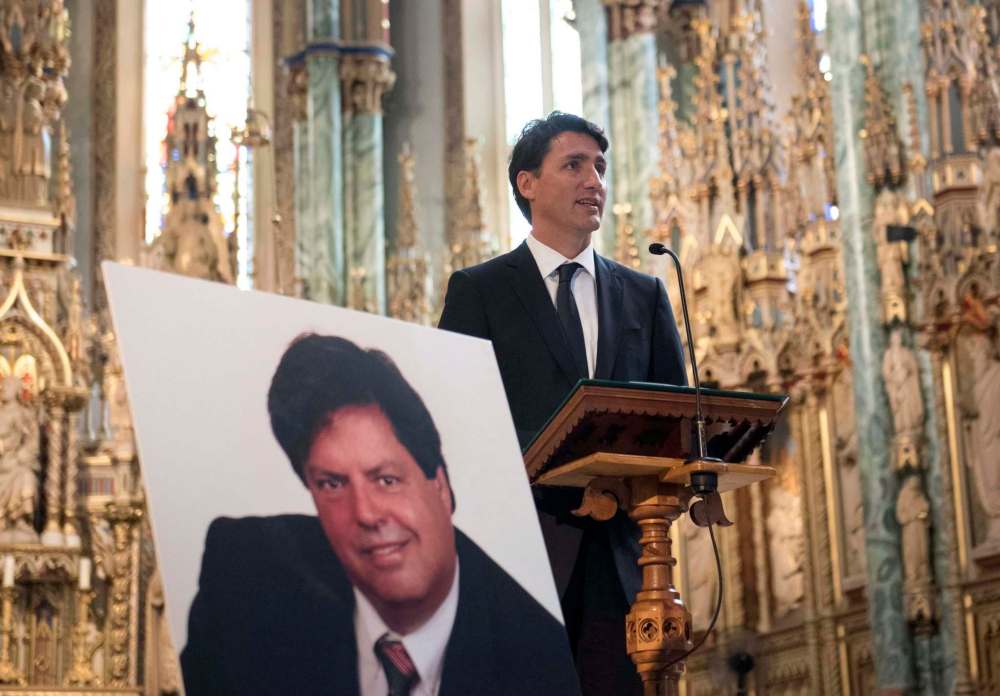
It’s no surprise, then, to learn that The Last Word traces its origins in Cooper’s graduate research: “My mom died in November 2004 and I returned to school within two weeks and was caught up on missed work by Christmas. I went on to write a research project for my master’s degree, and then a PhD dissertation, on modern grief.”
The impact of the loss of Cooper’s mother, Patricia, is evident throughout this book. Yet the author circles warily around the delicate subject. She offers up the sparest details about Patricia’s life and death.
As an academic writer, Cooper seems to find refuge in the general over the specific, the “we” of grief over the “I,” as she pulls back from this weighty topic and abstracts her own experience: “We grieve a moment in time and place that will never be again, and so, by extension, a version of ourselves that existed in that space.”
The glaring absence of more personal material raised its head again and again in this collection. Why didn’t Cooper expand on her mother as a subject and further examine and articulate her own grief through that direct experience?
Instead, the reader is inundated with cultural theory, pop culture references to Princess Diana and the 1994 British film Four Weddings and a Funeral.
The Last Word also looks at social media’s negative impact on death announcements and grieving with a cogent analysis of Facebook. It’s no surprise that in times of loss and suffering, shallow Facebook posts will not suffice.
Cooper asserts throughout the collection that eulogies are inadequate to describe a life lived and that amateur eulogizers fail to capture their primary subject, the recently deceased.
The strongest moments in this slim volume are when Cooper gets personal and specific. Cooper perfectly captures the big impact of a small gesture on the weary: “I would curse the intolerably basic woman — a mere acquaintance — who hounded us in the last weeks of my mom’s life for a lasagna dish she had left at our house.”
Traces of Cooper’s thesis on modern grief keep reasserting themselves within the discourse, making the reader strain to leap from the personal to the didactic. “The eulogy is as much about marking the loss suffered by a community as it is about addressing one’s own pain: at the intersection between the public and the private, the eulogy performs some heavy work,” Cooper writes.
If done poorly, eulogies are facile. And Cooper is correct — eulogies are often inadequate. However, she is unable to offer up a viable alternative to the popular public ritual, the centerpiece of the funeral.

If they forego the eulogy, mourners are left with flowers on the altar and a minister who may or may not have known the departed. The assembled mourners crave solace through personalized remembrance and have come to expect a spoken tribute, however ham-fisted.
Cooper is at her finest when she shares honest insights about her own loss, writing “Time didn’t ‘teach’ me about grief: time isn’t didactic and grief isn’t a case study.”
These insightful moments, revelations from a daughter who greatly misses her mother, transformed this collection from academic abstraction to genuine experience.
Julia Cooper demonstrates a profound understanding of the overwhelming nature of loss and the sad people who navigate in its wake.
Patricia Dawn Robertson is an independent journalist based in Saskatchewan.

By Julia Cooper
Coach House, 168 pages, $15
Advertisement Advertise With Us
Advertisement Advertise With Us