

Superintendent a perfect fit
Storied past paved way for role at school division
Advertisement
Read this article for free:
or
Already have an account? Log in here »
To continue reading, please subscribe:
Digital Subscription
One year of digital access for only $1.44 a week*
- Enjoy unlimited reading on winnipegfreepress.com
- Read the E-Edition, our digital replica newspaper
- Access News Break, our award-winning app
- Play interactive puzzles
*Billed as $5.77 plus GST every four weeks. After 52 weeks, price increases to the regular rate of $19.95 plus GST every four weeks. Offer available to new and qualified returning subscribers only. Cancel any time.
To continue reading, please subscribe:
Add Free Press access to your Brandon Sun subscription for only an additional
$1 for the first 4 weeks*
- Enjoy unlimited reading on winnipegfreepress.com
- Read the E-Edition, our digital replica newspaper
- Access News Break, our award-winning app
- Play interactive puzzles
*Your next Brandon Sun subscription payment will increase by $1.00 and you will be charged $17.95 plus GST for four weeks. After four weeks, your payment will increase to $24.95 plus GST every four weeks.
Read unlimited articles for free today:
or
Already have an account? Log in here »
Hey there, time traveller!
This article was published 29/06/2017 (3262 days ago), so information in it may no longer be current.
Duane Brothers was smiling. But then, in a way, he always appears to be smiling to those who don’t understand what he’s been through and how serious he is about what he does.
Brothers is the highly progressive superintendent of the Louis Riel School Division, which straddles St. Boniface and St. Vital.
Last week, in the process of discussing the importance of the recently announced publicly and privately funded Murray Field — which amounts to an artificial-turfed, multi-purpose field of dreams for the kids who live and go to school near Dakota Collegiate — Brothers stressed the message that the $1.8-million community play project sends to those kids.
That they matter.
Brothers mentioned that because many of the kids who live nearby reside in Manitoba Housing complexes and are in kindergarten to Grade 8 in schools such as St. George School where, he estimates, 80 per cent of the students are either indigenous or newcomers to Canada.
“That’s my favourite school,” Brothers said, flashing that smile.
I got why he singled out St. George, even though all 40 schools he oversees are his favourites. It’s because of his special mission to help kids from diverse and marginalized backgrounds.And because he identifies with them.
I know that because, over time, Brothers has shared some of his personal story with me, outlining how he is a descendant of both American slaves and marginalized indigenous people. And how that has driven him to where he is now.
Our genes dictate the colour of our skin and eyes, but it’s our early childhood experiences, and the school years that follow, that tend to define who we become. Brothers, who grew up to become an educator with a PhD, was nine years old when he experienced one of the most defining lessons of his life. It didn’t happen in a school classroom, though. It happened in the produce department of a St. James grocery store where he was checking out what you might call the low-hanging fruit.
“It was January,” he recalled, “and it was cold and my parents were stretched financially. So I surreptitiously grabbed a couple of grapes.”
That’s when a young Brothers heard the big voice of a man he would look up at and recognize as a local barber.
“He said, ‘Get those n—– hands off those grapes.’”
Brothers mimicked the nasty, threatening tone of the racist slapdown.
“And he slapped my hand.”
It would have been frightening and devastating for any kid. But, as his mother Toni described him, her oldest and only son was a sensitive child and doting big brother for his three younger sisters — Tanya, Tamara and Tara.
Back in the produce section on that cold-turned-bitter January day, Brothers’ father Murray, who was big, powerful and protective, heard what the barber had said to his little boy.
“And he went off on him,” the now 56-year-old Brothers recalled.
On the way home, young Brothers felt good about the way his father stuck up for him. Until his dad went off on him, too. He still remembers the warning that went with it.
“‘Don’t you ever put yourself in a situation where a white man has reason to be upset with you. Ever again.’”
“It was painful,” he said. “Growing up brown in St. James was tough.”
That was made even tougher by the expectations his father had for his son.
“We grew up with the message you got to be better to be equal. You can’t wear your Levi’s jeans scruffy. You got to tuck your shirt in. Don’t hit on white girls.”
Murray Brothers wanted his son to fit in to the white world, to essentially act like a snowflake in a neighbourhood that looked like a demographic blizzard. Which, in a way, was easier than fitting in with the city’s predominantly black community and culture from the West Indies. Duane Brothers had lighter skin — he also has Swedish and Irish ancestry — and green eyes. Later, in Grade 8, when an African-Canadian girl named Becky showed up at school, all his white pals had expectations for him, too.
“They said, ‘Why don’t you ask her out?’”
Brothers rebuffed that question with another. “Why don’t you?” But the damage was done.
“It exposed my shield. It allowed everyone to say, ‘Duane is black.’”
He reacted by distancing himself from Becky. While all his pals had dates for grad at Ness Junior High School, Brothers, the good-looking, personable kid who would later model as a young man, went stag.
So how did that pain, sadness and struggle get him to where he is now?
That, he told me, is what lead to his thesis and his recent PhD.
“My thesis is about complex poverty. History has long coattails. My dad’s side of the family is from Nova Scotia. My mom’s side of the family is from Oklahoma, Alabama.
“These were poor people, who, for multiple generations, were told they were useless.”
It also lead him to his role and position of influence as a school superintendent in which he hopes to make education better — and life easier — for kids of colour or with diverse backgrounds like him. Particularly the children at his “favourite” school.
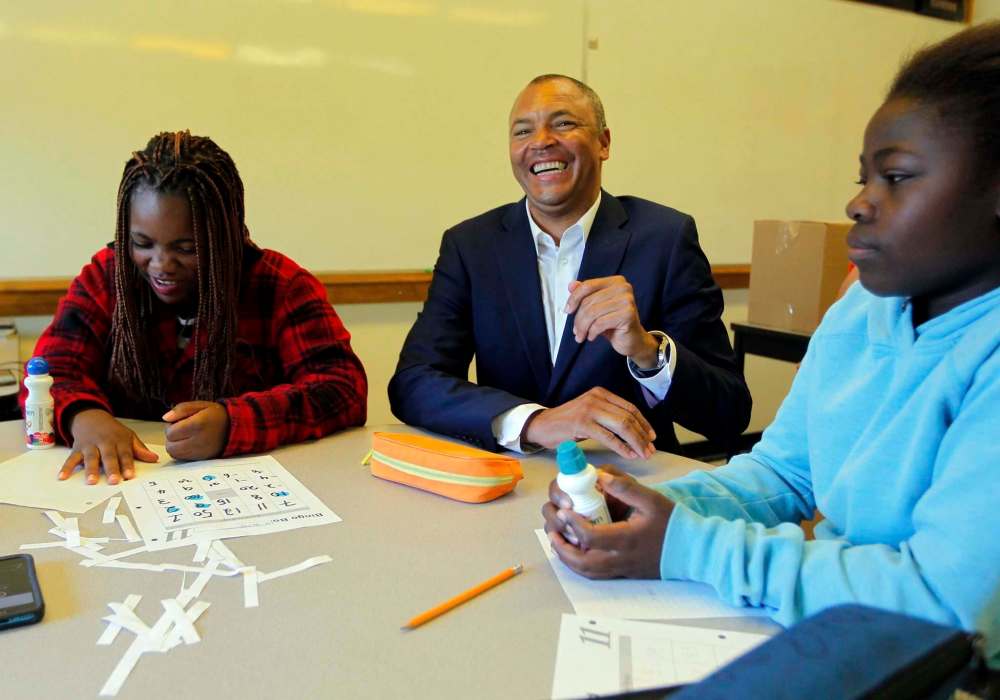
On Tuesday, I got to see why St. George School is so dear to him when we dropped by together. Still, there was this one moment. It happened in a classroom this time, when I sat down at a table of 13-year-olds and proudly introduced the school division’s “principal of principals,” as Brothers describes his job. And as I explained his background, growing up black in a white junior high, a girl who was born in Nigeria blurted out an unintentional slight.

“He’s not black,” she said.
Brothers smiled. He even joined the awkward laughter.
But that innocent remark exposed something profoundly ironic about this man who is so deeply devoted to easing the pain and helping students from marginalized cultures to succeed. The irony being, that while he found a way to succeed and even excel, the pain of not feeling as if he fit in has never ended for Duane Brothers.
Even in a school where he more than fits in.
gordon.sinclair@freepress.mb.ca