Legacy lives on in Tolkien book

Advertisement

Advertise with us

J.R.R. Tolkien is, arguably, the most prolific posthumous author of the 20th and 21st centuries. His body of work, most notably The Hobbit and The Lord of the Rings trilogy, cemented his legacy as the father of the modern fantasy genre. But it’s his son, Christopher, who is to thank for the ongoing publications of Tolkien’s writing.

Read this article for free:


or

Already have an account? Log in here »

To continue reading, please subscribe:

Subscribe and receive a limited-edition Free Press branded hat or tote.

Digital Subscription

One year of digital access for only $205*

  • Enjoy unlimited reading on winnipegfreepress.com
  • Read the E-Edition, our digital replica newspaper
  • Access News Break, our award-winning app
  • Play interactive puzzles

*First annual payment billed as $205.00 + GST for one year. This annual subscription will automatically renew at $233.00 + GST every 52 weeks (10% off the regular annual price of $259.35). Offer available to new and qualified returning subscribers only. Cancel any time.

To continue reading, please subscribe:

Add Free Press access to your Brandon Sun subscription for only an additional

$1 for the first 4 weeks*

  • Enjoy unlimited reading on winnipegfreepress.com
  • Read the E-Edition, our digital replica newspaper
  • Access News Break, our award-winning app
  • Play interactive puzzles
Start now

*Your next Brandon Sun subscription payment will increase by $1.00 and you will be charged $17.95 plus GST for four weeks. After four weeks, your payment will increase to $24.95 plus GST every four weeks.

Hey there, time traveller!
This article was published 08/07/2017 (3347 days ago), so information in it may no longer be current.

J.R.R. Tolkien is, arguably, the most prolific posthumous author of the 20th and 21st centuries. His body of work, most notably The Hobbit and The Lord of the Rings trilogy, cemented his legacy as the father of the modern fantasy genre. But it’s his son, Christopher, who is to thank for the ongoing publications of Tolkien’s writing.

In Beren and Lúthien, Christopher Tolkien gathers the definitive collection of materials related to his father’s story of the exiled hunter Beren and his love, the elvish princess Lúthien. While the details of the tale changed over Tolkien’s lifetime, the basic structure remains the same.

Beren, while wandering in the woods, sees Lúthien dancing and falls in love with her. Lúthien’s father, the elvish king Thingol, frowns upon their union and tells Beren that the only way he can marry his daughter is if he brings him a Silmaril, a sacred jewel that resides in the crown of Morgoth.
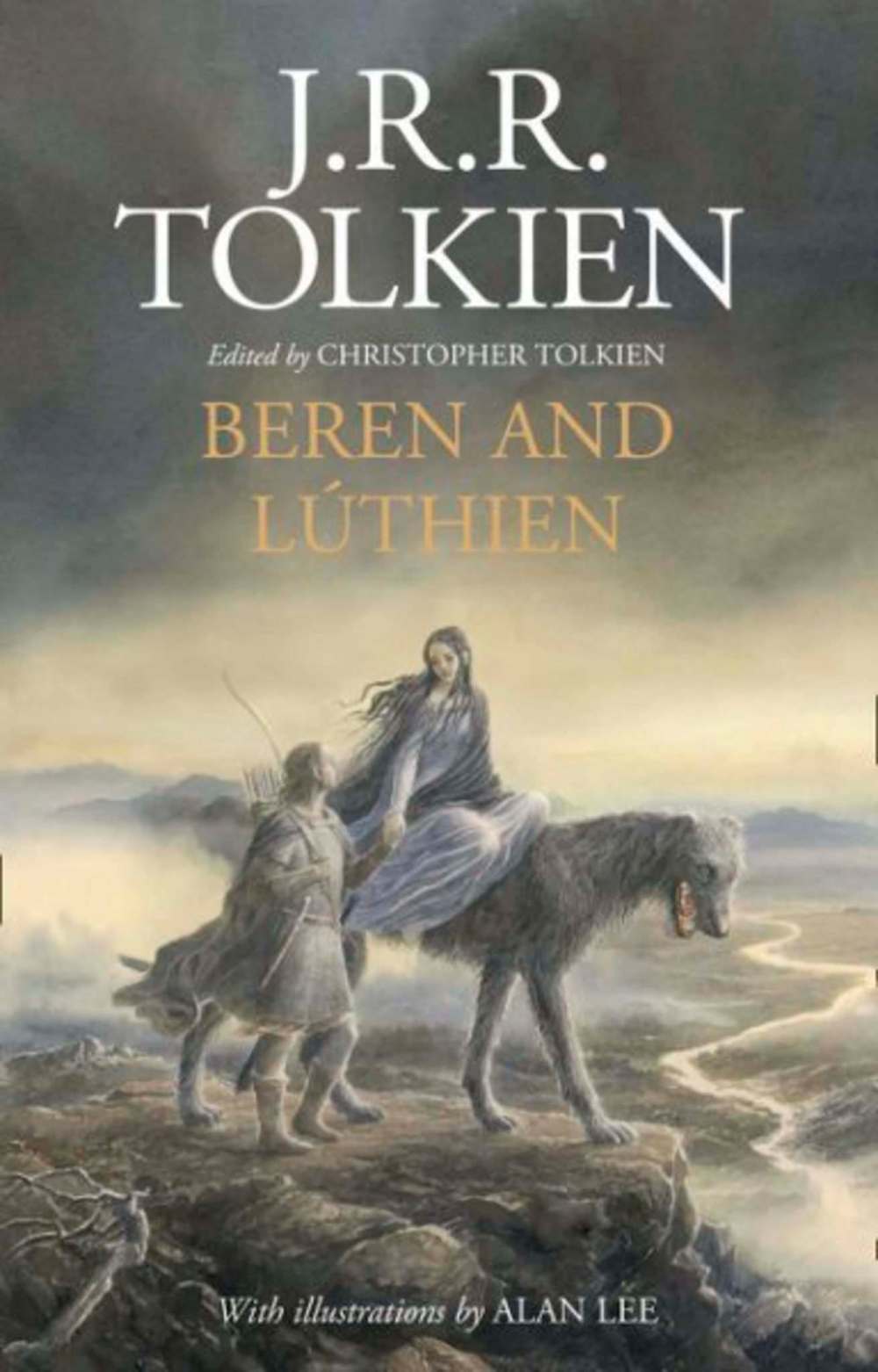
What follows is a quest to gain the Silmaril that involves imprisonment, elven magic, dismemberment and one of literature’s great dogs, Huan.

The earliest known version of Beren and Lúthien was written in 1917 and is a love story inspired by the author’s wife, Edith Mary Tolkien. The characters were of such import to Tolkien that their names are inscribed on the gravestone he shares with his wife.

Christopher Tolkien pulls pieces of the Beren and Lúthien myth from The Silmarillion, which he published in 1977, four years after his father’s death. There are sections copied from The History of Middle-earth, a 12-volume set Christopher published between 1983 and 1996. These passages appear in Beren and Lúthien in prose or, at times, in thousands of lines of rhyming couplets — further evidence of Tolkien’s incomparable genius.

Alan Lee’s beautiful illustrations only highlight the quality of this text. His full-colour plates bring to life the dark halls of Morgoth and the enchanted woods where Lúthien dances.

At times exhilarating, at times tedious, Beren and Lúthien reads more like a medieval chronicle than a literary narrative. It contains an endless list of names and deeds from the First Age of Middle-earth, and each retelling of the tale builds upon the foundations of what came before.

Every new addition includes more detail about Beren’s history, Lúthien’s descendants, the battle to free Beren from Thû (a necromancer who goes on to become Sauron of The Lord of the Rings fame) and the eventual confrontation with Morgoth and his evil wolf companion, Carcharoth.

While this book can certainly be read by those unfamiliar with Tolkien’s previous work, it often feels academic — a tome dedicated to the preservation of an old, but nonetheless important, piece of Tolkien lore.

After a lifetime of preserving his father’s legacy, this marks the end of Christopher Tolkien’s own literary life; in the preface, he acknowledges the book will likely be the last of his own editorial publications. At 93, he acknowledges his own mortality, which gives the collection a melancholic feel.

J.R.R. Tolkien died in 1973, but lives on thanks to the tireless efforts of his son. Like Lúthien’s elvish kinsfolk who fade from memory, while they may physically disappear from this realm, the legacy of both Tolkiens lives on in their shared tales of Middle-earth.

Lauren Chochinov holds a PhD in medieval literature and blames Tolkien for that predicament.
Report Error Submit a Tip

More Stories

Agriculture sector wary of ‘strong headwind’ from south

Laura Rance-Unger 4 minute read Yesterday at 2:01 AM CDT

Industry analysts talked in circles on a recent webinar as they discussed the implications for agriculture of Canada’s deteriorating relationship with its largest trading partner.

On one hand, panellists for the hastily convened Canadian AgriFood Policy Institute event acknowledged the futility of negotiating on quicksand: a deal made today with the United States might be sucked into the muck tomorrow.

But on the other, webinar panellists speculated with varying degrees of optimism over what it will take to get negotiators back to bargaining.

This disconnect isn’t unique to this cluster of analysts. However, it underscores the difficulty of coming to terms with the seismic shift in America’s attitudes towards Canada.

Puzzles Palace

1 minute read Monday, Jul. 27, 2026

To solve our puzzles, please subscribe with this special offer: |

Back to school means increased costs for parents, post-secondary students

Joel Schlesinger 6 minute read Preview

Back to school means increased costs for parents, post-secondary students

Joel Schlesinger 6 minute read Yesterday at 2:01 AM CDT

In the words of advice for students from Thornton Melon: “It’s rough out there. Move back in with your parents.”

As comedian Rodney Dangerfield’s character alluded to in the 1986 comedy Back to School, it is indeed a tough financial environment as students head back to the classroom in 2026.

A Capital One Canada survey found families are struggling with costs, with nearly six in 10 parents surveyed stating back-to-school expenses are higher than expected.

It’s not just tuition, new clothes and supplies. Extracurricular activities — like hockey, figure skating, ringette, soccer, dance, etc. — also ramp up, involving tuition-sized payments.

Read
Yesterday at 2:01 AM CDT

For newcomer pizza purveyors, it’s all about crafting solid foundations

David Sanderson 7 minute read Preview

For newcomer pizza purveyors, it’s all about crafting solid foundations

David Sanderson 7 minute read Yesterday at 2:00 AM CDT

A recent poll conducted by an Internet-based market-research firm determined that close to 20 per cent of people eschew their leftover pizza crust.

Some argued that the residual crust lacks flavour. Others submitted that it’s too hard or crunchy to enjoy sans toppings. Given that information, what are we to make of Crusty Craft Pizza, a five-month-old takeout spot whose owners are so confident in their European-style pizza crust that they’ve chosen to highlight it in their business moniker?

Whenever somebody informs them they don’t like pizza crust, their response is, well, they haven’t tried theirs, says Oleksii Samokvhal, who together with his wife, Iryna Mehedyn, opened Crusty Craft Pizza in early April, at 1311 Day St. in Transcona.

“It’s thin in the middle, with raised edges we hand-form ourselves,” says Mehedyn, a native of Ukraine who, like her Kyiv-born husband, relocated to Winnipeg to escape the conflict in their home country.

Read
Yesterday at 2:00 AM CDT

Canada’s first drive-thru-only McDonald’s opens in Winnipeg

Aaron Epp 4 minute read Preview

Canada’s first drive-thru-only McDonald’s opens in Winnipeg

Aaron Epp 4 minute read Wednesday, Sep. 2, 2026

One Grimace and dozens of smiles were on display Wednesday as McDonald’s staff and supporters celebrated the grand opening of the fast-food chain’s first drive-thru-only restaurant in Canada.

Read
Wednesday, Sep. 2, 2026

Art piece connects viewers to broader national landscape

Allison Gillmor 4 minute read Preview

Art piece connects viewers to broader national landscape

Allison Gillmor 4 minute read Yesterday at 2:01 AM CDT

WHAT IT IS: Copy Paperis a 2014 textile-based piece by Ontario-born, Winnipeg-based artist Kristin Nelson, currently on view at WAG-Qaumajuq as part of the exhibition Terra Cognita/Incognita.

Of the 125 works in the show — which uses historical and contemporary pieces from WAG-Qaumajuq’s permanent collection to explore how artists have represented the landscape over time and across cultures —probably the most attention-getting are the beautiful paintings of Canada’s lakes, plains, forests and mountains.

So, how does this seemingly modest, somewhat enigmatic work connect to Terra Cognita/Incognita’s larger themes?

WHAT IT’S ABOUT: In the middle of the exhibition, an antique desk holds several objects of beauty and utility, and this is where Copy Paper sneaks in, as something both “cognita and incognita,” known and unknown.

Read
Yesterday at 2:01 AM CDT