How video games gave us self-driving cars

Advertisement

Advertise with us

Self-driving cars. They’re the future of transportation — and they’re getting smarter all the time. Thanks to advances in software and artificial intelligence, these machines are now able to distinguish between cars and cyclists, or between pedestrians and your pet. Many can now “see” just like you can, picking out objects and obstacles approaching ahead. All that tech could eventually save lives, helping to prevent the 95 per cent of car accidents that safety regulators estimate are caused by human error each year.

Read this article for free:


or

Already have an account? Log in here »

To continue reading, please subscribe:

Subscribe and receive a limited-edition Free Press branded hat or tote.

Digital Subscription

One year of digital access for only $205*

  • Enjoy unlimited reading on winnipegfreepress.com
  • Read the E-Edition, our digital replica newspaper
  • Access News Break, our award-winning app
  • Play interactive puzzles

*First annual payment billed as $205.00 + GST for one year. This annual subscription will automatically renew at $233.00 + GST every 52 weeks (10% off the regular annual price of $259.35). Offer available to new and qualified returning subscribers only. Cancel any time.

To continue reading, please subscribe:

Add Free Press access to your Brandon Sun subscription for only an additional

$1 for the first 4 weeks*

  • Enjoy unlimited reading on winnipegfreepress.com
  • Read the E-Edition, our digital replica newspaper
  • Access News Break, our award-winning app
  • Play interactive puzzles
Start now

*Your next Brandon Sun subscription payment will increase by $1.00 and you will be charged $17.95 plus GST for four weeks. After four weeks, your payment will increase to $24.95 plus GST every four weeks.

Hey there, time traveller!
This article was published 09/07/2017 (3381 days ago), so information in it may no longer be current.

Self-driving cars. They’re the future of transportation — and they’re getting smarter all the time. Thanks to advances in software and artificial intelligence, these machines are now able to distinguish between cars and cyclists, or between pedestrians and your pet. Many can now “see” just like you can, picking out objects and obstacles approaching ahead. All that tech could eventually save lives, helping to prevent the 95 per cent of car accidents that safety regulators estimate are caused by human error each year.

But none of this would be possible without a piece of hardware many of us take for granted in our own home computers. It’s a technology that traces back to the earliest days of modern personal computing, one that people tend to associate more with World of Warcraft than newfangled widgets on wheels.

We’re talking about the graphics processor.
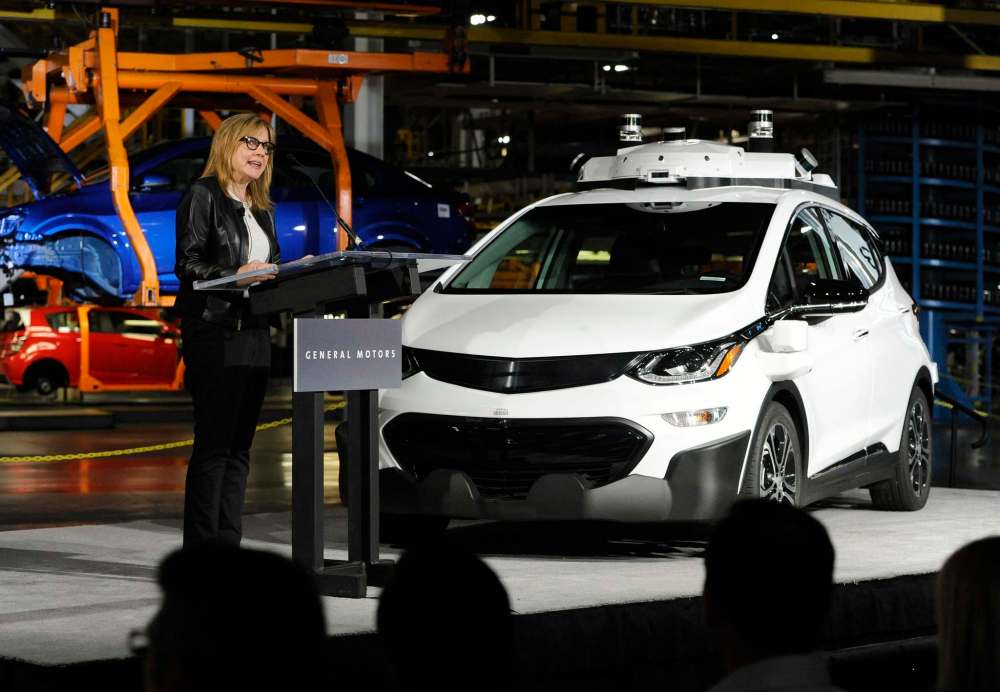
Jose Juarez / Detroit News
General Motors CEO Mary Barra stands by a self-driving Chevrolet Bolt EV, one of 130 the company has built at a factory in suburban Detroit, Mich. — making it among the first automakers to mass-produce self-driving vehicles.
Jose Juarez / Detroit News General Motors CEO Mary Barra stands by a self-driving Chevrolet Bolt EV, one of 130 the company has built at a factory in suburban Detroit, Mich. — making it among the first automakers to mass-produce self-driving vehicles.

In mainstream PCs, the graphics processor — often found on a graphics card — is what allows computers to draw all those pixels and polygons that make up today’s photorealistic video games. But as these processors have grown ever more powerful, engineers have discovered their utility in all sorts of non-gaming applications. Graphics processing units — or GPUs — have transcended their origins to become entire computers in their own right.

The GPU “is now powering everything from games to the visual effects you see in Hollywood films,” said Danny Shapiro, the senior director of automotive at Nvidia, which accounts for roughly 75 per cent of the US$7.8-billion market for GPUs. GPUs, Shapiro said, are central to “professional graphics, for automakers that are designing cars, to doctors and researchers that are searching for cures for cancer and using medical imaging techniques.”

It’s a sign of how big the GPU business has grown that some 200 other companies work with Nvidia’s automotive unit alone. GPUs are even part of the brains behind artificial intelligence, appearing in technologies such as the Amazon Echo, which converts natural human speech into data that machines can understand.

“The combination of GPUs and a CPU are now available that can accelerate analytics, deep learning, high-performance computing, and scientific simulations,” Chris Niven, research director for oil and gas issues at the research firm IDC, told ZDNet last month.

To understand why GPUs have become so prevalent in next-generation technologies, we have to talk about how they work.

Traditionally, the brain in most PCs has been the CPU, or the central processing unit. These chips are made by companies such as Intel. Apple has also been making its own, proprietary chips for the iPad and iPhone. The distinguishing feature of this technology is that it’s designed to run calculations serially, one after another, very quickly. The rise of dual- and quad-core CPUs has expanded their capabilities, allowing for more computations to occur simultaneously.

These chips are still ideal for machines that only need to run a few processes at the same time. But when it comes to technology such as self-driving cars, where the computers are constantly receiving and digesting information, multitasking becomes that much more important. And that’s where GPUs excel.

Computer researchers began to discover the potential behind GPUs as far back as the late 1990s, when the market was awash with dozens of competing chip makers. Their products found their way into desktop PCs and gaming consoles such as the Sega Dreamcast and Xbox, enabling consumers to experience groundbreaking titles such as Half-Life, Quake and Halo. By simultaneously and efficiently controlling the generation of shapes on a screen, GPUs helped bring first vector graphics — and then individual pixels — to life.

By the early 2000s, GPUs were being pitted directly against CPUs in computing tests, with some results showing enormous promise for graphics processors.

“Researchers at universities realized that, ‘Hey, here is this low-cost processor that we can apply to scientific and mathematical applications and get some acceleration for cheap,’” said Jon Peddie, president of Jon Peddie Research, an industry analysis firm.

One paper in 2002 found that compared to CPUs, “the graphics hardware allows us to establish a high-speed custom data processing pipeline. Once the pipeline is set up, data can be streamed through with devastating efficiency.”

The best GPUs on the market today come with as many as 5,000 cores, said Peddie, not just two or four or eight as with CPUs. While CPUs can process smaller amounts of information very quickly, the advantage of GPUs has to do with scale—processing lots of information at the same time.
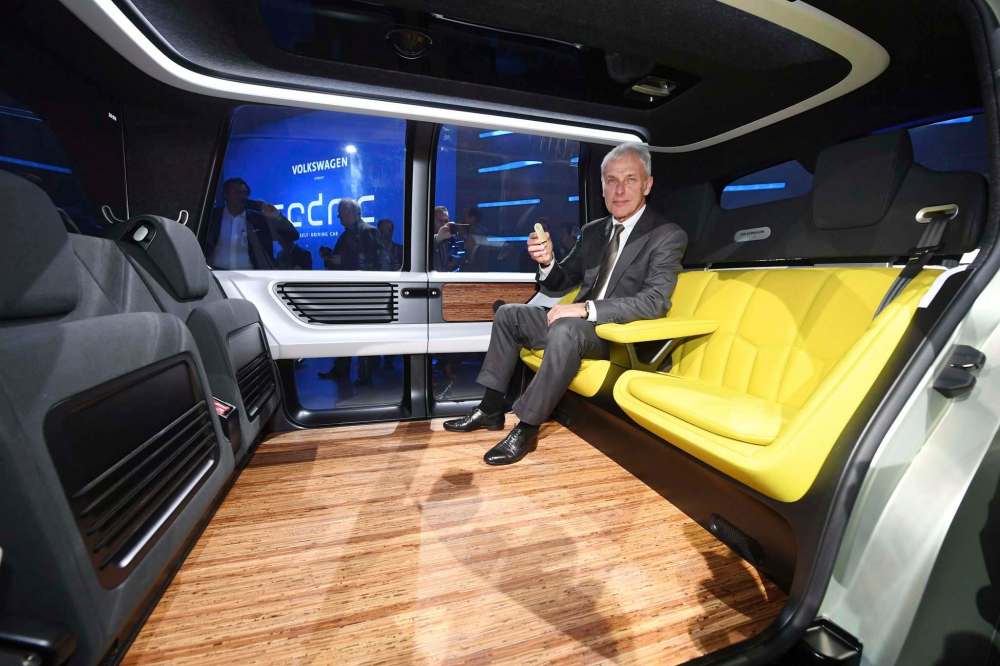
Uli Deck / DPA Files
Matthias Meuller, the CEO of Volkswagen, presents the autonomous concept car Sedric at the 87th Geneva International Motor Show in Switzerland in March 2017.
Uli Deck / DPA Files Matthias Meuller, the CEO of Volkswagen, presents the autonomous concept car Sedric at the 87th Geneva International Motor Show in Switzerland in March 2017.

This is why self-driving cars find GPUs so useful. Through the use of optical cameras, laser and radar sensors, cars look at their surroundings by taking many measurements per second.

“It’s 30 pictures every second,” Shapiro said.

“Each picture, a single frame, is made up of pixels. Each of these pixels or dots is a numerical value that says, ‘What is the colour of the light there?’ It’s just a bunch of numbers.”

GPUs like the ones found in self-driving cars are designed to crunch those numbers and figure out that some of those pixels represent an obstacle, whereas other pixels are lane markings and still others are traffic lights. While GPUs weren’t originally invented for those purposes, car engineers began taking advantage of the technology’s parallel computing powers about six or seven years ago, according to Peddie.

“The original use of GPUs in an automobile was for the instrument panel in the entertainment system,” he said. “It’s only been recently that people have been saying, ‘Hey, we can do this, or that!’”

As GPUs become even more powerful and gain even more features, you can expect them to crop up in even more places. Within automobiles alone, many stand-alone processors that used to handle just one function—such as the anti-lock brakes or the power windows — will all someday be routed through a single processor, the GPU, Shapiro said. And we’ll see cars work increasingly like Tesla’s automobiles, where you might customize your vehicle by picking and choosing different software packages to suit your driving style.

“You can almost have in-app purchases to add new features that weren’t there when you bought it,” he said.

For gamers who’ve grown accustomed to buying expansion packs to their software — also known as downloadable content, or DLC — this idea might sound very familiar.

— Washington Post

Report Error Submit a Tip

More Stories

Longtime voice of the Blue and Gold marks major milestone

David Sanderson 8 minute read Preview

Longtime voice of the Blue and Gold marks major milestone

David Sanderson 8 minute read Friday, Oct. 9, 2026

Bob McGregor made his debut as the Winnipeg Blue Bombers’ public-address announcer on June 7, 1997, during a pre-season game at Winnipeg Stadium between the hometown Blue Bombers and their western rivals, the Calgary Stampeders.

McGregor will be behind the microphone again this Saturday, detailing the action on the field in addition to leading a boisterous Princess Auto Stadium crowd through what has become his signature call, “And that is another Winnipeg Blue Bombers first down!”

The Bombers’ final home date of the 2026 regular season will mark a major milestone for McGregor, and the former newscaster feels it’s only fitting the same two teams as 10,717 days ago — the Bombers and Stampeders — will be the ones butting helmets.

“I knew at the start of the season I was closing in on 300 games as the PA guy, only it wasn’t until I went through the schedule that I realized my 300th would be Winnipeg-Calgary, which struck me as kind of cool,” McGregor says, seated in a St. James breakfast nook, dressed in dark trousers and a blue-and-gold Blue Bombers golf shirt.

Read
Friday, Oct. 9, 2026

Phoneless concert a beautiful chance to bask in moment

Jen Zoratti 5 minute read Preview

Phoneless concert a beautiful chance to bask in moment

Jen Zoratti 5 minute read Yesterday at 2:01 AM CDT

Outside the Scotiabank Arena in Toronto, digital billboards flashed fans their singular photo op for the night: “I took this photo before I saw Phoebe Bridgers: The Lost Tour 2026.”

It is, as it is for so many other people, my only documentation of a concert by one of my favourite artists. The American singer-songwriter — who I discovered at the Winnipeg Folk Festival in 2018 — has had a meteoric rise in the past few years, winning three Grammys in 2024 as one third of Boygenius, the indie-rock supergroup rounded out by Lucy Dacus and Julien Baker, and opening for Taylor Swift on select dates of her titanic Eras Tour.

Now, Bridgers is touring in support of Lost Weekend, her third album and first since 2020’s Punisher. It’s a feat of a record, a richly textured meditation on loss and grief, written in the aftermath of the death of her dad, with whom she had a complicated relationship.

So she is in a position to not only play multiple sold-out arena shows, but also insist that those shows be phone-free.

Read
Yesterday at 2:01 AM CDT

Towing company hands stolen car back, but not to owner

By Matthew Frank 4 minute read Preview

Towing company hands stolen car back, but not to owner

By Matthew Frank 4 minute read Friday, Oct. 9, 2026

A Manitoba man says he is dumbfounded after his car was stolen, impounded by a Winnipeg towing company and given back — to someone that wasn’t him.

Cody Lamb lives in the western Manitoba community of Douglas, about 18 kilometres east of Brandon, but spends weeks away from home working on oil rigs in Alberta.

The 24-year-old says on Sept. 11, while away for work, he heard from his girlfriend who told him his car wasn’t in their driveway. Lamb reported the car stolen to Brandon RCMP the same day.

After filing the report, he heard from Steinbach RCMP on Oct. 1 that his car was recovered that day in the community of Mitchell, roughly five km west of Steinbach.

Read
Friday, Oct. 9, 2026

Bombers, Stamps rumble a can’t-miss must-win

Taylor Allen 7 minute read Preview

Bombers, Stamps rumble a can’t-miss must-win

Taylor Allen 7 minute read Friday, Oct. 9, 2026

The Winnipeg Blue Bombers, Calgary Stampeders and Saskatchewan Roughriders are playing musical chairs and pretty soon the music is going to stop.

One of them will be left without a seat at the post-season table, and Saturday’s clash between the Bombers (7-8) and Stampeders (8-8) at Princess Auto Stadium (6 p.m.) will go a long way toward determining who that will be.

You’re not going to want to miss this one.

“We’ve shown we can play great, we’ve shown we can play terrible. So, let’s try to play on the great side and really lock in,” said Bombers halfback Evan Holm on the team’s mindset this week.

Read
Friday, Oct. 9, 2026

A Life's Story: Writer built bridges with genuine curiosity, compassion for diversity of religious practices

Janine LeGal 6 minute read Preview

A Life's Story: Writer built bridges with genuine curiosity, compassion for diversity of religious practices

Janine LeGal 6 minute read Yesterday at 6:00 AM CDT

Brenda Suderman knew how to make people feel comfortable. For a journalist, that character trait is a real strength, and it made people trust and appreciate her.

Whether covering musicals, worship spaces, the effects of pandemic shutdowns, death rituals and practices of different traditions, the discovery of the burial of 2,284 infants in unmarked graves, or any other of the countless topics she wrote about in her four- decade career, Suderman did it with genuine interest and care.

Born and raised in Winkler, Suderman grew up on a farm. Much of her childhood was spent in gardens and sugar beet fields.

Baptized at 16, she became a member of the Winkler Bergthaler Mennonite Church. The restrictions against women at the time contributed to planting the seeds of Suderman’s feminist perspective.

Read
Yesterday at 6:00 AM CDT

Landlords will face fines for breaching confidentiality

Carol Sanders 4 minute read Preview

Landlords will face fines for breaching confidentiality

Carol Sanders 4 minute read Friday, Oct. 9, 2026

The province is amending legislation to allow landlords to be penalized if they breach the confidentiality of tenants who break their lease by obtaining a domestic violence certificate.

“Hopefully, now there’s going to be measures in place so that if this happens again, and God forbid it happens again to anyone else, that there would be penalties imposed on landlords who do that,” said one victim whose concerns were published on the front page of the Free Press last month.

Under current legislation, landlords must ensure that any information received from those tenants regarding the termination of the tenancy is kept confidential, but there are no penalties for landlords who violate that section of the act. After hearing from victims put at risk when landlords broke the law by violating their confidentiality, the government announced Monday that it is amending the Residential Tenancies Act to allow for penalties.

The young woman who spoke to the Free Press showed that her landlord copied her alleged abuser in email correspondence that included her personal email address and the domestic violence certificate she obtained in 2025 to end a tenancy agreement early and leave an abusive relationship.

Read
Friday, Oct. 9, 2026