WEATHER ALERT

Your furry friend might not be green

Advertisement

Advertise with us

You’ve heard about the carbon footprint, but what about the carbon paw-print? According to a new study, United States cats’ and dogs’ eating patterns have as big an effect as driving 13.6 million cars for a year.

Read this article for free:

or

Already have an account? Log in here »

To continue reading, please subscribe:

Subscribe and receive a limited-edition Free Press branded hat or tote.

Digital Subscription

One year of digital access for only $205*

  • Enjoy unlimited reading on winnipegfreepress.com
  • Read the E-Edition, our digital replica newspaper
  • Access News Break, our award-winning app
  • Play interactive puzzles

*First annual payment billed as $205.00 + GST for one year. This annual subscription will automatically renew at $233.00 + GST every 52 weeks (10% off the regular annual price of $259.35). Offer available to new and qualified returning subscribers only. Cancel any time.

To continue reading, please subscribe:

Add Free Press access to your Brandon Sun subscription for only an additional

$1 for the first 4 weeks*

  • Enjoy unlimited reading on winnipegfreepress.com
  • Read the E-Edition, our digital replica newspaper
  • Access News Break, our award-winning app
  • Play interactive puzzles
Start now

*Your next Brandon Sun subscription payment will increase by $1.00 and you will be charged $17.95 plus GST for four weeks. After four weeks, your payment will increase to $24.95 plus GST every four weeks.

Hey there, time traveller!
This article was published 08/08/2017 (3274 days ago), so information in it may no longer be current.

You’ve heard about the carbon footprint, but what about the carbon paw-print? According to a new study, United States cats’ and dogs’ eating patterns have as big an effect as driving 13.6 million cars for a year.

The findings, published in the journal PLOS ONE, reveal how our furry, four-legged companions’ consumption of meat and other animal products adds a sizable, and largely overlooked, climate cost.

When it comes to environmental effects, meat-eating takes the cake. A 2014 study in the Proceedings of the National Academy of Sciences found that producing a kilogram of chicken results in about 3.7 kilograms of carbon dioxide, while a kilogram of pork comes with 24 kilograms of carbon dioxide. The same amount of beef, however, can be responsible for up to 1,000 kilograms of CO² —a worrisome figure given that climate researchers say this greenhouse gas is largely responsible for the significant warming of the Earth’s climate.
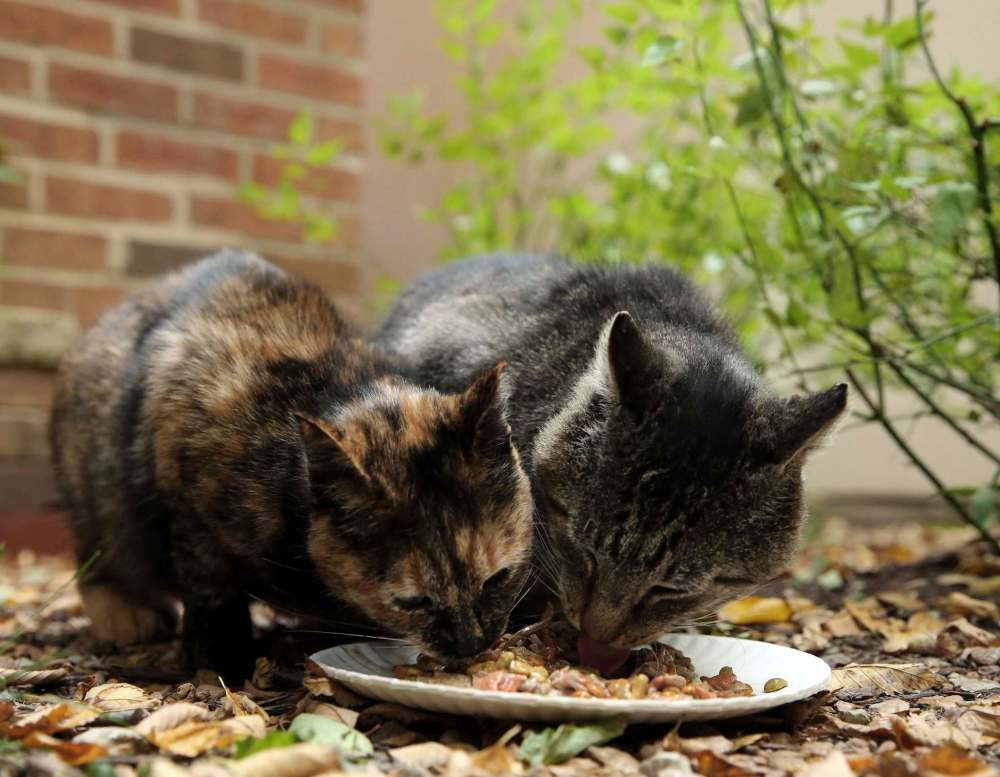
Kevin Tanaka / Chicago Tribune
According to one researcher, ‘the tradition of pet ownership in the U.S. has considerable costs’ in terms of climate change.
Kevin Tanaka / Chicago Tribune According to one researcher, ‘the tradition of pet ownership in the U.S. has considerable costs’ in terms of climate change.

That’s not even counting the livestock’s water-usage footprint, which dwarfs that of agricultural crops.

It’s a growing concern given that developed countries such as the U.S. consume lots of animal protein, and that developing countries that are economically on the rise seem to be increasing their share of meat consumption too.

But one sleepless night about five years ago, UCLA geographer Gregory Orkin realized something: those environmental assessments rarely, if ever, took into account the consumption by dogs and cats. The thought gave him pause — perhaps even paws.

“Because I couldn’t sleep, I got up and just kind of started throwing some numbers together,” he said. “It’s evolved a lot since then.”

He calculated the likely number of calories needed by the United States’ pet dogs and cats, who number around 163 million, and examined the ingredients in pet food and tallied up which ones were derived from animals.

The results? Cats’ and dogs’ overall caloric consumption was about 19 per cent that of humans in the U.S.

“Just to put that in context, that’s about the same amount of calories that the country of France consumes, and so that whet my appetite a little bit,” Orkin said.

Notably, dogs and cats actually consumed about 33 per cent of the animal-derived calories that humans did, perhaps because their diets are generally more meat-heavy than ours, Orkin said. On the other end, they also produce about 30 per cent of the feces that humans do (and much of that gets thrown in the trash in plastic bags, instead of treated how human waste is).

In short, Orkin concluded, American dogs and cats eat enough animal product to account for about 64 million tons of methane and nitrous oxide, two other powerful greenhouse gases. That’s about the same impact on our warming climate as driving 13.6 million cars for a year.

“Americans are the largest pet owners in the world, but the tradition of pet ownership in the U.S. has considerable costs,” he wrote. “As pet ownership increases in some developing countries, especially China, and trends continue in pet food toward higher content and quality of meat, globally, pet ownership will compound the environmental impacts of human dietary choices.”

Orkin stressed that he wasn’t advocating giving up beloved furry friends — far from it. But for people who want to be aware of their environmental impact so that they can try to reduce it, it’s probably worth knowing the full effect of their household, canines and felines included.

There’s also a movement toward putting more meat in pet foods, perhaps driven by what Orkin called the “humanization” of pet products. But dogs aren’t pure carnivores. They’re omnivorous, having developed the ability to readily digest starches — possibly from the trash heaps that accumulated around ancient human encampments. So dogs, at least, could potentially get even more of their required protein from non-animal sources than pet owners may commonly think.

“I certainly hope these kinds of numbers will encourage the market to consider adding those as market choices, and I also think that individuals can make choices,” Orkin said.

— Los Angeles Times

History

Updated on Tuesday, August 8, 2017 8:22 AM CDT: Photo added.
Report Error Submit a Tip

More Stories

Vacant Bay store on road to redevelopment, St. Vital Centre owner says

Gabrielle Piche 6 minute read Preview

Vacant Bay store on road to redevelopment, St. Vital Centre owner says

Gabrielle Piche 6 minute read Friday, Jul. 24, 2026

Entertainment attractions are coming to fill the former Hudson’s Bay space in St. Vital Centre.

Montreal-based real estate firm Leyad, the south Winnipeg mall’s owner, says it is finalizing an agreement for the vacant property. Further details should appear in the next couple months, said president Henry Zavriyev.

“We’re looking at what other types of experiences we can bring to the mall that aren’t just typical retail,” he said during a visit to Winnipeg this week.

“We want to create an experience where you can just come to the mall, hang out here for hours, no matter if you’re a kid, an adult, a retiree.”

Read
Friday, Jul. 24, 2026

Ref ‘dominates’ game in Sea Bears loss to Honey Badgers, says coach

Joshua Frey-Sam 7 minute read Preview

Ref ‘dominates’ game in Sea Bears loss to Honey Badgers, says coach

Joshua Frey-Sam 7 minute read Yesterday at 7:40 PM CDT

Following a festive Christmas-in-July-themed Saturday afternoon inside Canada Life Centre, Winnipeg Sea Bears head coach Mike Raimbault didn’t mince words about who he thought was the Grinch in a hard-fought 88-86 loss to the visiting Brampton Honey Badgers that ended in controversy.

As the Sea Bears owned a one-point lead in Target Score Time, Brampton guard Sean East II was awarded three free throws — all of which he converted — after a questionable foul called on Teddy Allen by official Perry Stothart.

Raimbault, who has been known to bite his tongue on such topics, left nothing to the imagination about where he stood on the game-deciding judgment made in a game that had major post-season implications.

“I just felt like it was a fitting ending to the game where Perry Stothart had dominated the flow of the game from the start,” he said. “For him to call a bit of a guess foul and end the game on the foul, I felt like it’s disappointing that he can come in and dictate how the game’s going to be played and flow, and (that) continues to be a bit of an M.O. for him. So I think we’re disappointed with the fact that the league continues to let that happen.”

Read
Yesterday at 7:40 PM CDT

An eroding Winnipeg neighbourhood looks to new foundations

Ian Bickis, The Canadian Press 5 minute read Preview

An eroding Winnipeg neighbourhood looks to new foundations

Ian Bickis, The Canadian Press 5 minute read Updated: 1:34 PM CDT

WINNIPEG - The lot Jesse Bettcher lives on in Winnipeg's north end used to be a pile of burnt rubble. Same with the one next door. And the one across the street.

But he's now the proud owner of a two-storey house with blue-grey siding and white trim, so new the orange construction fencing is still out front.

It's a dream home for Bettcher, and the latest hope for a city seeking to knock down, clean up and revitalize neighbourhoods that have seen hundreds of homes left vacant, leading to safety hazards and worries about the future.

He bought the house as part of a pilot project aimed at creating affordable home ownership. It let him and his family move out of a rental that he said was falling apart.

Read
Updated: 1:34 PM CDT

A Life's Story: Beloved matriarch, kindergarten teacher lived a musical life

Gabrielle Piché 5 minute read Preview

A Life's Story: Beloved matriarch, kindergarten teacher lived a musical life

Gabrielle Piché 5 minute read Yesterday at 6:00 AM CDT

Phyllis Dana faced a choice: leave Winnipeg to study opera at a prestigious Philadelphia school, or marry the man she loved.

She chose the latter.

Now, her Juno-winning granddaughter cherishes a Happy Birthday voicemail sung by Phyllis. Three generations of Dana women — Phyllis, her daughter, and granddaughter — would sing in Winnipeg’s prominent Jewish spaces. And hundreds of Manitobans know the matriarch as their kindergarten teacher.

“My mom said, ‘A sheet of music won’t keep you warm at night,’” Karen Dana recalled.

Read
Yesterday at 6:00 AM CDT

Puzzles Palace

1 minute read Monday, Jul. 13, 2026

To solve our puzzles, please subscribe with this special offer: |

Convicted sex offender awaits latest sentence

Dean Pritchard 4 minute read Preview

Convicted sex offender awaits latest sentence

Dean Pritchard 4 minute read Yesterday at 2:01 AM CDT

Prosecutors are seeking a 15-year prison sentence for a Red Lake, Ont., man who groomed two Indigenous girls online and drove nearly 500 kilometres to Winnipeg to sexually abuse one of them.

Scott Christopher Alcorn, 50, has pleaded guilty to one count each of child luring, sexual interference and possession of child sexual abuse material.

Alcorn was still on parole for child sex offences at the time of his April 2025 arrest, having been convicted four years earlier of providing a 16-year-old girl a bottle of alcohol in exchange for sex.

“Despite this (prior conviction)… Mr. Alcorn egregiously reoffended, this time to lure two children online and successfully groomed, manipulated and commodified one of (the victims),” Crown attorney Dayna Queau-Guzzi told provincial court Judge Robert Heinrichs at a sentencing hearing Thursday.

Read
Yesterday at 2:01 AM CDT