Story without borders
Taylor Sheridan's film about murder on Wyoming reservation resonates in Canada as well

Advertisement
Read this article for free:
or
Already have an account? Log in here »
To continue reading, please subscribe:

Digital Subscription
One year of digital access for only $205*
- Enjoy unlimited reading on winnipegfreepress.com
- Read the E-Edition, our digital replica newspaper
- Access News Break, our award-winning app
- Play interactive puzzles
*First annual payment billed as $205.00 + GST for one year. This annual subscription will automatically renew at $233.00 + GST every 52 weeks (10% off the regular annual price of $259.35). Offer available to new and qualified returning subscribers only. Cancel any time.
To continue reading, please subscribe:
Add Free Press access to your Brandon Sun subscription for only an additional
$1 for the first 4 weeks*
- Enjoy unlimited reading on winnipegfreepress.com
- Read the E-Edition, our digital replica newspaper
- Access News Break, our award-winning app
- Play interactive puzzles
*Your next Brandon Sun subscription payment will increase by $1.00 and you will be charged $17.95 plus GST for four weeks. After four weeks, your payment will increase to $24.95 plus GST every four weeks.
Read unlimited articles for free today:
or
Already have an account? Log in here »
Hey there, time traveller!
This article was published 10/08/2017 (3304 days ago), so information in it may no longer be current.
Canadian actors abound in Taylor Sheridan’s upcoming film Wind River — Graham Greene, Hugh Dillon, Tantoo Cardinal — so much so, one might get the impression it’s one of those American movies that employed Canadian locations doubling for American ones.
In fact, the film is set in Wyoming, Sheridan’s home base, but was shot in Utah. Sheridan, 47, who started out as an actor before turning to writing (Sicario, Hell or High Water) apparently has an affinity for Canadian talent, sometimes without realizing it. (For example, it was news to him that Hell or High Water executive producer Rachel Shane is a former Winnipegger.)
“I can’t say that it was conscious,” he says of the film’s unwitting Canadian content. “Hugh has been a friend of mine for the past 15 years. I didn’t even know Graham was Canadian and I didn’t even know Tantoo was Canadian until I made the offer to her.
https://youtu.be/zN9PDOoLAfg“I just think there’s a tremendous amount of talent that exists there, the film business in Vancouver and Toronto has always been robust, and that integration back and forth from Canada has been a natural flow for a long time.”
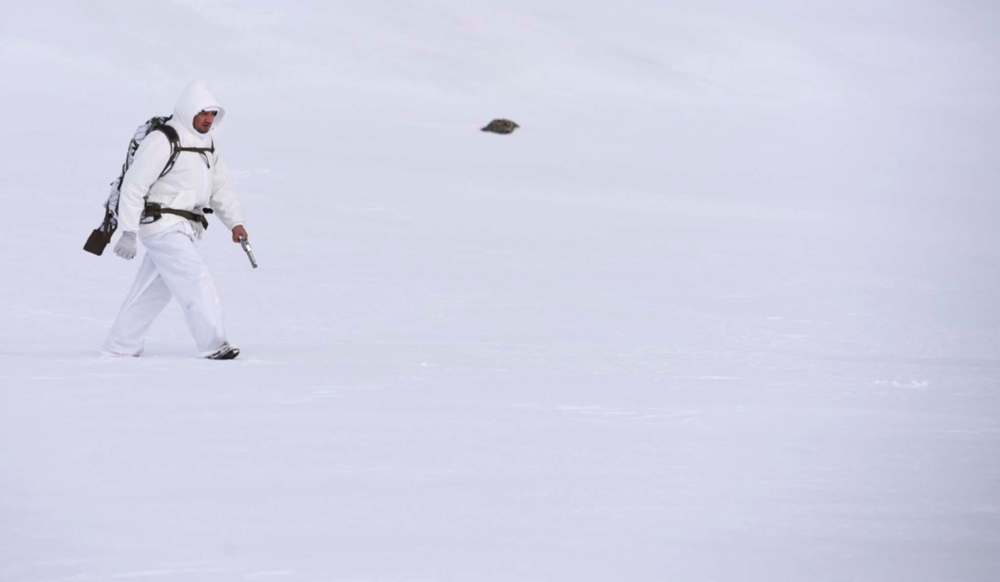
For Canadian audiences, the film’s story might pack an even more powerful punch. Wind River is the story of Cory (Jeremy Renner), a professional game tracker who discovers the dead body of a young Indigenous woman on a remote, frozen area of the wilderness on the Wind River Indian Reservation. The apparent homicide leads Cory to assist an out-of-her-element FBI agent (Elizabeth Olsen) to investigate the case in an area where little has changed since the violent days of the Wild West.
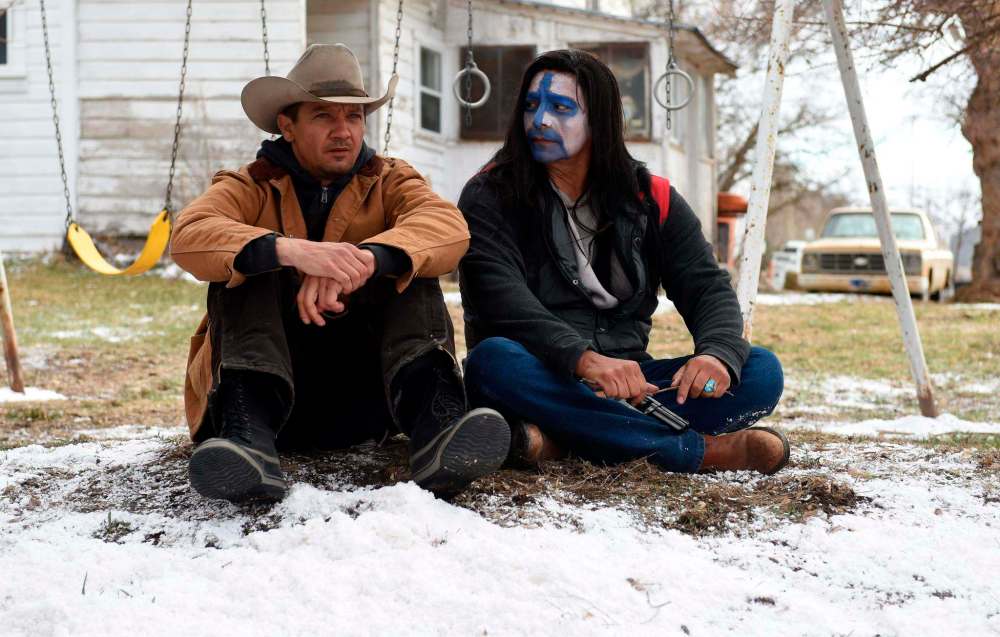
The film wraps up with an intertitle on the topic of missing and murdered Aboriginal women: “While missing person statistics are compiled for every other demographic, none exist for Native American women. No one knows how many are missing,” it reads.
The subject is a vital political issue in Canada, but in the U.S., Sheridan says, there is “zero” awareness of it.
“I have an awareness because I live very close to the rez, and I also have close friends who grew up on the reservation and heard stories,” he says on the phone from Park City, Utah. “When I read native actors for the roles, there wasn’t one Native American actor who read for me that didn’t begin their audition by saying: ‘My cousin…’ ‘My sister…’ ‘My best friend…’ ‘My somebody.’ They had all been touched by it.”
The lack of statistics, Sheridan explains, has to do with an information gap between state and U.S. federal law enforcement.
“It’s the state’s job to compile those statistics and the state doesn’t have any authority over the reservations, which are federal land,” he says. “So there is no one to keep them.
“There have been some articles,” he says of the issue. “But for whatever reason, it hasn’t been presented in a way that has captured the public consciousness, and I certainly hope this film addresses that.”
● ● ●

Wind River represents Sheridan’s first time directing. He ended up in that capacity because of a growing discontent with acting, notwithstanding recurring roles on TV shows such as Sons of Anarchy and Veronica Mars.
“It was a dissatisfaction with the way the business was treating me as an actor,” he says. “It was very difficult to support a family and I had a baby coming. I had to make a decision and I made the decision to tell my own stories. It was something that was festering inside me for a while and I just decided to start writing.”

That worked out well, with the Texas-born Sheridan scripting the much-praised 2015 film Sicario, followed up in 2016 with Hell or High Water, which won him an Oscar nomination for best original screenplay.
Though both those films are unrelated to each other and to Wind River, Sheridan considers them an unofficial trilogy.
“That was the design. It’s in two different forms, one as an exploration of the modern American frontier, and how much it has changed, and how little has it changed, since settlement.
“And also: How much do the consequences of that settlement still reverberate today?”
randall.king@freepress.mb.caTwitter: @FreepKing
Our newsroom depends on a growing audience of readers to power our journalism. If you are not a paid reader, please consider becoming a subscriber.
Our newsroom depends on its audience of readers to power our journalism. Thank you for your support.
Movie preview
Wind River
Directed by Taylor Sheridan
14A
107 minutes
Opens Aug. 18
Our newsroom depends on a growing audience of readers to power our journalism. If you are not a paid reader, please consider becoming a subscriber.
Our newsroom depends on its audience of readers to power our journalism. Thank you for your support.
Related Articles
Grace under pressure
Advertisement Advertise With Us
Advertisement Advertise With Us