Perlman gives Winnipeg a night of memories
Advertisement
Read this article for free:
or
Already have an account? Log in here »
To continue reading, please subscribe:

Digital Subscription
One year of digital access for only $205*
- Enjoy unlimited reading on winnipegfreepress.com
- Read the E-Edition, our digital replica newspaper
- Access News Break, our award-winning app
- Play interactive puzzles
*First annual payment billed as $205.00 + GST for one year. This annual subscription will automatically renew at $233.00 + GST every 52 weeks (10% off the regular annual price of $259.35). Offer available to new and qualified returning subscribers only. Cancel any time.
To continue reading, please subscribe:
Add Free Press access to your Brandon Sun subscription for only an additional
$1 for the first 4 weeks*
- Enjoy unlimited reading on winnipegfreepress.com
- Read the E-Edition, our digital replica newspaper
- Access News Break, our award-winning app
- Play interactive puzzles
*Your next Brandon Sun subscription payment will increase by $1.00 and you will be charged $17.95 plus GST for four weeks. After four weeks, your payment will increase to $24.95 plus GST every four weeks.
Read unlimited articles for free today:
or
Already have an account? Log in here »
Hey there, time traveller!
This article was published 18/09/2017 (3298 days ago), so information in it may no longer be current.
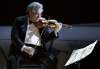
Legendary violinist Itzhak Perlman received a hero’s welcome after taking the stage on Saturday night, as the Winnipeg Symphony Orchestra launched its auspicious 70th-anniversary season with a bang.
The long sold-out gala concert, led by Alexander Mickelthwate, featured the award-winning Israeli-American artist performing Beethoven’s mighty Violin Concerto in D Major, Op. 35 — considered one of the pillars of the solo violin repertoire.
Regarded as one of the top violinists of all time, the 72-year old musician, who has performed with every major orchestra in the world and garnered 16 Grammy awards, notably last performed with the Winnipeg Symphony Orchestra (WSO) in 1975. He first came to prominence after appearing on Ed Sullivan’s Caravan of Stars at age 13, made his Carnegie Hall debut in 1963 and gained even greater fame after performing John Williams’ heart-stopping score for the 1993 film Schindler’s List. Perlman is also a renowned humanitarian, including his staunch advocacy for the rights of the differently abled, no doubt fuelled by his own life experience dealing with polio, contracted as a four-year-old child.
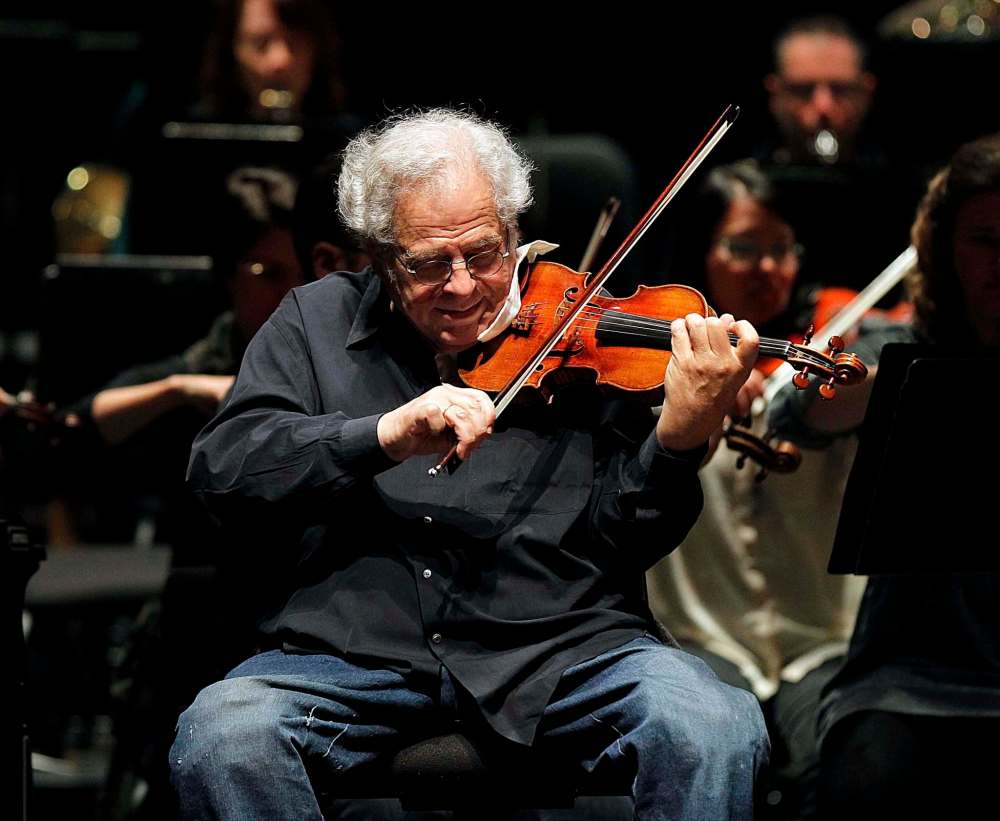
Seeing him onstage, in a word, is akin to witnessing living history — a fact clearly recognized by the mixed-generation crowd of 2,220 that immediately sprang to its feet at their first glimpse of the silver-haired violinist.
With the stage slightly reconfigured to allow room for Perlman’s scooter and raised platform set beside Mickelthwate’s podium, the soloist took his seat and then got down to the matter at hand — all physical concerns simply melting away in hallowed service of music-making. Equally known for his charm and humour, Perlman first examined his 1714 Soil Stradivarius after WSO concertmaster Gwen Hoebig, holding it, passed it to the elder musician .
After the orchestral introduction, including its softly beating timpani notes, Perlman’s glorious violin wafted like a rising phoenix, albeit marred by some early intonation issues that quickly resolved. Beethoven’s lone concerto, dated 1806 — composed nearly 100 years after Perlman’s instrument was made — relies more on establishing an egalitarian partnership between orchestra and soloist, than arguably providing a showcase for string pyrotechnics.
With each entry, Perlman imbued the roughly 45-minute work with requisite nobility, including dramatic flourishes, playful figuration and gossamer-light trills, in turn derived from his rich palette of tonal colour that ranged from honey-sweet lyricism to rugged multiple stops.
One highlight proved to be his choice of Fritz Kreisler cadenzas, which saw the artist scaling the heights before plumbing the depths throughout the solo passages, including more forceful declamations of the thematic material.
The following larghetto began with the artist, his eyes shut, gently swaying to the music as though transported — a deeply moving sight that seemed to traverse both time and space. He then rendered his embellished principal theme, followed by variations as though in hushed prayer, spinning his legato phrases with all-warm sincerity.
This segued into the Rondo finale, the soloist’s pleasure palpable as he performed its rollicking syncopated theme with lightness of bow. As expected, the audience roared its approval at the end with cries of “bravo” — truthfully, the most prolonged (and boisterous) standing ovation this writer has witnessed in 14 years of concert reviews. The icing on the cake would have been an encore (or two) that Perlman usually relishes — strangely not offered, despite several curtain calls.
The program opened with Tchaikovsky’s Symphony No. 4 in F minor, Op. 36, filled with sweeping themes rooted in the Motherland. Last performed here in 2013, the opening movement, including its insistent Fate motive, was performed crisply by the WSO’s bright and bold brass section and teemed with dramatic flourish, including pregnant pauses and brief sections of repose.
Mickelthwate, conducting without score, paced the musicians throughout the four-part work, including a fine lyrical solo by principal oboist Beverly Wang, which set the tone for the second movement, infused with Russian soul.
The following scherzo, scored for string pizzicati, popped like a cork in a champagne bottle, including antiphonal effects between sections kept tight and taut. Finally, the maestro pulled out the stops for the ebullient Finale: Allegro con fuoco, driven by Russian folksong, In the Field Stood a Birch Tree, hurtling toward the finish line punctuated by triumphant cymbal crashes.
Finally, it bears mentioning that this night of memories also included seeing the capacity crowd spontaneously leaping to its feet with heartfelt applause as soon as Mickelthwate took the stage. The maestro has now formally entered his 12th and final season with the WSO before assuming his new position with the Oklahoma Philharmonic Orchestra next September, clearly already riding a tidal wave of public support and affection that will surely gather tsunami strength with each flying month.
holly.harris@shaw.ca
Holly Harris writes about music for the Free Press Arts & Life department.
Our newsroom depends on a growing audience of readers to power our journalism. If you are not a paid reader, please consider becoming a subscriber.
Our newsroom depends on its audience of readers to power our journalism. Thank you for your support.
Itzhak Perlman
Winnipeg Symphony Orchestra
The Asper Foundation Opening Night Gala
Saturday, September 16
Attendance: 2,220 (SOLD OUT)
Five stars out of five
Holly Harris
Holly Harris writes about music for the Free Press Arts & Life department.
Our newsroom depends on a growing audience of readers to power our journalism. If you are not a paid reader, please consider becoming a subscriber.
Our newsroom depends on its audience of readers to power our journalism. Thank you for your support.
Related Articles
Perlman gives Winnipeg a night of memories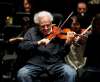

Advertisement Advertise With Us
Advertisement Advertise With Us
History
Updated on Monday, September 18, 2017 8:07 AM CDT: Adds photo