

Pine-eating budworms increase fire danger
Advertisement
Read this article for free:
or
Already have an account? Log in here »
To continue reading, please subscribe:
Digital Subscription
One year of digital access for only $1.44 a week*
- Enjoy unlimited reading on winnipegfreepress.com
- Read the E-Edition, our digital replica newspaper
- Access News Break, our award-winning app
- Play interactive puzzles
*Billed as $5.77 plus GST every four weeks. After 52 weeks, price increases to the regular rate of $19.95 plus GST every four weeks. Offer available to new and qualified returning subscribers only. Cancel any time.
To continue reading, please subscribe:
Add Free Press access to your Brandon Sun subscription for only an additional
$1 for the first 4 weeks*
- Enjoy unlimited reading on winnipegfreepress.com
- Read the E-Edition, our digital replica newspaper
- Access News Break, our award-winning app
- Play interactive puzzles
*Your next Brandon Sun subscription payment will increase by $1.00 and you will be charged $17.95 plus GST for four weeks. After four weeks, your payment will increase to $24.95 plus GST every four weeks.
Read unlimited articles for free today:
or
Already have an account? Log in here »
Hey there, time traveller!
This article was published 08/05/2009 (6374 days ago), so information in it may no longer be current.
An infestation of pine-eating pests is boosting the threat of serious forest fires in northwestern Ontario cottage country.
The jack pine budworm emerged in the Fort Frances area in 2003. Since then, the bug has moved northwest, eating its way through forested areas around Kenora and leaving dead, brittle trees in its wake.
"As hard as we’ve tried to limit or stop its advancement, it keeps popping up," said Tim O’Brien, a fire behaviour specialist with the Ontario Ministry of Natural Resources’ fire management program.
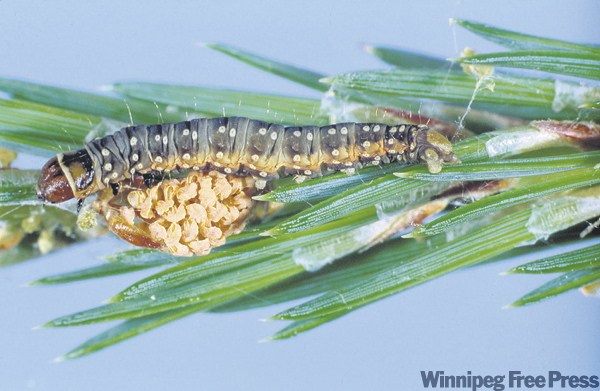
Budworm larvae destroy the upper crowns of jack pines, drying out foliage and turning it reddish brown. After a few severe infestations, the trees can eventually die off.
O’Brien said the ministry has mapped 1.7 million hectares of forest between Lake Superior and the Manitoba border harmed by budworms in recent years, the damage ranging from light to severe. Of that, 177,000 hectares have been killed by the budworms.
"When the trees are in a dead condition or a declining condition, the fire hazard increases dramatically," he said.
After the crowns of the trees die, the sun can beat down on the forest floor, he said, changing the forest environment and increasing the potential for fires. That potential increases further when the dead trees topple, posing a greater hazard on the ground.
O’Brien said the area around Kenora has large, continuous stretches of damaged forest. He expects firefighting resources would be beefed up in the area if a fire broke out.

The official fire season runs from April 1 to Oct. 31.
Glenn Peterson, Manitoba Conservation’s manager of forest health and renewal, said the jack pine budworm isn’t causing problems for now on this side of the border.
Manitoba had problems with the budworms in the early 2000s, but populations collapsed in 2002 and officials aren’t sure why.
lindsey.wiebe@freepress.mb.ca