

Physio services take a body blow
Province saves millions by slashing WHRA's outpatient programs, but at what human cost?
Advertisement
Read this article for free:
or
Already have an account? Log in here »
To continue reading, please subscribe:

Digital Subscription
One year of digital access for only $205*
- Enjoy unlimited reading on winnipegfreepress.com
- Read the E-Edition, our digital replica newspaper
- Access News Break, our award-winning app
- Play interactive puzzles
*First annual payment billed as $205.00 + GST for one year. This annual subscription will automatically renew at $233.00 + GST every 52 weeks (10% off the regular annual price of $259.35). Offer available to new and qualified returning subscribers only. Cancel any time.
To continue reading, please subscribe:
Add Free Press access to your Brandon Sun subscription for only an additional
$1 for the first 4 weeks*
- Enjoy unlimited reading on winnipegfreepress.com
- Read the E-Edition, our digital replica newspaper
- Access News Break, our award-winning app
- Play interactive puzzles
*Your next Brandon Sun subscription payment will increase by $1.00 and you will be charged $17.95 plus GST for four weeks. After four weeks, your payment will increase to $24.95 plus GST every four weeks.
Read unlimited articles for free today:
or
Already have an account? Log in here »
Hey there, time traveller!
This article was published 06/10/2017 (3275 days ago), so information in it may no longer be current.
After Luke Garrow’s friend almost drove off with his finger still hooked in the car door handle, Garrow resigned himself to the eventual amputation of his increasingly cumbersome digit.
The ring finger on his right hand had been locked at 90 degrees for years, a permanent reminder of the 2011 ATV accident that broke his back and tailbone and stole a chunk out of his femur.
At the time, that catalogue of more serious injuries took precedence over one minor finger. Besides, Garrow had reasoned, he’d broken fingers before. He could tape the broken one to a healthy one and it would heal — except it didn’t.
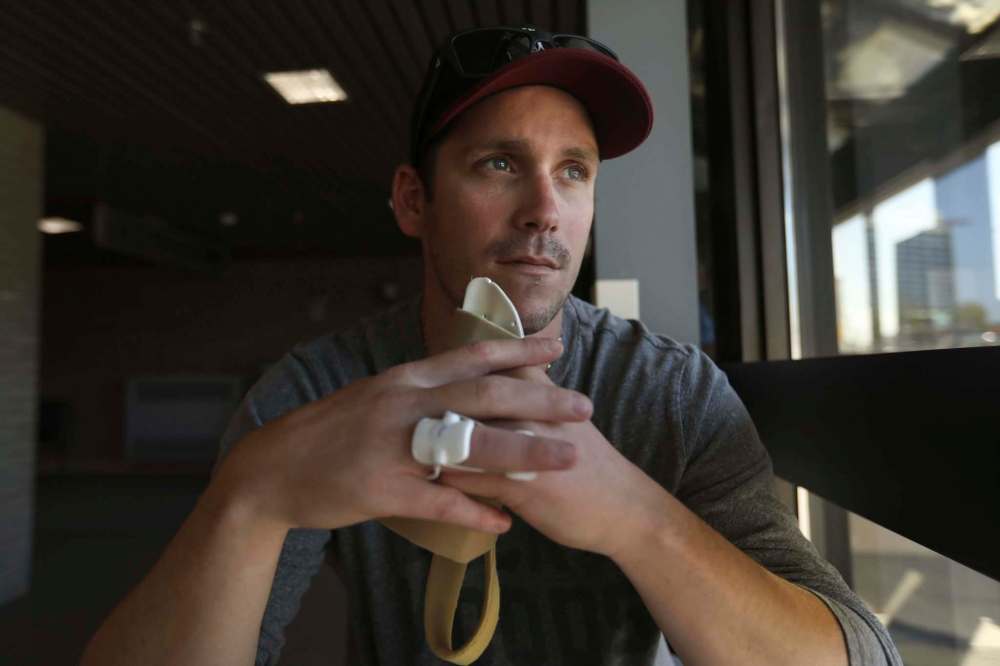
“I was at the point where I was going to have it removed,” he says, “but then a doctor said, ‘Well, how about let’s try a different doctor?’”
Garrow, who lives in Kenora, Ont., finally got in to see a specialist in Winnipeg earlier this year. But the St. Boniface Hospital surgeon didn’t want to operate unless Garrow would commit to driving in twice a week — five hours’ round trip every time — for more than a month to attend outpatient physiotherapy and occupational therapy at the hospital.
“He said that the surgery was a minor part of the process,” Garrow said, “and that I really had to commit.”
It’s a point physiotherapists, their unions and their professional associations have been making for months now, ever since the Winnipeg Regional Health Authority announced in early July it was cutting the vast majority of outpatient physiotherapy and occupational therapy programs in order to recoup $1.5 million annually.
Surgery is one step in the recovery process, they say. Outpatient physiotherapists can help with the others, assisting with pre-operative assessments and making sure a person is getting the required post-operative rehabilitation.
“How is this better for any Manitobans beyond saving money?” asked Bob Moroz, president of the Manitoba Association of Health Care Professionals, which presents the majority of Winnipeg outpatient physiotherapists.
“It’s absolutely pure cost,” he said. “It has nothing to do with patient care.”
The WRHA doesn’t deny this is a financially motivated cut, although its marketing around the issue can be confusing. The program cut falls under its “manage to budget” initiatives, but is lumped online into its “Healing our Health System” plan, which is meant to focus on broader reforms as recommended by consultant Dr. David Peachey and not the $83 million in annual savings the provincial government demanded of the WRHA.
That confusion seemed to be amplified earlier this week when the health authority announced it was scrapping a proposal to use a “means test” to decide which small group of Manitobans still will have access to outpatient physiotherapy after it cuts programs at seven facilities. The WRHA now plans to use “clinical criteria” it still has yet to determine.
This changes nothing except the criteria by which the WRHA will decide whose physiotherapy will be free and who will be told to go elsewhere and pay.
Between 20 and 30 physiotherapists will still lose their jobs. Whole programs will shutter at Concordia Hospital, Deer Lodge Centre, Grace Hospital, Misericordia Health Centre, St. Boniface Hospital, Seven Oaks Hospital and Victoria Hospital.
That’s where some of the frustration comes from.
Peachey’s report talks about the need to shift and consolidate services to make them better and more efficient, but those advocating on behalf of physiotherapists say this cut seems to run counter to that system-wide goal.
“There are a number of incidences in surgery where essentially, the quality outcome — if you’re to look at it long-term — is not great,” said Kate O’Connor, director of practice and policy for the Canadian Physiotherapy Association.
“It’s an issue of not having access to physiotherapy or rehabilitation,” she said. “There’s also an element of patient compliance to take responsibility and ownership over one’s health and well-being.”
But for many that ownership boils down to money, Moroz said.
“If you tell a 60-year-old pensioner who is living on a very, very fixed income, ‘You can have your surgery and we’ll give you a piece of paper to go find a private physiotherapist but you’re going to have to pay for it out of pocket,’ the person’s going to say, ‘Well, hang on; I can’t afford that so I’m not going to do that.’”
And if you can’t afford to pay between $75 and $90 a week every week for maybe three months, do you decide not to go through with the surgery at all?
“It may save money this year,” Moroz said, “but years from now the effects will be felt.”
!function(e,t,s,i){var n=”InfogramEmbeds”,o=e.getElementsByTagName(“script”),d=o[0],r=/^http:/.test(e.location)?”http:”:”https:”;if(/^/{2}/.test(i)&&(i=r+i),window[n]&&window[n].initialized)window[n].process&&window[n].process();else if(!e.getElementById(s)){var a=e.createElement(“script”);a.async=1,a.id=s,a.src=i,d.parentNode.insertBefore(a,d)}}(document,0,”infogram-async”,”https://e.infogram.com/js/dist/embed-loader-min.js”);
Add Comment
Roughly 30 physiotherapists handle tens of thousands of outpatient physiotherapy appointments at WRHA facilities every year, although the number of visits has been trending downward since 2010. Most appointments are at Health Sciences Centre, where there are three specialty outpatient options: hands, orthopedics and rheumatology.
The orthopedics clinic is the busiest in the city, with more than 13,000 visits in the last fiscal year, down from nearly 16,000 in the 2010-2011 fiscal year. St. Boniface Hospital, where Garrow visited, is the second-busiest with more than 10,500 in the last fiscal year, down from nearly 13,000 in 2010-2011.
Figuring out what will happen to the physiotherapists at facilities such as St. Boniface has been a logistical headache, Munoz said.
“It’s taken an amazingly and frustratingly long time to even get here,” he said. ‘Here’ being finalizing the labour adjustment agreement that will serve as the guide to the actual deletion of jobs and closing the service. There are ongoing issues, Moroz said, with the WRHA’s data on physiotherapists’ seniority levels not lining up with the unions’ data.
Lori Lamont, vice-president with the WRHA, said she couldn’t comment on the labour issues, although she made it clear the WRHA will miss its mid-October target for ending outpatient physiotherapy.
“We’re hopeful it will still be (in) 2017,” Lamont said, although there’s no new target “at this point.” A note posted for some staff at HSC earlier this week indicates November is the goal.
The WRHA not only needs to finalize a referral plan so that doctors have a strategy for sending patients on to private physiotherapists, but it has to finish outlining the clinical criteria to evaluate who will still have access to the service. In broad strokes, Lamont said that will include looking at who is currently accessing physiotherapy and then analyzing what the probable impact would be on other aspects of the health-care system if the WRHA cut one patient group’s access versus anothers.
Lamont said the WRHA is still working on a plan to monitor the impact of ending the service.
That comment came after the premier himself echoed public concerns that inadequate post-operative rehabilitation might actually lead to more expensive hospital procedures down the line, specifically for those getting hip and knee replacements.
“What I don’t want to do is create a situation where we look like we’re saving money short-term and we’re costing more long-term,” Premier Brian Pallister said in July.
But Moroz is worried that’s exactly what will happen.

“We provide support for all these other programs, so what is the effect throughout the entire system if you remove that service?” He said. “There’s a ripple effect… people don’t understand the impact of the work that our folks do and how that impacts everybody else.”
Garrow, meanwhile, was grateful.
More than a month after his surgery, he was sitting near the clinic at St. Boniface hospital, curling his injured finger in and out, in and out. It was discharge day. The physiotherapist sent him off with a list of stretches to do on his own and the occupational therapist fashioned him a few specialty braces to wear overnight.
“I’m super, super happy,” he said. “But at the same time, it’s kind of sad that the program won’t be there.”
jane.gerster@freepress.mb.ca
How often do people use the WRHA’s outpatient physiotherapy services?
Outpatient physiotherapy services are currently offered at Concordia Hospital, Deer Lodge Centre, Grace Hospital, Health Sciences Centre, Misericordia Health Centre, St. Boniface Hospital, Seven Oaks Hospital, and Victoria Hospital. HSC, which has three distinct clinics, is the busiest with 21,000 visits, while St. Boniface is a distant second. Most of the other facilities tend to have between 4,000 and 9,000 annual visits.
Before the end of the year, the WRHA plans to eliminate the bulk of the service, restricting access to select groups of patients at HSC.
A few highlights from recent years:
In 2016-2017:
There were more than 21,000 visits at HSC this year, the majority of which were to the orthopedics clinicThere were 10,598 visits at St. Boniface HospitalConcordia Hospital, Seven Oaks Hospital and Misericordia Health Centre all had more than 5,000 visits eachGrace Hospital logged more than 4,200 visits this year.
In 2015-2016:
There were more than 22,700 visits at HSC this year, the majority of which were to the orthopedics clinicThere were 9,209 visits at St. Boniface HospitalConcordia Hospital, Grace Hospital, Seven Oaks Hospital and Misericordia Health Centre all had more than 5,000 visits each.
In 2014-2015:
There were more than 25,400 visits at HSC this year, the majority of which were to the orthopedics clinicThere were 11,584 visits at St. Boniface HospitalGrace Hospital logged more than 6,500 visits this yearConcordia Hospital, Seven Oaks Hospital and Misericordia Health Centre all had more than 5,000 visits each
— source: the Winnipeg Regional Health Authority
Advertisement Advertise With Us
Advertisement Advertise With Us