Seal River adventure a sizzling read

Advertisement

Advertise with us

The rapids are like an executioner’s smile: welcoming in their majesty, but deadly in their intent. The white water is so loud a jackhammer would be a lullaby. And the immortal plague of biting insects draws more blood than the Red Cross.

Read this article for free:


or

Already have an account? Log in here »

To continue reading, please subscribe:

Subscribe and receive a limited-edition Free Press branded hat or tote.

Digital Subscription

One year of digital access for only $205*

  • Enjoy unlimited reading on winnipegfreepress.com
  • Read the E-Edition, our digital replica newspaper
  • Access News Break, our award-winning app
  • Play interactive puzzles

*First annual payment billed as $205.00 + GST for one year. This annual subscription will automatically renew at $233.00 + GST every 52 weeks (10% off the regular annual price of $259.35). Offer available to new and qualified returning subscribers only. Cancel any time.

To continue reading, please subscribe:

Add Free Press access to your Brandon Sun subscription for only an additional

$1 for the first 4 weeks*

  • Enjoy unlimited reading on winnipegfreepress.com
  • Read the E-Edition, our digital replica newspaper
  • Access News Break, our award-winning app
  • Play interactive puzzles
Start now

*Your next Brandon Sun subscription payment will increase by $1.00 and you will be charged $17.95 plus GST for four weeks. After four weeks, your payment will increase to $24.95 plus GST every four weeks.

Hey there, time traveller!
This article was published 21/10/2017 (3282 days ago), so information in it may no longer be current.

The rapids are like an executioner’s smile: welcoming in their majesty, but deadly in their intent. The white water is so loud a jackhammer would be a lullaby. And the immortal plague of biting insects draws more blood than the Red Cross.

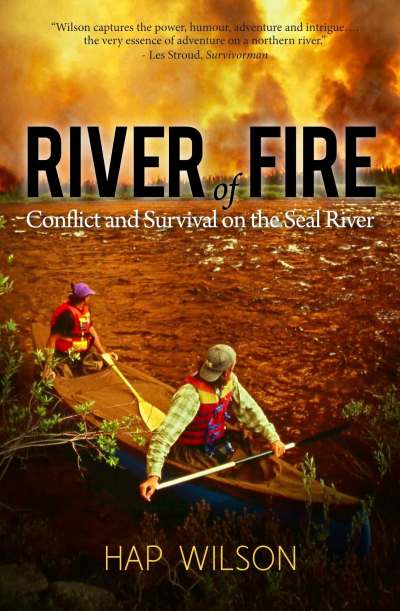
To the city dwellers Canadian naturalist and writer Hap Wilson guided on this way-up wilderness river in Manitoba, what started out as a storybook adventure soon turned into a nasty tug-of-war for survival against the couldn’t-care-less forces of nature.

Wilson’s River of Fire is a classic saga, well worth reading and a bargain at 20 bucks — hair-raising canoeing on one of the last great wild rivers in Canada, extremely dangerous and razor-sharp rocky rapids, water so cold you’d be dead in minutes, animals that can eat you and clouds of black flies that have made lost men lose their minds long before starvation killed them.

And, on this weeks-long trip in 1994, it includes a blinding, choking and near-fatal run-in with a monster of a wildfire coming right at them as nature goes berserk.

However, River of Fire is more than just an account of four men surviving the 310 kilometres of the isolated Seal River, located north of Churchill and running all by its lonesome into Hudson Bay. On this adventure, the quartet also comes face to face with near-mutiny, with outrage and with enough strain in their interpersonal relationships that at times, they could have used a priest more than a paddle.

The trip was sponsored by New York-based Men’s Journal magazine. It hired an American writer and photographer to chronicle the classic Canadian adventure, as well as two Canadian guides to coach them through the Seal and make sure the two city boys came back alive. Wilson, who lives in Ontario, was the expedition’s leader; he is a professional guide and has published a dozen books on the outdoors and geography.

But beyond the drama of this guide’s story is something powerful that makes his book much more than a dramatic travelogue. It offers insight into how Wilson’s mind worked under pressure, his spiritual empathy with the Dene and Inuit, his astute understanding of the colonialism they suffered and how they continue to live with it — even laugh at it — and his surprising eloquence in describing all these things. This is a man who can calculate what’s going on inside and around him and describe it exquisitely.

He speaks of life, mortality, human conduct, hypocrisy, history that lies, racism and his strengths and weaknesses. He is very good at putting down in words what he sees and thinks — and what he sees and thinks is worth putting down in words.

An example: “I had never been this close to a bush fire and it was absolutely terrifying; but in an obtuse way, incredibly beautiful too, hellishly powerful and oddly spiritual; frightful but utterly divine and utterly final. Drifting along, we all became mesmerized by the magnitude and pageantry of such a pyrotechnic show, like kids at a fireworks display.”

And later: “We were suddenly surrounded by white (beluga) whales… Our eyes would meet and they would look right into your soul… A complex and marginal solemnity passed between us. No words, just a mild feeling of wonder.”

Wilson wrote River of Fire two years after the excursion and left it on a shelf unpublished until now. He’s not sure why.

Barry Craig is a retired journalist.

Report Error Submit a Tip

More Stories

Chronic kidney disease must be recognized

Carrie Thibodeau 5 minute read 2:00 AM CDT

Canada needs a strong plan of action to tackle chronic kidney disease.

Canada is facing a looming health crisis that remains largely unaddressed and invisible at the policy and health system level. More than four million Canadians live with chronic kidney disease (CKD) and 50,000 currently receive dialysis or are living with a transplant, both life-sustaining but burdensome treatments.

With no cure, CKD profoundly impacts quality of life, contributing to lost income, overall poor health, and uncertainty about the future. The implications of CKD extend far beyond patients and families. CKD is now the 11th leading cause of death in Canada and one of our most expensive chronic diseases. Health-care costs exceed $11.7 billion annually, with most expenses incurred in the later stages of the disease, particularly dialysis and transplantation.

By 2050, the total cost burden of CKD is projected to rise to $17.6 billion and an estimated 6.2 million Canadians will be affected, driven by an aging population and rising rates of diabetes and high blood pressure.

NDP expects crypto, data centre electricity levy to shave about $50 annually off residential Hydro bills

Chris Kitching 5 minute read Preview

NDP expects crypto, data centre electricity levy to shave about $50 annually off residential Hydro bills

Chris Kitching 5 minute read Updated: 8:36 AM CDT

Revenue from the province’s new electricity levy on cryptocurrency businesses and large AI data centres will go toward offsetting residential bills, rather than the coffers of cash-strapped Manitoba Hydro.

Read
Updated: 8:36 AM CDT

Group’s second LP made to get hearts racing

By Sheldon Birnie 5 minute read Preview

Group’s second LP made to get hearts racing

By Sheldon Birnie 5 minute read Updated: 11:37 AM CDT

While a live performance is a moment in time that comes and goes, a record is something that, ostensibly, lives on.

Read
Updated: 11:37 AM CDT

Man pleads guilty to manslaughter for chasing, stabbing man downtown

Erik Pindera 4 minute read Preview

Man pleads guilty to manslaughter for chasing, stabbing man downtown

Erik Pindera 4 minute read Updated: Yesterday at 6:28 AM CDT

An intellectually disabled man who drunkenly chased down a man he had been arguing with and fatally stabbed him in broad daylight admitted to manslaughter on Wednesday.

Matthew Gerald Tomack Pelletier, now 38, chased Ricky Dwayne Mancheese, 49, down Kennedy Street before stabbing him six times in front of his wife on the sidewalk between Sargent and Cumberland avenues, at about 11:50 a.m. on June 11, 2024.

Pelletier, who police arrested the next day, was charged with second-degree murder, but instead pleaded guilty to the lesser offence of manslaughter in front of Court of King’s Bench Justice Joan McKelvey on Wednesday.

“This type of incident on Winnipeg streets is all too common and must be strongly deterred,” said McKelvey.

Read
Updated: Yesterday at 6:28 AM CDT

Hockey teams scramble after two city arenas put on ice

Morgan Modjeski 6 minute read Preview

Hockey teams scramble after two city arenas put on ice

Morgan Modjeski 6 minute read Yesterday at 7:12 PM CDT

Instead of ice, Barry Bonni walks onto a dull concrete surface at the Terry Sawchuk Memorial Arena on Thursday.

The arena, as well as the West Kildonan Memorial Arena, have had to close after failing inspections. Predictably, the city’s hockey community is in a tailspin because ice time is so precious.

“We’re now in panic mode,” said Bonni, president of the River East Royal Knights on Thursday. The Sawchuk arena is the team’s home rink.

Bonni, who is a living legend in Manitoba’s hockey community, said the Manitoba Major Junior Hockey League club is scrambling to find ice time.

Read
Yesterday at 7:12 PM CDT

Seal River adventure a sizzling read

Reviewed by Barry Craig 4 minute read Preview

Seal River adventure a sizzling read

Reviewed by Barry Craig 4 minute read Saturday, Oct. 21, 2017

The rapids are like an executioner’s smile: welcoming in their majesty, but deadly in their intent. The white water is so loud a jackhammer would be a lullaby. And the immortal plague of biting insects draws more blood than the Red Cross.

To the city dwellers Canadian naturalist and writer Hap Wilson guided on this way-up wilderness river in Manitoba, what started out as a storybook adventure soon turned into a nasty tug-of-war for survival against the couldn’t-care-less forces of nature.

Wilson’s River of Fire is a classic saga, well worth reading and a bargain at 20 bucks — hair-raising canoeing on one of the last great wild rivers in Canada, extremely dangerous and razor-sharp rocky rapids, water so cold you’d be dead in minutes, animals that can eat you and clouds of black flies that have made lost men lose their minds long before starvation killed them.

And, on this weeks-long trip in 1994, it includes a blinding, choking and near-fatal run-in with a monster of a wildfire coming right at them as nature goes berserk.

Read
Saturday, Oct. 21, 2017