Opening their eyes
Grade 10 math class takes a dark turn so teens can focus on blind classmate's challenges
Advertisement
Read this article for free:
or
Already have an account? Log in here »
To continue reading, please subscribe:

Digital Subscription
One year of digital access for only $205*
- Enjoy unlimited reading on winnipegfreepress.com
- Read the E-Edition, our digital replica newspaper
- Access News Break, our award-winning app
- Play interactive puzzles
*First annual payment billed as $205.00 + GST for one year. This annual subscription will automatically renew at $233.00 + GST every 52 weeks (10% off the regular annual price of $259.35). Offer available to new and qualified returning subscribers only. Cancel any time.
To continue reading, please subscribe:
Add Free Press access to your Brandon Sun subscription for only an additional
$1 for the first 4 weeks*
- Enjoy unlimited reading on winnipegfreepress.com
- Read the E-Edition, our digital replica newspaper
- Access News Break, our award-winning app
- Play interactive puzzles
*Your next Brandon Sun subscription payment will increase by $1.00 and you will be charged $17.95 plus GST for four weeks. After four weeks, your payment will increase to $24.95 plus GST every four weeks.
Read unlimited articles for free today:
or
Already have an account? Log in here »
Hey there, time traveller!
This article was published 04/11/2017 (3244 days ago), so information in it may no longer be current.
Talk about reliving your worst nightmare.
It’s Monday afternoon and I’m trapped in Grade 10 math class and — just like more than 40 years ago — I don’t have a clue about what’s going on.
But it gets worse — did I mention I’m wearing a blindfold? Well, I am. In fact, almost everyone in teacher Sacha Amaladas’s Grade 10 pre-calculus/applied math class at West Kildonan Collegiate is wearing a blindfold, too.
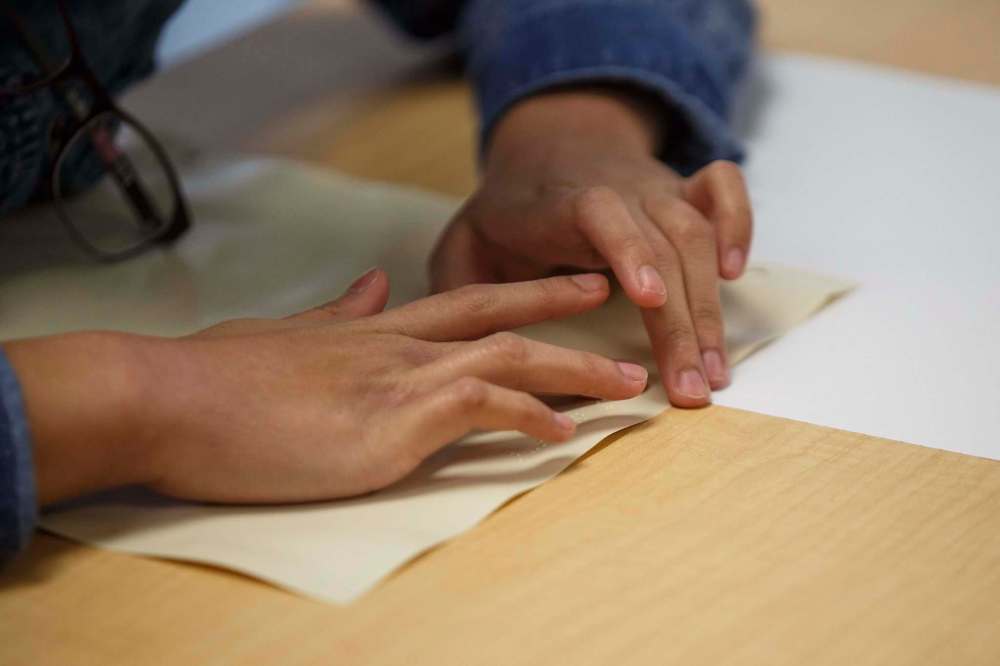
The blindfolds are essential because Amaladas is conducting a unique experiment — a braille math workshop designed to give her students a tiny taste of what a blind classmate, 15-year-old Macara Slobodian, goes through every day of her life.
“I just want to try and teach the kids empathy, give them a bit of perspective,” Amaladas tells me before the students arrive. “They’re doing the same math as Macara, but she’s doing it without seeing it. Math is so visual at this level.”
The 31-year-old teacher is also hoping the workshop gives her first blind student the opportunity to forge closer bonds with her sighted classmates, and put her special abilities on display.
“The kids are afraid to talk to her sometimes because they don’t know how to relate to someone with vision loss,” Amaladas says. “I hope this gives her a little more confidence.
“I want them to see her as just another Grade 10 kid and appreciate her for what she has to offer. It shouldn’t always be a pity party for her. She is doing well now. She’s getting the grades but it takes so much time and effort for her.”
For instance, most of the class learns from a single math textbook. For Macara, however, that book, when translated into braille, occupies 33 bulky folders that fill up the bottom two shelves of a bookcase in the classroom.
After the kids trudge in, we’re broken up into groups of four and told to slip on our blindfolds. Moments later, we’re handed sheets of embossed paper and invited to explore them with our fingers.
What we’re holding — and what the kids have not yet been told — are papers featuring the numbers 0 to 11 and basic math symbols — all in braille.
For the record, braille is a system of touch reading for the visually impaired; numbers and letters are represented by raised dots. You know you are reading a number, because it will be prefaced by four dots in the shape of a backwards letter L.
Eventually, we slip off our blindfolds, examine the sheets and Macara explains what our fingers have been feeling. “The numerical value of the dots has nothing to do with the numerical value of the numbers,” the soft-spoken teen explains. “It’s the positioning of the dots.”
Then, blindfolded, we try to memorize the numbers and math symbols. It is difficult, using mere words, to explain how difficult a task this is for an aging newspaper columnist, but I will give it a try: It is very, very difficult.

The students, however, pick it up with relative ease. There’s none of the typical teenage chatter and indifference. They approach this challenge with remarkable focus and intensity, some lowering their heads to the table to get as near the raised dots as possible.
“Shhhh!” a student at a nearby table scolds. “I’m trying to figure this out.”
Next up is a worksheet with a trigonometry problem written in braille. According to the kids at my table, we’ve been given the values for two sides of a right-angled triangle and we have to figure out the value of the hypotenuse, the longest side of the triangle.
In all honesty, I cannot even feel the (bad word) triangle. Never a whiz at math, and now sporting a blindfold, I am literally, and figuratively, in the dark.
The teens at my table, even though it’s their first encounter with braille, have no trouble spitting out the right answer. It’s the same thing a few minutes later when we’re handed a second worksheet featuring 11 simple math problems in braille.
“OK, the first question is two minus one,” says Sam Hampson, 15, who is — I’m pretty sure — sitting across from me. “The last one is 10 plus two equals 12.”
I’m even more impressed with the moral lessons these kids are learning when their ability to see is taken away. “It takes a second to get used to it, but once you are it makes sense pretty quick,” Sam confides as we slip out of our blindfolds.
“When you put the blindfold on, it gets a lot more challenging. It makes me feel kind of bad for Macara. We have a hard time when we can see. She has to figure out what the question is first — it’s an extra step. Taking the blindfold off is a relief.”
Adds Kailee Krebs, 15: “We almost take it for granted what Macara has to go through to understand a math question. It (learning braille) gave us insight into her life. It makes you realize we shouldn’t be complaining. She has to try so much harder than us.”
Next, everyone gathers around a single desk to watch Macara solve a more complex math problem. As she works, her left hand punches the keys of an oversized calculator, while at her right sits educational assistant Lynn Andrushuk, who has worked with Macara since Grade 3.
“We’re in our eighth year together,” Andrushuk explains. “I guide her around and help with her assignments and translate them from braille to English so the teacher can read it. In gym, I’m definitely her eyes. I’ve taken a couple of shots for her (in dodgeball).”
As the class watches in complete silence — you could hear a pin drop — Macara displays her skill at absorbing and answering a complicated problem, relying mainly on her fingers.
When she fires off the correct answer, there’s a moment of silence before the class erupts in thunderous applause for a pint-sized girl who still wears spectacles, partly for protection but mostly because she always has.
Unlike her classmates, who can check their work visually, Macara operates something like a computer — using her memory to retain multiple math steps.
“She can remember the first five steps,” Amaladas says, proudly. “She doesn’t have the luxury of looking back at the previous steps. She has to understand the math completely because she has to explain to someone what to write down for her.”
The workshop ends with a no-holds-barred Q&A session in which Macara fields a few questions about math, and a lot about her life without sight.
She was born with sight in one eye, but lost that around the age of five. The biggest challenge in learning braille is the contractions. It can take a month or two to read a 200-page braille novel. Yes, she loves going to the movies, and picks up the story by listening to the dialogue.
Even if a miracle could restore her sight, she’s not sure she’d want that. “I’m used to the way I have things now,” she tells the entranced class.
Later, Macara concedes she’s not a big math fan, but was grateful for the workshop put on by her teacher. “I thought it was really great,” she says. “I really feel this particular group of kids has a better understanding of what I have to do every day.”
The adults in the room appear just a touch misty-eyed. “It went better than I expected,” Amaladas says with a sigh. “The kids were super-respectful and very engaged.”
It would be fair to say everyone saw things just a little more clearly when their sight, albeit briefly, was taken away.
doug.speirs@freepress.mb.ca