A pinball league of their own
Advertisement
Read this article for free:
or
Already have an account? Log in here »
To continue reading, please subscribe:

Digital Subscription
One year of digital access for only $205*
- Enjoy unlimited reading on winnipegfreepress.com
- Read the E-Edition, our digital replica newspaper
- Access News Break, our award-winning app
- Play interactive puzzles
*First annual payment billed as $205.00 + GST for one year. This annual subscription will automatically renew at $233.00 + GST every 52 weeks (10% off the regular annual price of $259.35). Offer available to new and qualified returning subscribers only. Cancel any time.
To continue reading, please subscribe:
Add Free Press access to your Brandon Sun subscription for only an additional
$1 for the first 4 weeks*
- Enjoy unlimited reading on winnipegfreepress.com
- Read the E-Edition, our digital replica newspaper
- Access News Break, our award-winning app
- Play interactive puzzles
*Your next Brandon Sun subscription payment will increase by $1.00 and you will be charged $17.95 plus GST for four weeks. After four weeks, your payment will increase to $24.95 plus GST every four weeks.
Read unlimited articles for free today:
or
Already have an account? Log in here »
Hey there, time traveller!
This article was published 05/11/2017 (3195 days ago), so information in it may no longer be current.
Robin Lassonde is the top-ranked female pinball player in the world. Yet at a tournament this summer, a man approached her during a break and asked whether she was playing or just watching. Playing, Lassonde said. “Oh,” the man replied. “I was just asking because I didn’t know if you were here as a cheerleader.”
The classic — and, yes, male-dominated — pastime of slapping buttons and nudging machines to rescue an 80-gram steel sphere from its downhill trajectory is not only still around — it’s enjoying a renaissance. The International Flipper Pinball Association (IFPA) has gone from 10,000 ranked players to 40,000 over the past five years, reflecting the organization’s expanded reach and the increased interest in the hundreds of weekly leagues and thousands of one-time tournaments around the world. Pinball parlours are making a comeback, and new pinball manufacturers now enter the market every year after two relatively stagnant decades.
Where, in pinball’s growth, is there a place for women? The pinball community has grappled with this question in recent years as Lassonde and others have navigated its sometimes-sexist culture. And a few have pinned their hopes on a controversial solution — a wave of new all-female leagues and tournaments.
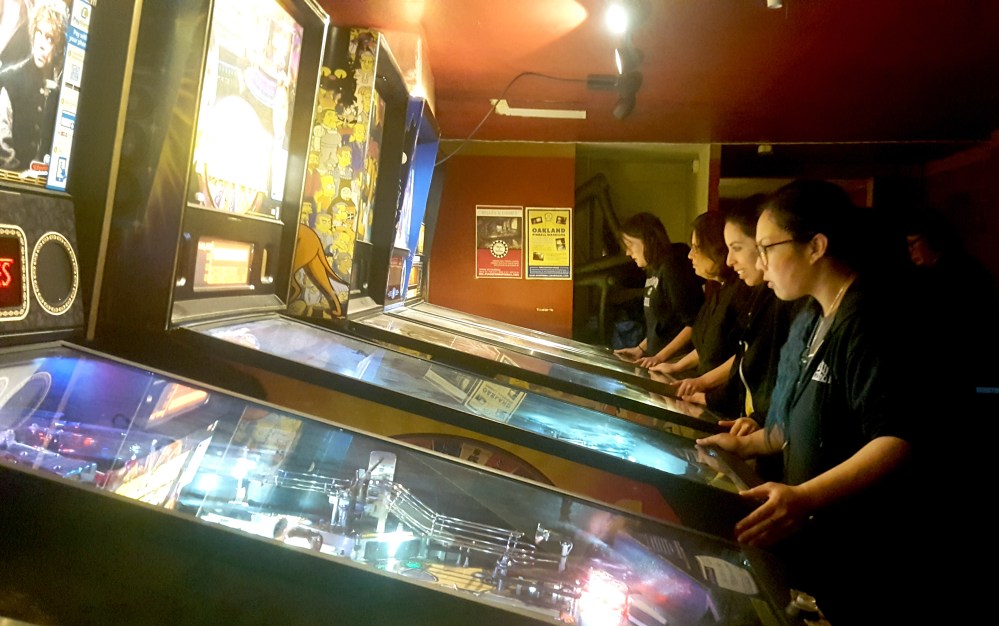
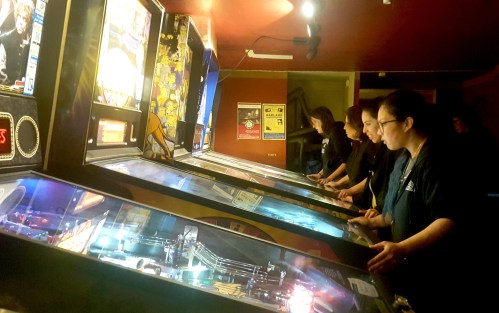
“Everybody I played pinball with was a guy,” says Echa Schneider, a competitor in Oakland, Calif., who founded Belles & Chimes, touted as the world’s first women-only pinball league, in 2013. “I really was like, ‘I just want to meet some other women to play pinball with.’”
Of the top 200 ranked players in the world, only three are women. IFPA president Josh Sharpe estimates that just over 11 per cent of IFPA-registered players are female — though, he points out, that’s up from eight per cent when he began tracking the metric a few years ago.
Unlike sports that can at least nominally attribute their gender imbalance to physical strength, pinball offers no gameplay advantage for masculinity. Consider, for example, that the most recent winner of the World Pinball Championships, Escher Lefkoff, was 13 years old.
Yet pinball bears the scars of a classically male hobby. Barely clothed fantasy women populate the backglasses and playfields of older machines, often with little relevance to the game’s theme. Echoes of that linger — manufacturer Bally sold a Playboy pinball machine in 1978, Data East copied the theme in 1989 and Stern Pinball released a more modern Playboy version in 2002, this time with optional full nudity.
Stern made waves in 2015 when it manufactured the game Whoa Nellie! Big Juicy Melons, ripe with puns comparing produce to female anatomy.
“What a poor choice,” Schneider says, “when you look at the way the world’s changing and the way the pinball community is changing and the expectations around the way women are depicted in media — and they put out this game where the theme is ‘Men like boobs’?”
“When people ask, ‘Why do you need a special women’s league?’” she adds, “I’m like, ‘This is why, because parts of this industry can be tone-deaf and uninviting.’”
Women-only contests have also weathered the argument that their very existence implies women somehow aren’t good enough for the main competition.
“There is no skill-based argument for a women’s division,” says Elizabeth Cromwell, who helped initiate a major all-female tournament at the World Pinball Championships near Pittsburgh. “It is entirely a sociological argument.”
Only a few years after Schneider launched Belles & Chimes in the Bay Area, it boasts more than 200 players, with franchises in Oklahoma City, Cleveland, Phoenix, Denver, Chicago, Charlotte, both Portlands, Eugene, Ore., and soon Minneapolis — and a handful of other women’s pinball leagues have formed. Schneider has fielded accusations from complete strangers that Belles & Chimes did the game a “huge disservice” and would “ruin pinball.”
In these leagues of their own, women are finding a place where they can enjoy their favourite hobby free of the concerns that accompany a mixed-gender event. One relieved new league member confided in Schneider she had competed in a local coed contest that had 12 people and six of the guys asked her out.
Many women have discussed other causes of discomfort on pinball message boards such as Pinside, Tilt Forums and Rec.Games.Pinball. Obvious harassment is relatively rare. More insidious and pervasive are the inadequately disguised assumptions a female pinball player must be an amateur or some male player’s supportive girlfriend.
“It’s a one-off thing for a guy to be asked, ‘Do you know what you’re doing?’” says Zoë Vrabel, the fourth-ranked female player in the world.
“It’s an every-time thing for a woman.”
Eyes roll whenever a man calls an exuberant female player “distracting” or grouses about how he can’t believe he “lost to a girl.”
Plus, Schneider says, there’s something intimidating to a lot of women about “30 dudes being super intense.”
Last August, Cromwell wrote a post on Tilt Forums called “Sexism in Pinball: Practical Examples” that touched a nerve, with more than 300 subsequent posts debating the intentions and effects of the behaviours she listed — including men telling female players they’re “dressed too nice to play in a pinball tournament,” unsolicited touching and qualifying compliments about gameplay with the classic “… for a girl.”
Then, this summer, an incident at a tournament in Oregon led three female finalists to plunge their balls onto the playfield and walk away in protest, letting the balls fall past the unattended flippers.
It started when Vrabel was about to compete in the women’s finals of the Northwest Pinball Championships, a sub-tournament within the main coed event. Vrabel says she was asked whether she might serve as tournament director for her section, which she found offensive. (Tournament organizer Germain Mariolle says the idea was merely floated in response to last-minute scheduling difficulties and then rejected.) Conflicts of interest notwithstanding, she felt the idea implied that her focus was divisible, reinforcing her perception that women’s tournaments were treated as afterthoughts.
To Vrabel, it failed a popular sniff test used by pinball players to detect sexism: would you say the same thing to Keith Elwin, one of the top players in the world? It would be like asking quarterback Tom Brady whether he wouldn’t mind doubling as a ref.
A couple of subsequent comments from male officials asking whether the female finalists knew certain rules — innocent in their intent, but which the finalists thought failed the Elwin test — frustrated Vrabel further, as did a nearby discussion on a live-stream chat of whether one player, Nycole Hyatt, knew about the second set of rear flipper buttons on the Johnny Mnemonic machine, since she didn’t seem to be using them. (Of course she knew, Vrabel says; the buttons weren’t working.)
After Vrabel reported those ignominies, the live-stream discussion switched to a debate over what constitutes sexism. The sheer discomfort of the situation inspired her to deliberately drain her last ball; it just wasn’t fun anymore. Two of her competitors followed suit.
Mariolle says he regrets the turn of events and hopes the situation can become a valuable learning experience.
The incident has generated online debate over exactly what happened, and commenters have accused the forfeiters of oversensitivity. But for Vrabel, the offences were anything but isolated.

Schneider agrees. “I don’t think you will find a woman who plays pinball who has never had those experiences,” she says.
Happily, Schneider has found the IFPA supportive of the new women-only tournaments, rankings and leagues.
“I’ve never pretended to put myself in the shoes of the women players out there,” Sharpe, the IFPA president — and director of marketing at Stern Pinball in its post-Whoa Nellie era — said in an email, “so my process has always been, let me ask the women and see what THEY WANT.”
What they want, increasingly, are steps to make competitive pinball less daunting and more inclusive. Schneider feels optimistic and is even finding male players less likely to see their female counterparts as lower-tier — because, she suspects, “now they’re used to getting their a– kicked by women.”
— Washington Post