
‘King of Swing’ Benny Goodman would have turned 100 this month

Advertisement

Advertise with us

FOR decades Benny Goodman and his clarinet popped up just about everywhere, and when they did, just about everyone knew it.

Read this article for free:


or

Already have an account? Log in here »

To continue reading, please subscribe:

Subscribe and receive a limited-edition Free Press branded hat or tote.

Digital Subscription

One year of digital access for only $205*

  • Enjoy unlimited reading on winnipegfreepress.com
  • Read the E-Edition, our digital replica newspaper
  • Access News Break, our award-winning app
  • Play interactive puzzles

*First annual payment billed as $205.00 + GST for one year. This annual subscription will automatically renew at $233.00 + GST every 52 weeks (10% off the regular annual price of $259.35). Offer available to new and qualified returning subscribers only. Cancel any time.

To continue reading, please subscribe:

Add Free Press access to your Brandon Sun subscription for only an additional

$1 for the first 4 weeks*

  • Enjoy unlimited reading on winnipegfreepress.com
  • Read the E-Edition, our digital replica newspaper
  • Access News Break, our award-winning app
  • Play interactive puzzles
Start now

*Your next Brandon Sun subscription payment will increase by $1.00 and you will be charged $17.95 plus GST for four weeks. After four weeks, your payment will increase to $24.95 plus GST every four weeks.

Hey there, time traveller!
This article was published 23/05/2009 (6352 days ago), so information in it may no longer be current.

FOR decades Benny Goodman and his clarinet popped up just about everywhere, and when they did, just about everyone knew it.

Goodman, who would have turned 100 on May 30, defined for most people the swing era that dominated popular American music for much of the 1930s and 1940s.

From Carnegie Hall and New York’s exclusive clubs to his backing up Jack Teagarden in 1933 on Texas Tea Party, he was as versatile and prolific as he was famous.
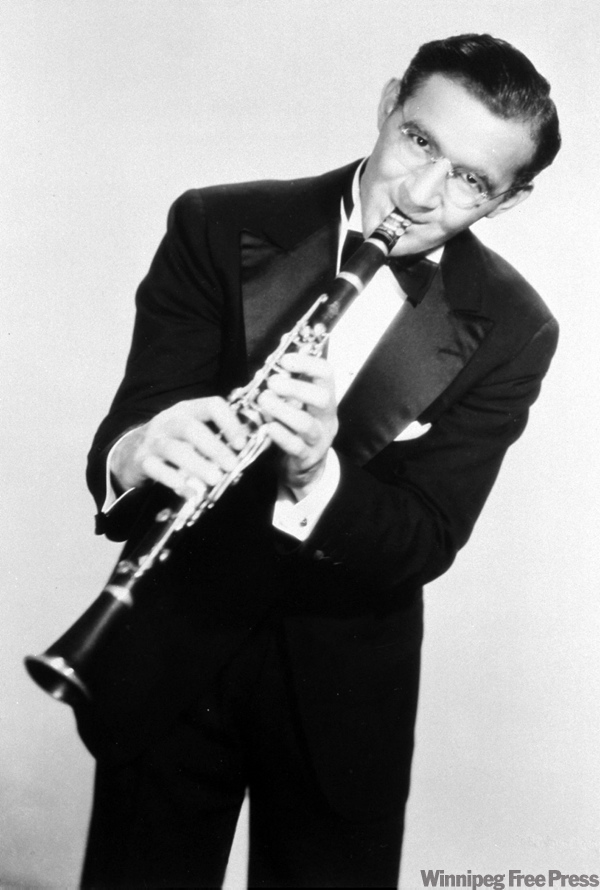
ASSOCIATED PRESS
Goodman in 1937
ASSOCIATED PRESS Goodman in 1937

"Goodman had a style that can be identified before his name is announced," Ben Pollack, with whom Goodman first recorded in 1926, says in Nat Shapiro and Nat Hentoff’s 1955 classic book Hear Me Talkin’ To Ya.

Goodman sat in on the last recording session of hard-drinking, hellroaring and superbly talented blues singer Bessie Smith in 1934. A few days later he was there for the recording debut of promising young blues singer Billie Holliday. He even recorded with classic composer Bela Bartok.

Whether he was the greatest of his era is subjective, but he helped bring jazz out of smoky dives and into "respectable" (white) young America, to high school and college audiences and the American mainstream.

Goodman, who died of a heart attack in 1986 at age 77, relished the title King of Swing given him by the new white audiences who were largely unaware that black musicians, such as Louis Armstrong, were playing swing as far back as 1925.

"That some special thing, that style, that fluency he had lasted all the way through his career," says Gunther Schuller, a composer, conductor, and music historian whose books include The Swing Era.

The extent of Goodman’s staggering output is a guess. One 1969 discography, BG On The Record, runs to 600 pages and authors D. Russell Conner and Warren Hicks say they don’t have all of it. He recorded under numerous aliases with dozens of groups. Some was never released and is in private hands.

Before he formed his own band in 1934, Goodman did well with endless radio shows and dance records that fed an insatiable demand for something new.

Goodman was born to a large impoverished immigrant family in Chicago in 1909 as jazz was beginning to move up from the South.

He began studies very young, had his union card at age 13 and by 1923 was playing with the big names on Great Lakes excursion boats.

Goodman’s success was helped along mightily by piano player and arranger Fletcher Henderson, who had worked for Armstrong.

He delivered it big-time on Aug. 21, 1935, at the Palomar Ballroom in Los Angeles at the end of a tour that had gone poorly.

The crowd was uninspired, so the band switched to some of Henderson’s more lively arrangements.

People went crazy, Goodman shot to instant fame and many jazz historians consider that evening the beginning of the swing era.

Schuller calls Goodman’s playing flawless. Goodman expected no less, ever, from his sidemen and was not an easy man to work for. His turnover was high.

Vocalist Helen Ward quit citing his rudeness to her. Another, Helen Forrest, called him the rudest man she had ever met.

When Goodman returned with a band from a State Department-sponsored 1962 trip to the Soviet Union, someone asked saxophonist Zoot Simms what it was like playing in the Soviet Union.

"Every day with Goodman is like playing in the Soviet Union," he answered.

Goodman launched careers and led the dissolution of the taboo against black and white musicians playing together. He hired some of the best black talent around, including Lionel Hampton and Teddy Wilson. They, Goodman and drummer Gene Krupa made up the wildly popular Goodman Quartet beginning in the 1930s.

Some jazz writers say Artie Shaw may have been the better player. But in the public mind it is Goodman’s name that remains welded to swing.


— The Associated Press

Report Error Submit a Tip

More Stories

Former Oilers teammates square off for first time

Ken Wiebe 7 minute read Preview

Former Oilers teammates square off for first time

Ken Wiebe 7 minute read Yesterday at 4:41 PM CDT

Calvin Pickard has been many things to Stuart Skinner.

An ally, sounding board, confidante and most importantly, a close friend.

They were a goalie tandem for parts of three seasons with the Edmonton Oilers, making two trips to the Stanley Cup final, combining for 29 playoff wins, but falling just short of achieving the ultimate goal on both of those occasions.

They were opponents just once last season when the Oilers and Pittsburgh Penguins met for the first time since the trade that shipped Skinner to Pennsylvania, but it was Tristan Jarry – the guy he was traded for – standing at the opposite side of the rink.

Read
Yesterday at 4:41 PM CDT

Israel and Palestine: 30 wasted years

Gwynne Dyer 5 minute read 2:00 AM CDT

Here is how the high command of the Israel Defence Forces (IDF) laid down the rules for “remotely” killing suspected Palestinian activists in the densely populated Gaza Strip after the surprise Hamas attack on Israel on Oct. 7, 2023.

Israeli forces were told that up to 20 Palestinian civilians could be killed in a strike against a single suspected member of Hamas, even one of the lowest rank and importance. For a more “senior” Hamas member, the permissible number of non-combatants who could be ‘accidentally’ killed in the process went up to 100.

The order went out only hours after the attack, when there were not yet any IDF troops on the ground in Gaza and all strikes had to be remote, but most strikes have remained remote right down to the present because using drones and artillery keeps Israeli casualties very low.

The drone operators or artillery gunners who delivered the high explosives did not choose the targets themselves. An AI system called Lavender did that, using a network of surveillance devices that generated tens of thousands of likely targets, some known by name, some just “acting suspiciously.” Human operators spent about 20 seconds confirming each one.

Riding the Unity Bus to rally support for Canada in Alberta

Melissa Martin 8 minute read Preview

Riding the Unity Bus to rally support for Canada in Alberta

Melissa Martin 8 minute read Updated: Yesterday at 9:57 PM CDT

WAINWRIGHT, Alta. — The Unity Bus arrives right on time, pulling into a parking lot on the edge of this town of about 6,600 people close to the Alberta-Saskatchewan border. As the vehicle slows to a halt, resplendent in its patriotic red-and-white paint, a small group of supporters stand waiting, decked in their own maple leaf garb.

The Unity Bus’s doors open and former Alberta deputy premier Thomas Lukaszuk bounds to the ground. The supporters, volunteers with Lukaszuk’s Forever Canadian campaign, welcome him with applause; he greets them with open arms. He knows many by name, having been to Wainwright four times; some of them fondly call him “the boss.”

“Do you need some stickers?” he asks. “Do you need some swag to give away?”

It’s a chilly Thanksgiving Monday morning on the eastern edge of Alberta. A sharp wind nips at exposed skin and drab grey clouds hang low in the sky. Such weather does not encourage high spirits, but Lukaszuk and these volunteers can’t afford to let theirs falter: in just one week, on Oct. 19, Albertans will vote on a historic question on whether to remain in Canada.

Read
Updated: Yesterday at 9:57 PM CDT

Today’s horoscope

Georgia Nicols 4 minute read Preview

Today’s horoscope

Georgia Nicols 4 minute read Yesterday at 2:00 AM CDT

MOON ALERT: There are no restrictions to shopping or important decisions. The moon is in Scorpio.

ARIES (March 21-April 19)

Tread carefully as it’s easy to get into an argument, especially with your kids or even a romantic partner. Very likely the dispute will be about mutual expenses, shared property or perhaps differing values. Do what you can to keep the peace.

TAURUS (April 20-May 20)

Read
Yesterday at 2:00 AM CDT

A question of public utility

Tom Pearson 5 minute read 2:00 AM CDT

The editorial page of the Free Press often provides perspectives that are thought-provoking and sometimes contradictory. “Keeping the lights on,” (Oct. 5) by Hal Turner and “Wasteful operations should be held accountable,” (Oct. 6) by Barry Prentice are both thought-provoking. They are not contradictory because they cover two quite different topics. Where they differ is in their delivery and the quality of the underlying facts.

Mr. Turner provides what is, in my view, the most cogent rationale for gas-fuelled generation that I have read. He highlights the essential aspect of power supply to Manitobans. He supports the argument for natural gas generation with succinct, relatable facts and anecdotes relating to what other comparable utilities have done. He states that, “Manitoba Hydro’s experts are neither anti-wind nor pro-fossil fuel.” They are simply seeking the best possible solution for Manitobans — a fact many special-interest groups either ignore or sadly, impugn.

Although some would argue the contrary, I believe that Mr. Turner’s position and longevity in the Manitoba Hydro organization lend gravitas to his column. Mr. Turner understands that “keeping the lights on” is a non-negotiable requirement and a public trust.

Before I turn to Mr. Prentice’s column, I should disclose that before I retired (it’s been a while), I was responsible at different times for Winnipeg’s regional water system and subsequently water supply from source to tap. In that context I was also responsible for the operation of the Greater Winnipeg Water District (GWWD) railway. Like Mr. Turner’s perspective on the supply of electricity to Manitobans, I regard the supply of safe drinking water to Winnipeggers as a public trust.

Carney: Trump’s ‘energy ceasefire’ could ‘de-escalate’ war in Ukraine

Kyle Duggan, The Canadian Press 4 minute read Preview

Carney: Trump’s ‘energy ceasefire’ could ‘de-escalate’ war in Ukraine

Kyle Duggan, The Canadian Press 4 minute read Sunday, Oct. 11, 2026

OTTAWA - Mark Carney thanked U.S. President Donald Trump for “his leadership toward securing an energy ceasefire" between Ukraine and Russia, the Prime Minister's Office said on Sunday.

But on the same day, Carney also expressed to Ukraine's leader that Trump's new diesel supply agreement with Russia undermines Canada's efforts to end the war in Europe.

Trump posted on his Truth Social account on Sunday that Ukraine and Russia have agreed to an "energy ceasefire," but did not immediately offer any details.

Carney expressed “strong support for this agreement," according to a readout from the PMO that followed a conversation between the two leaders. And on his own social media account, Carney offered that Trump’s newly announced “energy ceasefire” could help wind down Russia’s war against Ukraine.

Read
Sunday, Oct. 11, 2026


