Reality of home office demands design decisions
Combining your living space with working space creates challenges
Advertisement
Read this article for free:
or
Already have an account? Log in here »
To continue reading, please subscribe:

Digital Subscription
One year of digital access for only $205*
- Enjoy unlimited reading on winnipegfreepress.com
- Read the E-Edition, our digital replica newspaper
- Access News Break, our award-winning app
- Play interactive puzzles
*First annual payment billed as $205.00 + GST for one year. This annual subscription will automatically renew at $233.00 + GST every 52 weeks (10% off the regular annual price of $259.35). Offer available to new and qualified returning subscribers only. Cancel any time.
To continue reading, please subscribe:
Add Free Press access to your Brandon Sun subscription for only an additional
$1 for the first 4 weeks*
- Enjoy unlimited reading on winnipegfreepress.com
- Read the E-Edition, our digital replica newspaper
- Access News Break, our award-winning app
- Play interactive puzzles
*Your next Brandon Sun subscription payment will increase by $1.00 and you will be charged $17.95 plus GST for four weeks. After four weeks, your payment will increase to $24.95 plus GST every four weeks.
Read unlimited articles for free today:
or
Already have an account? Log in here »
Hey there, time traveller!
This article was published 02/12/2017 (3153 days ago), so information in it may no longer be current.
Working from home has become as ordinary as having a job in the first place. No one blinks at a request to go remote part time, because traditional separations between work and home are softening.
But what if you must live and work under the same roof full time? If you need a work surface the size of ping-pong table, or you need running water, or your boss at the headquarters out of town just plain doesn’t want to pay rent for your office anymore? How do you meld your working space with your home?
Jerry Zremski, bureau chief for the Buffalo News and a former National Press Club president, confronted this reality.
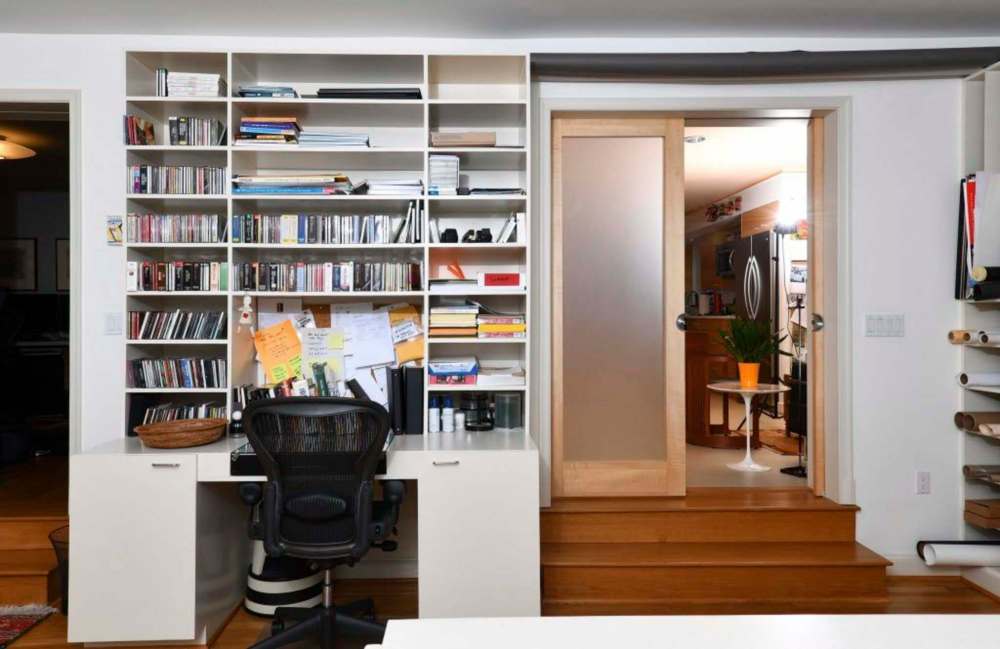
“For years, we had a two-reporter, plus intern, bureau in the National Press Building. But in March 2010, I started working at home. My employers felt it made financial sense,” he said, sitting behind his spacious white desk.
“It was a big sacrifice. This was a guest bedroom,” he said, gesturing around the 10-by-12-foot bright and airy room. “Now I give up my bedroom for guests.”
Years ago, Zremski renovated his two-bedroom Washington condo. So he brought back Natalya Mumzhiu with NM Design Studio, and asked her to rethink the second bedroom.
“I wanted it to look like an office, because if it was just me and my laptop at the kitchen table, it wouldn’t feel like work,” he said.
“Jerry called and said he was moving his office into the house,” Mumzhiu said. “I also work from home, and know how important it is to have a pleasant, organized and professional space.”
She placed the desk perpendicular to the windows “so he could look outside all the time with just a turn of his head,” she said.
“I told her I needed a lot of room for files, and she said, ‘I’ll invent something,”’ Zremski said.
She made a desk from an Ikea kitchen countertop, and set it over three file cabinets. She built wood shelves onto the walls and covered cabinets with frosted glass doors.
“Glass creates a peaceful atmosphere and tricks the eye, making the space look bigger than it really is,” she said.
“This is an office 100 per cent. If you looked just at this room, you’d see an office and never guess it was in a condo,” Zremski said.
Artist Larry Kirkland designs monumental, site-specific installations for institutions around the world. His 39-foot-high bronze doors, etched in Latin verse from the first page of Genesis in the Gutenberg Bible, form the entrance to the new Museum of the Bible in Washington.
He conceives these works in a light-filled, double garage-sized studio — designed by architect Michael Lee Beidler — that joins his Washington house with translucent glass pocket doors.
“So I keep the light between the two spaces,” Kirkland said.
The rectangular studio is bookended by walls of paned windows and doors that face a porch on one side and a yard on the other.
“The space is magnificent for my private working world and our home life,” he said. Kirkland lives with his partner, Brendan Doyle.
“We transform it for dinner parties and holiday meals. We had Brendan’s retirement party here. That was the bar,” he said, pointing to the drafting table piled with drawings and books.
A huge eggshell-coloured metal layout table on wheels dominates the space, and is Kirkland’s primary working area. They roll it onto the porch for their 30-person Thanksgiving dinner. Now it’s covered with pieces of the bronze doors, slabs of engraved granite and a model for an addition to the D.C. Superior Court.
The giant nine-by-18-foot wall behind the layout table “is my pin-up wall. In the future, when we sell the house — I know we won’t live here forever — a family can open up the space with a fireplace or windows,” Kirkland said.
Roommates, partners, even spouses can sometimes be problematic.
“I think if one works at home, you have to separate your places and be disciplined. Now that Brendan is home more often, he’ll barge in and say, ‘Let’s have lunch.’ But I don’t want lunch. My idea of lunch is to stand at the kitchen sink, eat half a sandwich and not dirty any utensils so I don’t have to worry about cleaning up.”
Edmond van der Bijl, an entrepreneur, innovator and artist who paints, sculpts and creates video, also contends with family at home.
Occasionally, he rents a studio. But mostly he works from the Washington house he shares with his wife, Arianna, and two small children.
“I try to set up a little corner in a room that’s dedicated to me, where I can lock the door. But it’s not a private office or a cocoon. People walk through,” he said.
“As we speak, I can hear my son crying, and it’s killing me. Parenthood makes your life less comfortable, but artistry isn’t about being comfortable. It’s about stretching your creativity and powers of observation, and getting comfortable with things not being perfect.”
Zremski tries to demarcate the end of a working day with a distinct break. He goes to the gym or meets friends.
“It’s difficult to really make the separation between work and home, especially when the commute between my bedroom and desk is 10 seconds. The unavoidable result is that the personal blends with the work,” he said.
“I try not to come into my office when I’m not working, but if I need the recipe for Thai basil chicken I can’t help it,” he said, because his recipe folder is on the computer. Then, of course, he checks email.
The evolving state of workplaces has led to a remote-friendly culture, a lot of give-and-take and self-imposed rules.
Van der Bijl said: “The entrepreneurial nature of working out of the house forces you to make the most of situations that aren’t always ideal, but hustling to be creative elicits the best of people.”
— Washington Post