

Broom police another sign of curling’s ‘progress’
Advertisement
Read this article for free:
or
Already have an account? Log in here »
To continue reading, please subscribe:
Digital Subscription
One year of digital access for only $1.44 a week*
- Enjoy unlimited reading on winnipegfreepress.com
- Read the E-Edition, our digital replica newspaper
- Access News Break, our award-winning app
- Play interactive puzzles
*Billed as $5.77 plus GST every four weeks. After 52 weeks, price increases to the regular rate of $19.95 plus GST every four weeks. Offer available to new and qualified returning subscribers only. Cancel any time.
To continue reading, please subscribe:
Add Free Press access to your Brandon Sun subscription for only an additional
$1 for the first 4 weeks*
- Enjoy unlimited reading on winnipegfreepress.com
- Read the E-Edition, our digital replica newspaper
- Access News Break, our award-winning app
- Play interactive puzzles
*Your next Brandon Sun subscription payment will increase by $1.00 and you will be charged $17.95 plus GST for four weeks. After four weeks, your payment will increase to $24.95 plus GST every four weeks.
Read unlimited articles for free today:
or
Already have an account? Log in here »
Hey there, time traveller!
This article was published 04/12/2017 (3099 days ago), so information in it may no longer be current.
OTTAWA — They made some curling history here at the Roar of the Rings on Monday afternoon.
For the first time ever, officials conducted random testing of the brooms the teams are using this week to make sure they comply with new rules introduced in 2016 that outlaw so-called ‘Frankenbrooms,’ abrasive broom heads that some people thought had made it too easy to control a thrown rock.
And with that, yet another piece of ‘The Gentleman’s Game’ died.
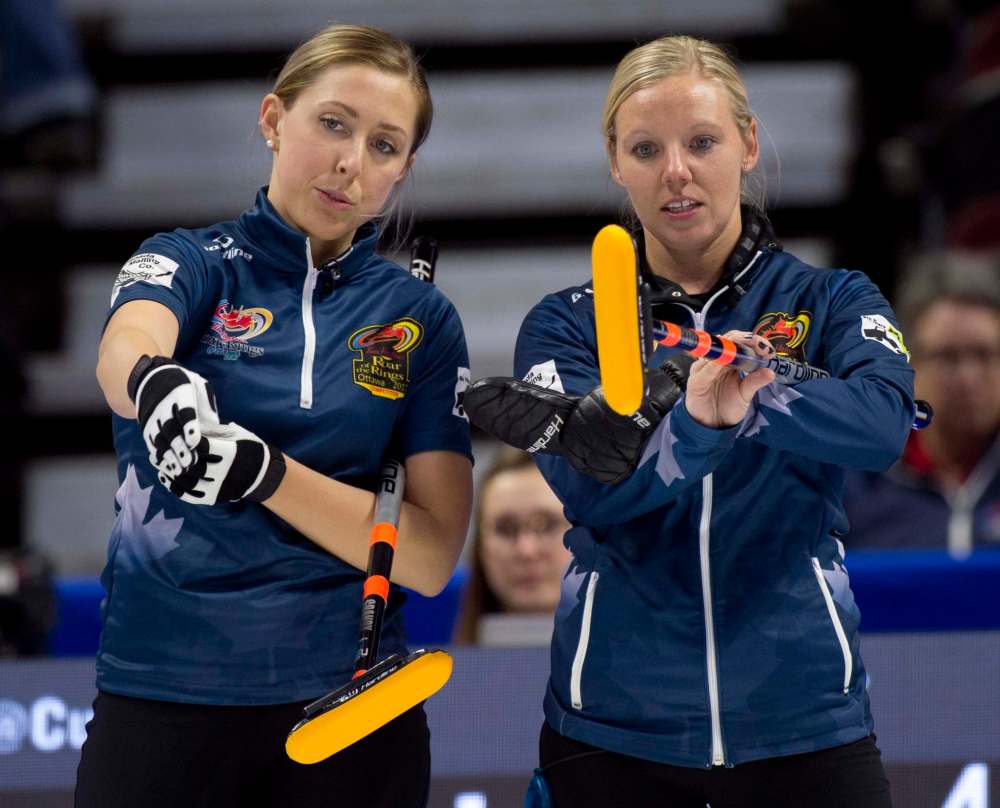
Remember the days when curling didn’t have any officials at all because the game was entirely self-policing? From the lowest club game all the way to the world championships, curlers for decades called all their own infractions on themselves.
It was one of the things that made the sport both so unique and so endearing.
Your team burned a rock? You told the other team you did it and removed the offending stone. You slid over the hog line? Your own sweepers would call you on it and remove the stone.
It was a good system because it was the honour system and it worked, at every level of the game.
But such are the vagaries of the world in which we now live that as of Monday, the term ‘broom police’ has now been added to ‘electronic hogline detection’ and ‘curling umpire’ as things that actually exist.
So how does one go about conducting something as goofy as ‘random broom head testing?’
Turns out it’s quite a thing.
The eight teams competing on Monday afternoon’s draw were pulled aside prior to the draw and each was ordered to turn over one broom from a randomly selected player so that it could be tested by Curling Canada officials, under the supervision of a couple of scientists from the National Research Council.
No, I’m not kidding.
The scientists were volunteers, in case you were wondering — like I was — whether your tax dollars were paying for something this frivolous.
The NRC types brought with them something called a durometer.
I will save you the trouble: “a durometer is an instrument for testing the hardness of various plastics and rubber… (which) measures the depth of an indentation in the material created by a given force on a standardized presser foot.”
In other words, a durometer is the nerdiest of all the various -meters. Which made it perfect, of course, for this task.
The broom heads were tested according to 11 different mind-numbing criteria that basically add up to — ‘You can’t use it in a game if it works too good.’
Blessedly, all the brooms passed. I don’t want to even ponder what kind of fecal storm there would have been if a broom had failed and, according to the rules, the offending curler had been kicked out of an event at which Canada is determining its men’s and women’s Olympic representatives in curling.
(A second-time broom offender, if you’re wondering, is banned from the sport for a year, along with his or her entire team.)
“There was no doctoring of my broom, that’s for sure,” said Winnipeg skip Reid Carruthers, whose broom was the one selected for testing on his team.
I asked Carruthers if he felt as I did — a little sad that it’s now gotten to the point in curling where brooms have been added to urine on the list of things that have to be tested, lest anyone cheat.
“Yes and no,” Carruthers replied. “The sportsmanship is part of what makes this game what it is for sure.
“But if we want to be considered something like a professional sport — we’re playing here in an NHL arena — then what other sport doesn’t have rules in place for what equipment you can use and a way to test for it?
“I thought it was worse before when we had no rules (on broom heads) in place at all. So now we have rules and people are playing clean. It’s just like doping in sport — it’s unfortunate but you have to police it.”
All of which is true, I suppose. But all this ‘professionalizing’ of curling comes at a price.
A lot of hard feelings among this country’s top curlers resulted from the battle over the broom heads. Teams such as Carruthers’ and fellow Winnipegger Mike McEwen’s — who were both early adopters of the controversial new broom technology — were basically accused of cheating by their fellow competitors and even today, Carruthers says there’s still a guy or two on tour who he “wouldn’t invite to my dinner table.”
Now, there’s always been grudges in curling. But you only needed to look at how Brad Gushue and John Morris settled theirs on Monday morning to see how it’s supposed to be done.
The two Olympic gold medallists were playing each other on the early draw when Morris — who opened here with three straight losses and is doing a full burn — bumped into Gushue third Mark Nichols while both men were sweeping a rock in the house.
Morris’s broom caught Nichols on the knuckles and that rankled Gushue, who exchanged some words with Morris on the ice before both men got back to playing.
No officials were called. No penalties were assessed. No video reviews conducted.
It was just two grown men settling a dispute on their own — and then laughing about it afterward when reporters tried to make it into something it wasn’t. (Gushue jokingly called it a “slash” and said he counselled Nichols to wear a pair of hockey gloves for the next game.)
It was old-time curling played the right way, which is to say without anyone running to the officials at the slightest offence.
So yeah, there’s still hope for curling, even on a day we were introduced to the malignancy that is broom police.
All of this professionalization that seems to pass for progress in curling ultimately comes back to the day curling became an official Olympic medal sport, which I’d argue is simultaneously the best and worst thing thing that ever happened to the sport of curling.
Because while the Olympics has given exposure to curling like never before — and everyone is better off for it — it’s also removed a lot of the charm that made the game so lovable and quintessentially Canadian.
It used to be — and this wasn’t that long ago — that any club curler with a bit of skill and a lot of luck could get on a run and play his or her way all the way to a Canadian championship — and maybe even knock off a few former world champions along the way.
Forget about that now. Unless you’re in the gym every day, have a nutritionist and sports psychologist on full-time retainer and have quit your day job, your odds of getting to this level of curling are slim and next to none.

Progress? Of a sort, I suppose.
But I’m not sure even the NRC could measure it.
paul.wiecek@freepress.mb.caTwitter: @PaulWiecek
Related Articles
McEwen edged out of Olympic spot




Advertisement Advertise With Us
Advertisement Advertise With Us