Joy story
Campaign aims to help people focus on little ways to feel happy
Advertisement
Read this article for free:
or
Already have an account? Log in here »
To continue reading, please subscribe:

Digital Subscription
One year of digital access for only $205*
- Enjoy unlimited reading on winnipegfreepress.com
- Read the E-Edition, our digital replica newspaper
- Access News Break, our award-winning app
- Play interactive puzzles
*First annual payment billed as $205.00 + GST for one year. This annual subscription will automatically renew at $233.00 + GST every 52 weeks (10% off the regular annual price of $259.35). Offer available to new and qualified returning subscribers only. Cancel any time.
To continue reading, please subscribe:
Add Free Press access to your Brandon Sun subscription for only an additional
$1 for the first 4 weeks*
- Enjoy unlimited reading on winnipegfreepress.com
- Read the E-Edition, our digital replica newspaper
- Access News Break, our award-winning app
- Play interactive puzzles
*Your next Brandon Sun subscription payment will increase by $1.00 and you will be charged $17.95 plus GST for four weeks. After four weeks, your payment will increase to $24.95 plus GST every four weeks.
Read unlimited articles for free today:
or
Already have an account? Log in here »
Hey there, time traveller!
This article was published 09/01/2018 (3108 days ago), so information in it may no longer be current.
So, how are you doing on your New Year’s resolutions? Good? Bad? Ugly?
A quick Google search will give you statistics that aren’t encouraging. On the one hand, the failure rate is almost universal. On the other hand, if you’re ready to throw in the towel, you’re in good company.
So why did you make that resolution? Odds are it’s because you felt that tackling the object of your unhappiness would help make you happy.
What if you skipped over the “unhappiness middle man” and went right to the result? What if your resolution was to simply look around every day and find one small thing that makes you feel happy and to keep track for 100 days in a row?
Dmitry Golubnichy, 30, took that very approach. He is the founder of 100 Happy Days Foundation, the instigator of the #100HappyDaysChallenge and the author of Can You Be Happy 100 Days in a Row? (Thomas, Allen & Son, $19.95, 160 pages).
Golubnichy’s story starts in fall 2013. He was generally unhappy with his life, even though it looked pretty darn good on paper.
The avid skier was miserable because there wasn’t enough snow in the Alps. He had only visited 35 countries. His apartment in Zurich was too small and he wasn’t moving up quickly enough at work.
He went back to his hometown in Lviv, Ukraine, to kvetch to his friends. What he found was a group of people who had found contentment with they had in front of them: same jobs; married to high school sweethearts; sharing a beer in the neighbourhood bar week after week.
Happiness was achievable with much less than he thought he needed. He set out to find one small happy thing every day in a row for 100 days and to post a picture of it on Facebook, Twitter or Instagram with the hashtag #100happydays.
People noticed. It snowballed. When he decided to turn the project into a website, 3,000 people registered in one evening. The project is now a non-profit foundation on a mission to help the world be a happier place.
To date, approximately eight million people worldwide have taken up the challenge.
Dmitry Golubnichy shared a few thoughts with the Free Press via email.
FP: What was the moment when you realized that the challenge was changing your life?

DG: The shift was noticeable already after a week or so. In the beginning I struggled to find one thing that I liked during the day, then later I had around five moments captured per day. If you want a silly example, my iPhone ran out of memory really fast after starting this challenge. It showed to me how much of my daily life satisfaction is dependent solely on my choice to focus on the good. Once you start seeing so much “happiness” around it gives you extra motivation to go through the day and life as a whole.
FP: What was your hardest moment during the challenge and how did you overcome it?
DG: The challenge helped me realize not only what brings joy into my everyday life, but also what sucks happiness out of it. Indeed, you can continue pouring happiness into a bucket, but it will never be full if there are holes in it. Perhaps the hardest moment in the challenge was to stop complaining and to make a conscious decision to minimize the factors that negatively influenced my well-being at that time.
FP: What is the best tip you would suggest for someone wanting to take on the challenge?
DG: So many people fail to get to Day 100 because they are hunting for the best picture every day that would get them maximum likes on social media. The truth is, happiness is not perfect. The point of the challenge is to find joy in those little things in everyday life. Instead of thinking what others would like to see, listen to yourself for what makes you happy. Not only will you learn so much about yourself, but you will also see positive changes starting to happen in life around you.
FP: Is there one thing in particular that you can count on to make you happy when things are not going well?
DG: I am very fortunate to have strong relationships with my parents. Even though they have always taught me to strive for the best in life, they are also the ones reminding me not to go too hard on myself. No need to discuss problems — just hearing their voice puts a smile on my face. It always reminds me that all those small upsets are so insignificant when compared to what’s important in life for me.
FP: Are you still able to work full time for the foundation?
DG: Absolutely — every morning I wake up feeling grateful that I can realize my dream of helping people live a more happy and fulfilling life. Following this mission, the foundation has launched multiple programs and projects since its initiation, from Global Bubble Parade and Kindness Ninja Scavenger Hunt to HIGH5 test and Applied Happiness Institute.
Golubnichy’s book Can You Be Happy for 100 Days in a Row? gives you 100 ideas to help spur you along, as well as other easy activities to help reinforce your new behaviour. These are interspersed with little bits of information on the science of happiness. For instance, the more time we spend in nature, the happier we are. Exercise helps you be happy (so you can still resolve to do the frigid morning jog, just do it for fun… and maybe in the woods).
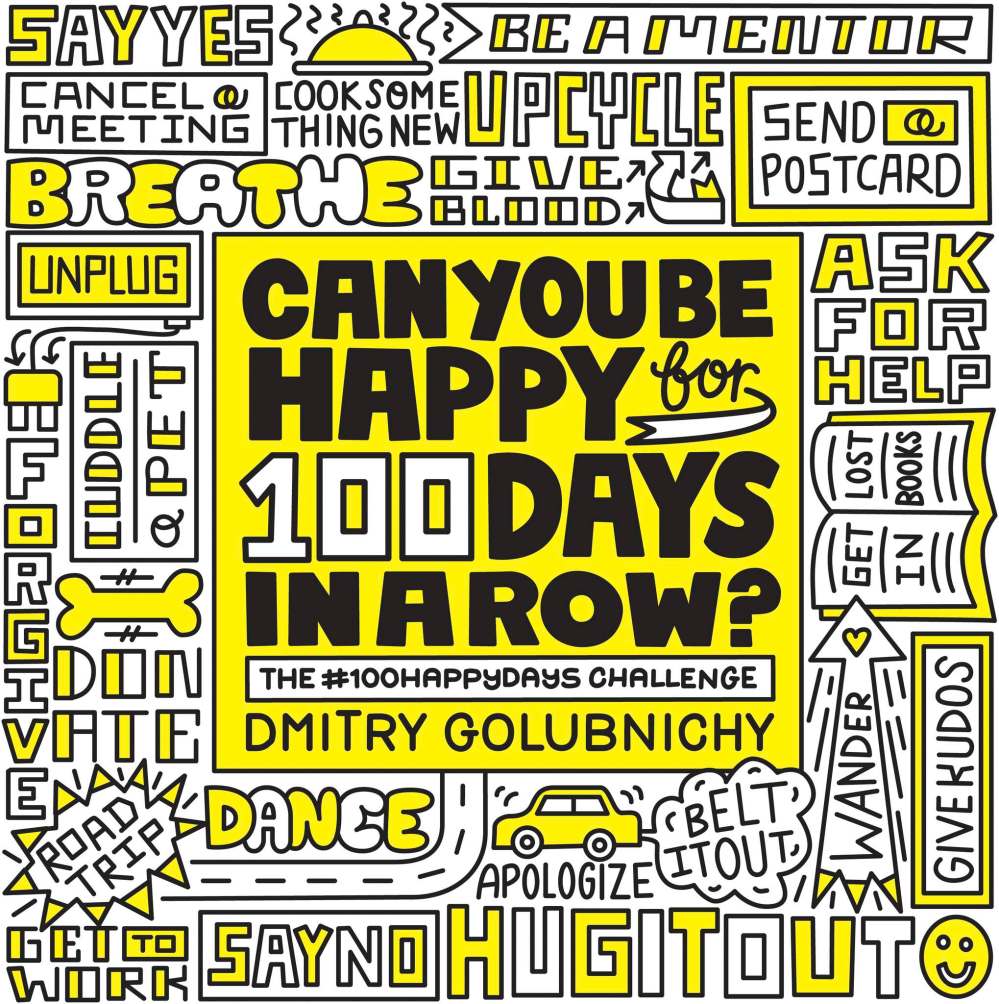
Here are a few ideas from the book. Remember: different things make different people feel happy. If you don’t find something on this list, keep looking. It could be right in front of you and you just haven’t acknowledged it yet.

- Climb into fresh sheets.
- Get lost in a painting. (Can’t get to the museum? Find one online or in a book.)
- Bring a co-worker a coffee. (Kindness spreads.)
- Memorize a poem. (Even if it starts with the lady from Nantucket.)
- Rearrange your furniture. (It gives you a new perspective and can make your space “flow” better.)
- Start filling a piggy bank. (Then plan something fun for when it’s full.)
- Cook something new. (It’s enjoyable and will nourish body and soul.)
- Wash a bowl. (Mindfully enjoy washing a dish, or doing any small task.)
- Take the stairs instead of the elevator. (Enjoy the exercise and an extra moment for a quiet thought.)
If you are up for the challenge, go to 100happydays.com and sign on. You can watch Dmitry Golubnichy’s Ted Talk here at http://wfp.to/happydays.
Twitter: @WendyKinginWpg
History
Updated on Tuesday, January 9, 2018 7:56 AM CST: Adds photos