Skyactiv-x brings diesel tech to gas engine
Mazda takes a big step without having an electric or hybrid in lineup

Advertisement
Read this article for free:
or
Already have an account? Log in here »
To continue reading, please subscribe:
Digital Subscription
One year of digital access for only $1.44 a week*
- Enjoy unlimited reading on winnipegfreepress.com
- Read the E-Edition, our digital replica newspaper
- Access News Break, our award-winning app
- Play interactive puzzles
*Billed as $5.77 plus GST every four weeks. After 52 weeks, price increases to the regular rate of $19.95 plus GST every four weeks. Offer available to new and qualified returning subscribers only. Cancel any time.
To continue reading, please subscribe:
Add Free Press access to your Brandon Sun subscription for only an additional
$1 for the first 4 weeks*
- Enjoy unlimited reading on winnipegfreepress.com
- Read the E-Edition, our digital replica newspaper
- Access News Break, our award-winning app
- Play interactive puzzles
*Your next Brandon Sun subscription payment will increase by $1.00 and you will be charged $17.95 plus GST for four weeks. After four weeks, your payment will increase to $24.95 plus GST every four weeks.
Read unlimited articles for free today:
or
Already have an account? Log in here »
Hey there, time traveller!
This article was published 09/02/2018 (3179 days ago), so information in it may no longer be current.
IRVINE, Calif. — Is the move to electrified vehicles (EV) ahead of its time?
That’s just one of the conversation starters at an event to unveil a groundbreaking new engine technology developed by Mazda, a gasoline engine that thinks it’s a diesel. At least, almost.
Robert Davis, Mazda’s senior vice-president, special assignments, pointed to the number of states — and provinces — powered by cleaner hydroelectric power next to jurisdictions still using coal, natural gas or nuclear power.
Davis suggested that instead of putting excess hydro power into cars, perhaps more overall gains could be made by having states or provinces ship clean power to jurisdictions still using fossil fuels.
In the United States, Davis said, governments could save 236 million tons of carbon-dioxide emissions by using clean power from other states and from provinces such as Manitoba to decommission coal-fired power plants. By comparision, he said reducing emissions through EVs would save only 148 million tons.
Davis said instead of trying to drive certain technologies, governments would be better off setting targets, either for fuel economy or emissions and letting carmakers draw their own roadmaps to get there.
“With an EV incentive in the U.S., you get US$7,500 from the federal government and US$2,500 from some states. Yet, even with this US$10,000 discount, EVs are only five per cent of the market,” he said.
The situation is similar in Canada: in Ontario, buyers can get up to $14,000 in government rebates for buying an electric vehicle. In Quebec, up to $8,000 and in B.C., up to $6,000.
Not surprisingly, those provinces represent 98 per cent of the EV market in Canada. But even at that, EVs are only three per cent of Canada’s entire automotive market.
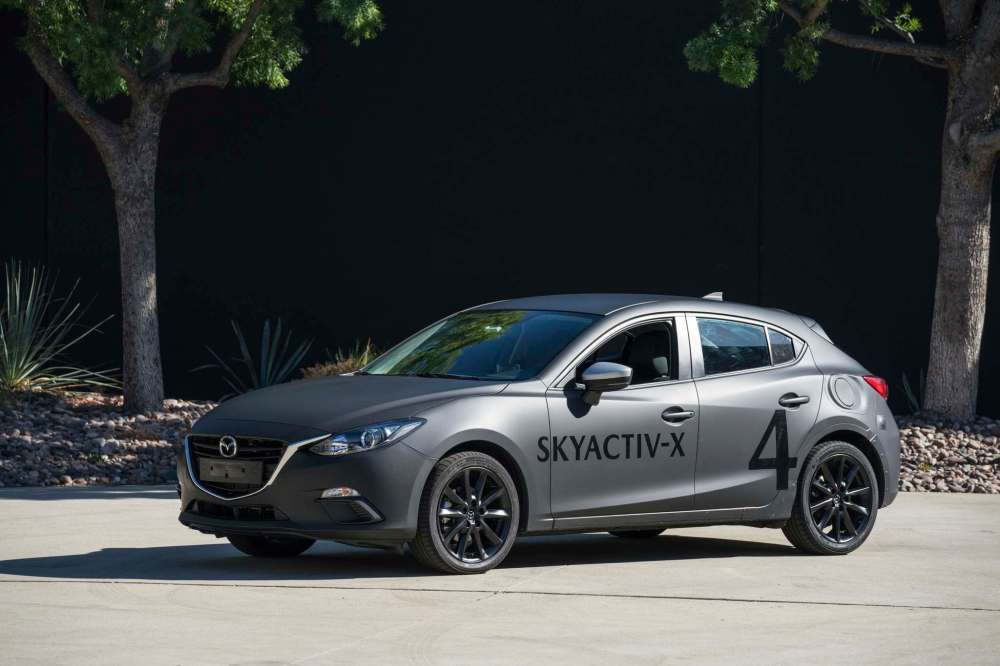
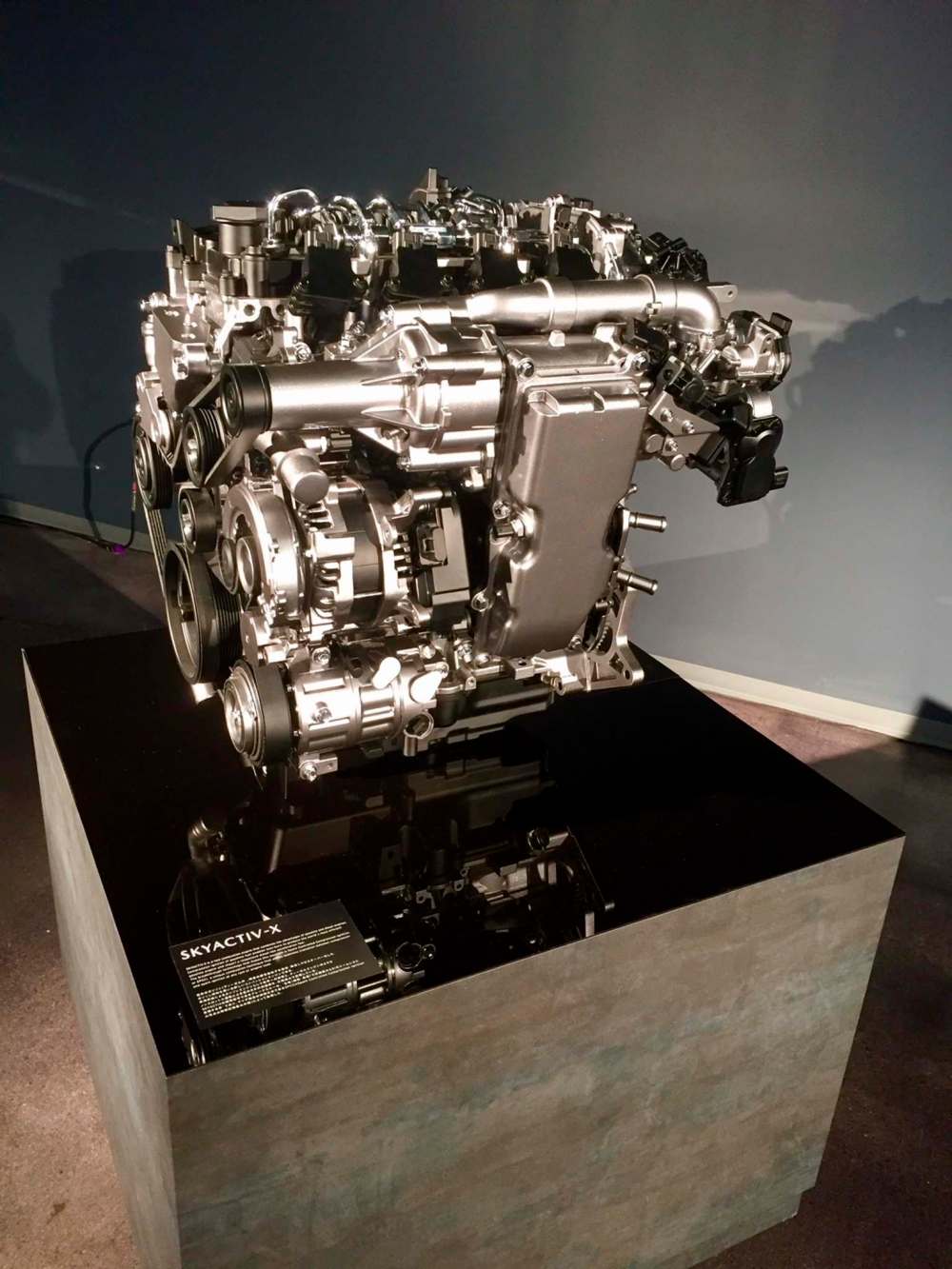
At this event, Mazda unveiled the Skyactiv-x engine. It’s a breakthrough in that it uses, partially, diesel technology — but with gasoline, not diesel fuel. It is an engine slated for production in 2019, and was installed in five prototype vehicles for testing here.
Dave Coleman, a powertrain engineer for Mazda, said instead of starting with an existing engine and implementing incremental improvements, his team started with the theoretical ideal engine and worked backward.
Diesel engines operate by using compression of the fuel-air mixture to self-ignite the fuel. It’s more efficient than gas engines because all the fuel ignites at the same time, creating more power for a given amount of fuel, but at a price of 13 per cent more carbon-dioxide emissions than gasoline for the same amount of fuel.
The idea is problematic for gasoline, however, because gasoline’s increased volatility makes it susceptible to self-igniting at the wrong time. Figuring out how to make a gas engine operate like a diesel without blowing itself up has been a problem.
Indeed, in developing the Skyactiv-x, Mazda blew up a number of engines before getting it right.
The benefit of the engine is the ability to run it, under certain conditions, extremely lean. Typical gas engines must operate at a ratio of air to fuel that’s one to one. Skyactiv-x can run as lean as two parts air to one part fuel.
The secret is using a spark plug. The engine is programmed so the compression stroke only compresses the fuel-air mixture to just before the point of self-ignition. A small fireball created by the spark plug at just the right time then pushes the cylinder pressure past the point of self-ignition, igniting the entire charge of fuel at once.
Jay Chen, another powertrain engineer, likened the difference between conventional spark-plug technology and Skyactiv-x to an inflated balloon: “If you let the balloon go, the air comes out slowly,” he said, mimicking the sound of a flyaway balloon. “But if you press it and press it until it breaks, you release all of its energy instantly.”
That instant release is what gives the Skyactiv-x engine the ability to run very lean, yet still offer excellent torque. Driving the prototypes around Irvine, including freeway time, showed the new engine to be even more powerful than the conventional gas engine currently in the Mazda3, particularly with the manual transmission.
Chen said the Skyactiv-x is expected to be 20 per cent more efficient than Mazda’s already efficient Skyactiv-G gasoline engine that’s in current Mazda models.
Coleman said Mazda has been able to maintain the No.1 ranking in the United States for both fuel efficiency and emissions, despite having a fossil-fuel-only fleet.

“For a company that doesn’t sell any electrics or hybrids, that’s a pretty remarkable achievement,” he said.
Davis said Mazda is convinced internal combustion engines will remain a prominent part of automotive technology for some time, even as electric and hybrid vehicles rise in number.
“That’s why we feel so strongly about getting the internal combustion engine right before we start layering on electrification technologies,” he said.
Mazda does not expect to start building an electric or hybrid until 2020, but says EVs and hybrids will play a role in its objective of lowering 2010 emission levels by 50 per cent by the year 2030 and by 90 per cent by the year 2050.
kelly.taylor@freepress.mb.ca
Kelly Taylor
Copy Editor, Autos Reporter
Kelly Taylor is a copy editor and award-winning automotive journalist, and he writes the Free Press‘s Business Weekly newsletter. Kelly got his start in journalism in 1988 at the Winnipeg Sun, straight out of the creative communications program at RRC Polytech (then Red River Community College). A detour to the Brandon Sun for eight months led to the Winnipeg Free Press in 1989. Read more about Kelly.
Every piece of reporting Kelly produces is reviewed by an editing team before it is posted online or published in print — part of the Free Press‘s tradition, since 1872, of producing reliable independent journalism. Read more about Free Press’s history and mandate, and learn how our newsroom operates.
Our newsroom depends on a growing audience of readers to power our journalism. If you are not a paid reader, please consider becoming a subscriber.
Our newsroom depends on its audience of readers to power our journalism. Thank you for your support.
Kelly Taylor
Copy Editor, Autos Reporter
Kelly Taylor is a copy editor and award-winning automotive journalist, and he writes the Free Press‘s Business Weekly newsletter. Kelly got his start in journalism in 1988 at the Winnipeg Sun, straight out of the creative communications program at RRC Polytech (then Red River Community College). A detour to the Brandon Sun for eight months led to the Winnipeg Free Press in 1989. Read more about Kelly.
Every piece of reporting Kelly produces is reviewed by an editing team before it is posted online or published in print — part of the Free Press‘s tradition, since 1872, of producing reliable independent journalism. Read more about Free Press’s history and mandate, and learn how our newsroom operates.
Our newsroom depends on a growing audience of readers to power our journalism. If you are not a paid reader, please consider becoming a subscriber.
Our newsroom depends on its audience of readers to power our journalism. Thank you for your support.
Advertisement Advertise With Us
Advertisement Advertise With Us