Hysteria repeats itself
Sometimes, it doesn't take much to work sports fans into a frenzy
Advertisement
Read this article for free:
or
Already have an account? Log in here »
To continue reading, please subscribe:
Monthly Digital Subscription
$1 per week for 24 weeks*
- Enjoy unlimited reading on winnipegfreepress.com
- Read the E-Edition, our digital replica newspaper
- Access News Break, our award-winning app
- Play interactive puzzles
*Billed as $4.00 plus GST every four weeks. After 24 weeks, price increases to the regular rate of $19.95 plus GST every four weeks. Offer available to new and qualified returning subscribers only. Cancel any time.
Monthly Digital Subscription
$4.99/week*
- Enjoy unlimited reading on winnipegfreepress.com
- Read the E-Edition, our digital replica newspaper
- Access News Break, our award-winning app
- Play interactive puzzles
*Billed as $19.95 plus GST every four weeks. Cancel any time.
To continue reading, please subscribe:
Add Free Press access to your Brandon Sun subscription for only an additional
$1 for the first 4 weeks*
*Your next subscription payment will increase by $1.00 and you will be charged $16.99 plus GST for four weeks. After four weeks, your payment will increase to $23.99 plus GST every four weeks.
Read unlimited articles for free today:
or
Already have an account? Log in here »
Hey there, time traveller!
This article was published 10/02/2018 (2977 days ago), so information in it may no longer be current.
As sports riots go, this one was fairly modest.
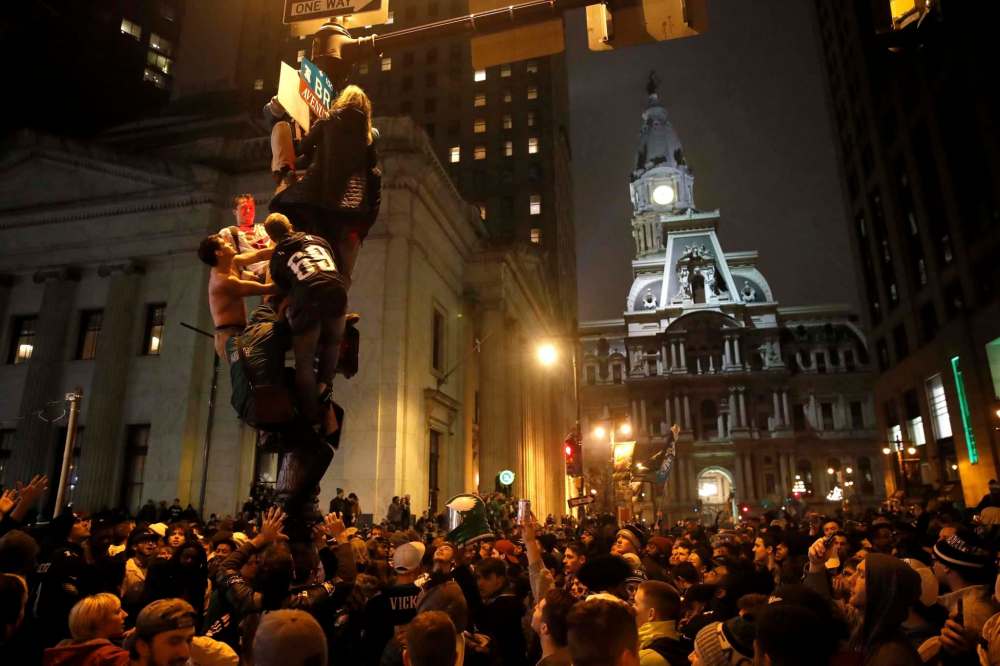
It began shortly after the final whistle last Sunday night, when Philadelphia Eagles supporters came out en masse to celebrate their team’s first-ever Super Bowl victory.
Tens of thousands of boisterous fans packed downtown Philly, braving the cold weather and standing shoulder to shoulder to bask in their team’s 41-33 win over the favoured New England Patriots.
Not surprisingly, as Sunday night became Monday morning, some of Philadelphia’s fans became unruly, smashing department store windows, looting a gas station convenience store, flipping and burning a car, collapsing a hotel awning, and toppling countless light poles, which had been greased in a futile effort to prevent revellers from climbing them.
“Tens of thousands came out and celebrated this amazing victory, and but for a handful of bad actors, the celebration was peaceful and jubilant,” a spokeswoman for the mayor told the media.
Late-night hosts were quick to pile on, with NBC’s Seth Meyers joking: “After defeating the New England Patriots, Philadelphia then went on to defeat Philadelphia.”
So, yes, they trashed the place, but let’s see how the Philly Super Bowl mayhem compares with today’s chaos-filled list of Five of the Most Memorable Sports Riots in History:
5) The famous fracas: Disco Demolition Night (July 12, 1979)
Recalling the riot: It’s one thing to riot in the jubilant aftermath of your favourite team winning its first Super Bowl championship. It’s another thing to riot because, well, you really hate disco music. But that’s exactly what happened in what became the most infamous promotion in the history of Major League Baseball.
It was the summer of 1979 and disco was taking over the world, a fact that enraged diehard fans of rock ’n’ roll. Among the most angry was Steve Dahl, then a 24-year-old Chicago disc jockey who had been fired when his station went all-disco. In his new job at a rival rock station, Dahl vented his anger by destroying disco records on air.
“Back in the day when we had turntables, I would drag the needle across the record and blow it up with a sound effect,” Dahl told National Public Radio in the U.S. “And people liked that.”
One of the people who liked that was Mike Veeck, then promotions director for the Chicago White Sox, who came up with the idea for Disco Demolition Night at Comiskey Park, wherein thousands of disco records were blown sky-high during a doubleheader between the Sox and the Detroit Tigers.
Admission was 98 cents if you brought a disco record to be blown up at centre field. Veeck thought 35,000 might show up, but was shocked when about 60,000 disco haters arrived.
After the Sox lost the first game, a giant crate full of records was placed in the outfield and Dahl, in a combat helmet and military jacket, led chants of “Disco sucks,” then they blew up the crate. Which is when chaos erupted and fans spilled onto the field, tearing up the batting cage, setting fires, climbing the foul poles and running the base baths.
Riot police were called and the field was eventually cleared, but not before nine people were hurt, 39 were arrested and the Sox were forced to forfeit the second game. Veeck was fired, but became president of the Charleston RiverDogs, a minor-league club that, in 2014, staged Disco Demolition 2, blowing up the CDs of Justin Bieber and Miley Cyrus. So it turned out OK.
4) The famous fracas: The Vancouver Stanley Cup Riot (June 15, 2011)
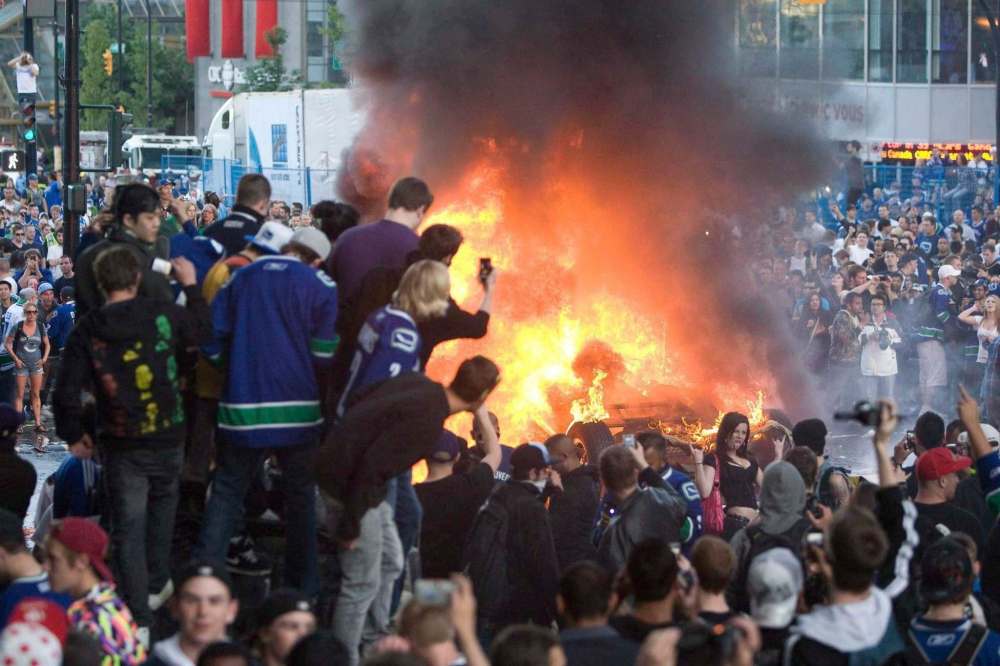
Recalling the riot: This was the riot we never expected to happen. Hours before Game 7, a Free Press colleague asked this columnist whether there would be trouble if the Vancouver Canucks lost to the Boston Bruins in the Stanley Cup final. Here’s what we replied: “Not in our old hometown. It’s way too mellow.” Famous last words.
Almost immediately after the Canucks were beaten, an out-of-control mob took to the streets, lighting cars on fire, flipping cars, overturning porta-potties and smashing windows of area businesses. Beer bottles were flung at outdoor viewing screens and broken glass littered the streets. It was surreal to see “fans” sporting the jerseys of mild-mannered Canucks Henrik and Daniel Sedin taunting and hurling debris at police.
By morning, at least 140 people were reported injured, including one critically, four people were stabbed, nine officers were injured and at least 101 people were arrested.
According to eyewitnesses, a group heard chanting “Let’s go riot, let’s go riot” as early as the first period were among those responsible for flipping the first car. The damage came to approximately $3.7 million, after 112 businesses and 122 vehicles were vandalized and 52 assaults took place.
The B.C. Prosecution Service spent $5 million pursuing 912 charges against 300 alleged rioters. Of the 300 charged, 284 pleaded guilty. On the upside, thousands of volunteers turned up in the morning to begin cleaning up the damage.
Mayor Gregor Robertson said the riot — which he blamed on a small group of “losers” and “criminals” — would not prevent the city from hosting other large events. “We are not going to back off and give our city over to a bunch of losers. We are not going to let them change our plans to gather in big numbers and celebrate who we are in Vancouver,” Robertson said.
3) The famous fracas: The Richard Riot (March 17, 1955)
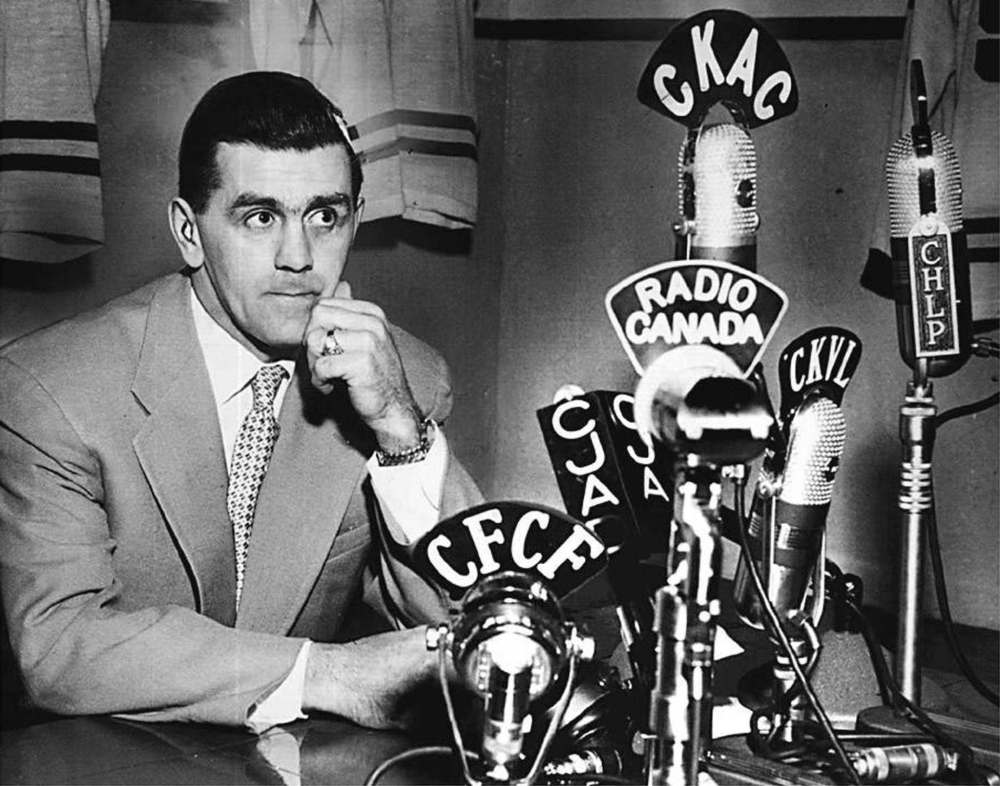
Recalling the riot: There are few things that get Canadians — French or English — as fired up as the game of hockey, and few melees in our history are as notorious as the legendary Richard Riot, named after Maurice “Rocket” Richard, the mercurial and iconic Montreal Canadiens superstar.
On March 13, 1955, the superstar got into it with defenceman Hal Laycoe of the Boston Bruins. Richard was high-sticked by Laycoe, and after the play was whistled down, the Habs star attacked Laycoe with his stick and, during the melee, bloodied the face of linesman Cliff Thompson, who was attempting to restrain him.
The next day, NHL boss Clarence Campbell — seen by many French Canadians as the despotic face of Anglo-Canadian control — suspended Richard for the rest of the season and the playoffs. Laycoe, the instigator, went unpunished.
If Campbell had not shown up for the Canadiens’ next home game on March 17 at the Montreal Forum, it’s possible the most famous riot in Canadian history might never have happened. According to The Hockey News: “Making matters worse, the NHL president showed up after the game had already started, so he was instantly noticeable as he made his way to his seat. Security was high, but fans threw food, shoes and other things at Campbell. One even managed to get past the security and, as he went to shake the hand of Campbell, slapped him in the face.”
When the Forum was evacuated after a tear-gas bomb exploded and Campbell declared the game a forfeit by Montreal after one period, outraged fans spilt outside and began ripping up the neighbourhood. The seven-hour riot injured a reported 32 people and caused damage pegged at about $850,000 in modern dollars.
It has also been viewed as an early driving force behind Quebec’s so-called “Quiet Revolution.” It went on most of the night with fears of a repeat a few hours later as it grew dark again — only quelled when Richard went on radio and TV, asking for calm.
Richard promised to “take my punishment and come back next year to help the club and the younger players to win the Cup.” He did.
2) The famous fracas: The Peruvian Soccer Riot (May 24, 1964)
Recalling the riot: What you need to know is that this was the deadliest soccer riot in history, a tragedy that, officially, left 328 people dead, although that figure is believed to be an underestimate as it doesn’t include anyone who was killed by gunfire outside the packed stadium.
It began on May 24, 1964, as Peru hosted Argentina at Estadio Nacional in Lima in a qualifying match for the right to compete in the Olympic soccer tournament at the Tokyo Summer Games. Argentina was leading 1-0 with about six minutes to play when the Uruguayan referee disallowed an equalizing goal by Peru, prompting an angry mob to break down barriers and invade the field.
“Police fired tear gas into the air, causing panic, and hundreds of fans who tried to flee were crushed on their way out of the stadium as the gates to the exits were closed,” the website TheSportster.com said.
What made the riot so deadly was the fact that corrugated steel shutters at the bottom of the tunnels that connected to the street level were closed, meaning those trying to flee the tear gas were crushed to death in the stairwells. The shutters eventually burst from the crush of bodies.
“Hundreds of spectators were crushed and trampled on as the panic-stricken crowd charged towards the exits to escape police, tear gas and dogs. In the stampede, children and women were thrown to the ground, but the uncontrolled mob surged on,” Britain’s Guardian newspaper reported at the time.
“Some people broke down a section of the wire barrier surrounding the pitch and set fire to benches and terraces. They kicked down a wall in an attempt to invade the field to try to get at the referee. Stones, bottles and cushions were thrown at the police and the pitch looked like a battlefield with missiles strewn everywhere.”
Later, thousands of people, including weeping mothers and children, blocked hospital entrances, trying to discover if their loved ones were among the dead.
1) The famous fracas: The Nika Riots (AD 532)
Recalling the riot(s): This was not only the world’s first recorded sports riot, but also the most brutal. When the dust had settled, an estimated 30,000 people were dead and at least half of the Byzantine Empire’s capital of Constantinople was burned.
“It took place back in the sixth century in the Byzantine Empire, which looked to chariot racing as its equivalent of soccer at the time,” according to TheSportster.com.
“The same things were at stake back then; competitors could get rich, spectators were there for a good time and gamblers always had some gold on the line.” It seems fans of the main racing teams, the Blues and the Greens, were like a pair of politically conscious street gangs.
On Jan. 10, 532, several drivers were to be executed over deaths that occurred at an earlier race, but one Blue and one Green escaped and went into hiding in a church. Fans made pleas for lenience, and Emperor Justinian reduced their death sentences to life imprisonment and ordered a new set of races for Jan. 13.
That’s when irate fans demanded the drivers be pardoned entirely and, by day’s end, were chanting “Nika!” (or “conquer”). The rival fans then joined forces and launched an attack on the imperial palace and set fire to the city.
“The crowd had killed dozens of people, and had also declared a new emperor, but Justinian ordered his troops into the mob; butchering and murdering thousands over the next few days,” TheSportster.com says.
Notes smithsonianmag.com: “Imagine a force of heavily armed troops advancing on the crowds in MetLife Stadium or Wembley and you’ll have some idea of how things developed in the Hippodrome, a stadium with a capacity of about 150,000 that held tens of thousands of partisans of the Greens and Blues.”
While soldiers hacked away with swords and spears, the imperial guard blocked the exits and prevented panicked rioters from escaping. It marked the end of chariot racing as a mass spectator sport. Which probably explains the creation of golf.
doug.speirs@freepress.mb.ca