Hug life
Advertisement
Read this article for free:
or
Already have an account? Log in here »
To continue reading, please subscribe:

Digital Subscription
One year of digital access for only $205*
- Enjoy unlimited reading on winnipegfreepress.com
- Read the E-Edition, our digital replica newspaper
- Access News Break, our award-winning app
- Play interactive puzzles
*First annual payment billed as $205.00 + GST for one year. This annual subscription will automatically renew at $233.00 + GST every 52 weeks (10% off the regular annual price of $259.35). Offer available to new and qualified returning subscribers only. Cancel any time.
To continue reading, please subscribe:
Add Free Press access to your Brandon Sun subscription for only an additional
$1 for the first 4 weeks*
- Enjoy unlimited reading on winnipegfreepress.com
- Read the E-Edition, our digital replica newspaper
- Access News Break, our award-winning app
- Play interactive puzzles
*Your next Brandon Sun subscription payment will increase by $1.00 and you will be charged $17.95 plus GST for four weeks. After four weeks, your payment will increase to $24.95 plus GST every four weeks.
Read unlimited articles for free today:
or
Already have an account? Log in here »
Hey there, time traveller!
This article was published 17/02/2018 (3067 days ago), so information in it may no longer be current.
It seemed like a perfectly timed message for girls as the #MeToo movement picked up steam.
“Reminder,” read a headline on the Girl Scouts Facebook page late last year. “She Doesn’t Owe Anyone a Hug. Not Even at the Holidays.”
But the reaction was stunning.
“You have gone overboard,” blasted one commenter among the hundreds of fiery responses to the November post. “One, no one MAKES a child give a hug. Two, don’t assume physical affection leads to negative behaviour.”
Countered another, “It’s about teaching a kid that her body is HERS, even from a young age.”
Who would have thought that hugging could trigger so much ire? After all, America today is a nation of huggers, clutching each other every chance we get. We hug to say hello, hug to say goodbye. Presidents hug. Total strangers hug. It’s harmless, right? More than that — it’s a sign that we’re open. That we’re caring.
But now we have #MeToo. And it turns out that not everyone needs a hug.
The Girl Scout dust-up exposed a deep national division — and not about the future of the republic.
On one side of the gulf stand those who wonder why it has suddenly become so wrong to wrap your arms around another person — like, say, a co-worker — and hold them in a warm embrace.
On the other are those who want to know: why in the world did anyone ever think it was right?
● ● ●
Here’s what makes the hugging question so tricky: from the outside, all hugs look benign. Only the huggee knows whether what’s coming is a welcome embrace or slightly icky.
Take the incident last summer, when Kesha bounded up to Jerry Seinfeld on a red carpet and pleaded for a hug as the cameras rolled.
“No thanks,” Seinfeld replied, his voice creeping higher with alarm.
“A little one,” the gregarious singer insisted, going in for it.
“Yeah, no thanks,” Seinfeld repeated. By then, he’d stepped back a full foot from the pop star/aggressor. Kesha, finally getting it, let out a wounded whine and slunk off.
So who was in the wrong here? Everyone and no one, it seems.
“I find it kind of hysterical that we go for the hug, even though we are really unsure of the hug,” says Lizzie Post, co-president of the Emily Post Institute, which is devoted to solving the country’s etiquette quandaries.
“To be any good, an embrace must be mutual,” Garrison Keillor once wrote. Yes, it’s surreal to cite Keillor now, on the subject of touching. But exploring the weirdness is why we’re all here, no?
For what it’s worth, Post believes that we hug too much. “The reason I can say that is because we have these reactions,” she says. “It gets awkward, or someone has to say something ahead of the hug to stop the hug from happening. If we were really OK with hugging, we’d just hug.”
Post has answered many questions about hugs in her 10 years at the institute. In one episode of her Awesome Etiquette podcast last year, a listener wrote in to ask whether it was bad form to refuse them. (Particularly from the older male colleagues who always seem to want them.)
On the other side are those like the Texas sheriff who announced huffily on Facebook last year that he was quitting hugs because the workplace “can become hostile if an employee ‘feels’ threatened by your hugs.”
“SO IT’S OVER,” he fumed.
But is it?
● ● ●
There’s no clearly defined moment when the hug became the gold-standard American greeting, nothing definitive about when we shed our stoic American reserve and started hugging it out on every holiday and first date and at the end of every argument.
Sammy Davis Jr. infamously wrapped his arms around former U.S. president Richard M. Nixon at a 1972 event, leaning into the come-from-behind squeeze with closed eyes and a beaming smile as he showed his controversial support for the candidate. (The hug cost him dearly among his black fan base, which didn’t like Nixon one bit.) Pope Francis embraced Sunni Muslim leader Sheikh Ahmed al-Tayeb in 2016, telling onlookers, “Our meeting is the message.”
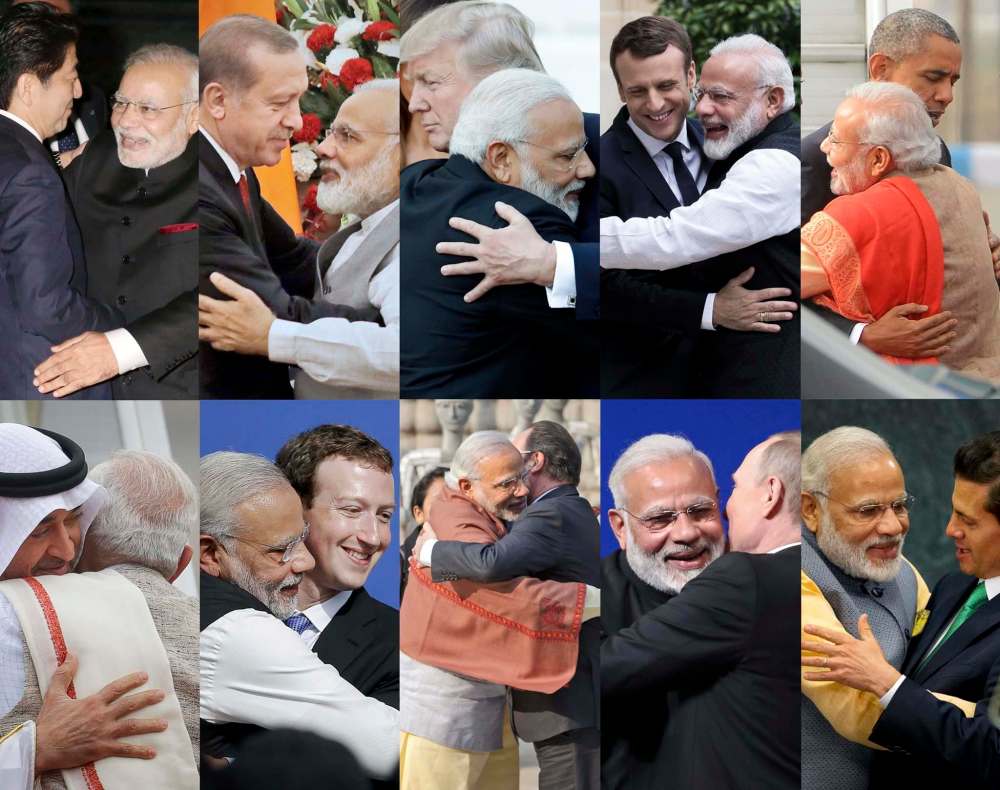
The Queen was moved to give Michelle Obama a little side hug back in 2009, setting English tongues wagging because it was a clear break from Her Majesty’s strict no-touching protocol. And when Indian Prime Minister Narendra Modi enveloped U.S. President Donald Trump in a bro hug last year, it might not have made such a stir if the embrace hadn’t cut short Trump’s usual protracted and strangely vigorous handshake with foreign leaders.
As for former U.S. president George W. Bush, he hugs, well, everyone.
For some, the hug has taken on divine meaning. An Indian saint known as Amma travels the world hugging followers who have been known to line up for hours just for a life-affirming cuddle. After the 2016 U.S. presidential election, a Massachusetts man started “Hug It Out America,” a one-man effort to connect with strangers.
After the 9/11 attacks, Brainard and Delia Carey, a.k.a. the performance art duo Praxis, opened their arms to legions of New Yorkers, offering free hugs in an East Village storefront.
“It was the comfort people needed,” says Brainard Carey, adding that the emotional resonance of their project led them to hugging performances at major arts institutions. “It sounds like we’re doing this enormously altruistic thing — giving hugs to everyone. But you have to remember, we’re also receiving hugs from everybody. After a day of doing that, you get kind of high.”
Science affirms the idea that hugs may be good not only for the soul, but also for our physical well-being.
“There are data showing that hugging provides a buffer to stress,” says Srini Pillay, a Harvard psychiatrist who studies brain science. “People will often recommend hugging as a form of social bonding that calms down the fight-or-flight system.” A good, solid hug releases oxytocin, may improve the immune system and lowers blood pressure.
“But when the hug is awkward,” Pillay warns, “I can’t imagine that what is actually happening is that the person is becoming calmer.”
Perhaps what they feel is a little more like the three women who have accused California state Sen. Bob Hertzberg — known, unfortunately, as “Huggy Bear” — of forcefully embracing them, then hanging in there a little too long.
“It was like dirty dancing,” one said. “It was gross.”
Culturally, Post says, we know that the hug is iffy territory. “A hug can feel too intimate to some people, especially now, in an era when we’re illuminating how women feel on a daily basis.”
So maybe it’s time to embrace something new as our preferred greeting. Or something old.
As Post notes, no one frets this much over a handshake.
— Washington Post