

Not the cow, but the how: vegetarian defends beef sector
Advertisement
Read this article for free:
or
Already have an account? Log in here »
To continue reading, please subscribe:

Digital Subscription
One year of digital access for only $205*
- Enjoy unlimited reading on winnipegfreepress.com
- Read the E-Edition, our digital replica newspaper
- Access News Break, our award-winning app
- Play interactive puzzles
*First annual payment billed as $205.00 + GST for one year. This annual subscription will automatically renew at $233.00 + GST every 52 weeks (10% off the regular annual price of $259.35). Offer available to new and qualified returning subscribers only. Cancel any time.
To continue reading, please subscribe:
Add Free Press access to your Brandon Sun subscription for only an additional
$1 for the first 4 weeks*
- Enjoy unlimited reading on winnipegfreepress.com
- Read the E-Edition, our digital replica newspaper
- Access News Break, our award-winning app
- Play interactive puzzles
*Your next Brandon Sun subscription payment will increase by $1.00 and you will be charged $17.95 plus GST for four weeks. After four weeks, your payment will increase to $24.95 plus GST every four weeks.
Read unlimited articles for free today:
or
Already have an account? Log in here »
Hey there, time traveller!
This article was published 03/03/2018 (3129 days ago), so information in it may no longer be current.
You don’t have to look too far on Google to find a strong narrative that says eating beef is bad — bad for your health, bad for the environment and bad, of course, for the animals.
Couple that with the rise in alternative proteins from the likes of plants, insects and petri dishes, and it’s fair to say the meat industry is on the defensive.
But beef producers have been getting some help lately from the most unusual of sources, an environmental lawyer who is also a vegetarian.
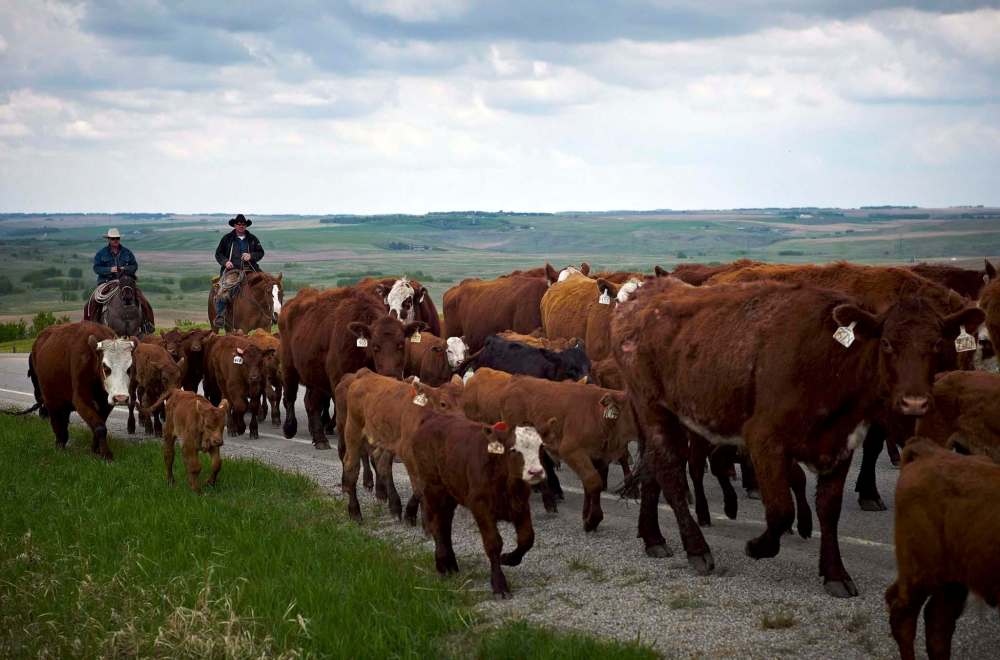
You could argue that California author Nicolette Hahn Niman, a 50-something environmentalist, lawyer, non-meat-eater and mother of two who happens to be married to a beef rancher, embodies the whole debate around beef in one package.
When Hahn Niman considers all the angles on the beef debate, she comes to this conclusion:
“It’s not the cow, it’s the how,” says the author of Defending Beef: The Case For Sustainable Meat Production published in 2014, and an earlier publication called The Righteous Porkchop.
In other words, she finds it ludicrous to say that animals on the landscape are harmful, because they were an essential part of the ecosystem for a long time before humans came along.
“When you look at the big picture and the Earth’s history and how it evolved, there were lots of large animals on the Earth for millions of years and only in recent history are they absent,” she said.
“Well-managed cattle plays a vital role in the ecosystems.”
The keywords here are “well-managed” and “on the landscape”, fulfilling that natural ecosystem function, rather than in confined feeding facilities that rob them of that traditional role. On that front, there’s a lot of work that needs to be done to make animal industry more animal-welfare friendly and more ecologically sound, she said. Too many cows in one spot, for example, can harm soil and water quality, just as too many burgers aren’t good for one’s health.
However, there are better ways and there are producers and researchers showing us how, she said.
Meat contains nutrients that are hard to replace in a plant-based protein diet. As well, about 1.3 billion of the world’s poorest people depend on livestock for their survival. To them, meat isn’t a luxury.
She warns against allowing debates such as the one over beef to be digested down into vastly oversimplified ideas.
“In nature, everything is connected, nothing is linear,” Hahn Niman told a recent conference in Red Deer. “Only human-created machines are linear.
“You can’t take cattle and talk about them like a human-created machine,” she said, referring to recent headlines that say cows produce more harmful greenhouse gases than cars.
Vehicles consume non-renewable fuel on one end and pump out exhaust on the other.
Cattle, on the other hand, convert renewable energy into protein, all the while contributing to the nutrient cycle, water cycle and soil food web.
“If you graze badly, you degrade the soils; if you graze well, you improve the soils,” she said. Manure contributes to the biological activity in soil, which builds natural fertility. She noted there is emerging research that shows the populations of soil bacteria in areas grazed by cattle have higher numbers of methane-eating bacteria.
“There’s more and more evidence that quite a bit of the methane that cattle emit is actually consumed by the healthy soils because of these methane-eating bacteria that inhabit them,” she said.
Removing cattle from the landscape equates to a loss of grasslands, which reduces wildlife and bird habitat, and a decline in soil health once it loses its permanent cover.

But because it’s complex, all of this is tough to talk about — especially with people unfamiliar with agriculture.
Hahn Niman said she’s learned to start from the ground up, focusing on the role livestock plays in building healthy soils.
“It’s all about the soil and it’s all about the health of that soil and especially the biology of the soil,” she said.
“Because to me, that’s that common ground”
Laura Rance is editorial director at Glacier FarmMedia. She can be reached at 204-792-4382 or laura@fbcpublishing.com
History
Updated on Saturday, March 3, 2018 10:16 AM CST: Photo added.