

Brier’s new format goes over cold
Curling championship changes miss the button with players
Advertisement
Read this article for free:
or
Already have an account? Log in here »
To continue reading, please subscribe:

Digital Subscription
One year of digital access for only $205*
- Enjoy unlimited reading on winnipegfreepress.com
- Read the E-Edition, our digital replica newspaper
- Access News Break, our award-winning app
- Play interactive puzzles
*First annual payment billed as $205.00 + GST for one year. This annual subscription will automatically renew at $233.00 + GST every 52 weeks (10% off the regular annual price of $259.35). Offer available to new and qualified returning subscribers only. Cancel any time.
To continue reading, please subscribe:
Add Free Press access to your Brandon Sun subscription for only an additional
$1 for the first 4 weeks*
- Enjoy unlimited reading on winnipegfreepress.com
- Read the E-Edition, our digital replica newspaper
- Access News Break, our award-winning app
- Play interactive puzzles
*Your next Brandon Sun subscription payment will increase by $1.00 and you will be charged $17.95 plus GST for four weeks. After four weeks, your payment will increase to $24.95 plus GST every four weeks.
Read unlimited articles for free today:
or
Already have an account? Log in here »
Hey there, time traveller!
This article was published 07/03/2018 (3107 days ago), so information in it may no longer be current.
REGINA — Rarely does Brad Gushue dither over a shot call, so a blunt take from the straight-shooting defending Brier champ should not be unexpected.
The bullet fired Wednesday morning was aimed at the new format being used at this year’s national men’s curling championship.
“The more I play it, the more I hate it, to be honest,” the Team Canada skip said.
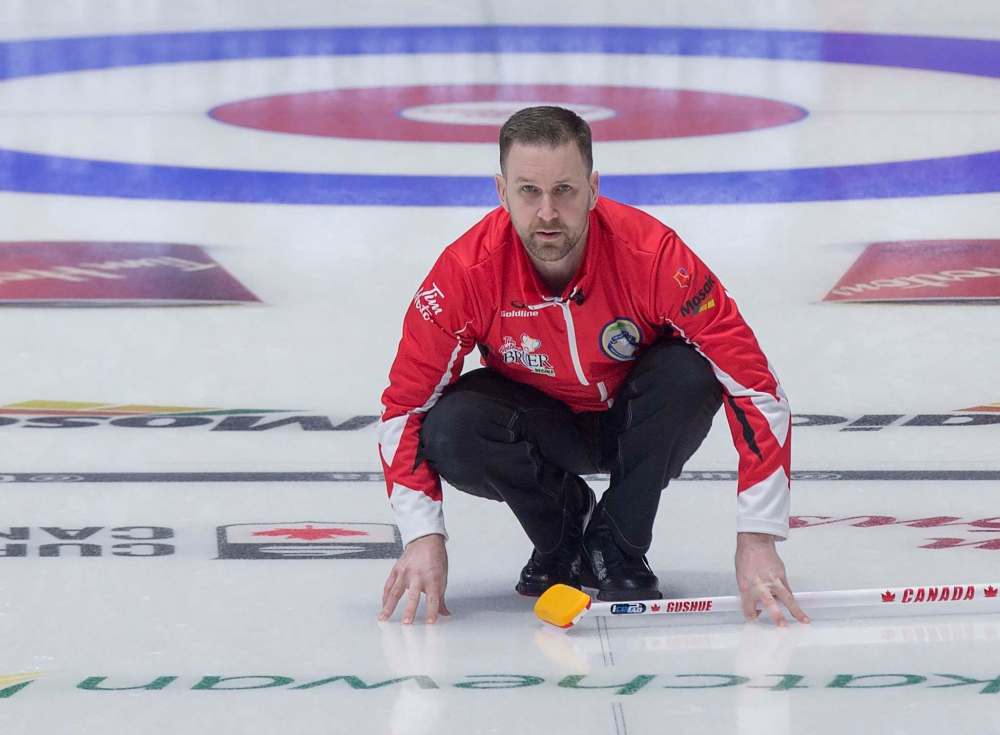
“I don’t like it all. It’s a terrible format and I’m not going to mince words. I’ve said it right from the get-go, coming in here. Just as a fan, watching the Scotties, I thought it was terrible and playing in it is just as bad.”
Gushue is playing in his 15th Brier, more than any other curler here this week — and that amounts to 73 curlers, if you toss in alternates.
He has the most victories (116 as of Wednesday afternoon) in the championship’s history and that number swells with each win he generates this week at Brandt Centre.
The resident of St. John’s, N.L., has an Olympic gold medal, a prized possession captured at the Torino Winter Games in 2006.
Suffice it to say, Gushue’s got some hefty credentials. So his opinion on the new 16-team format, split in half, with teams playing a round robin within their pools, carries weight.
Gushue doesn’t get the rationale for creating the great divide.
“We’re all talking in the locker rooms, how it’s two completely different events. We haven’t seen (Reid) Carruthers or (Brad) Jacobs all week. You have no idea how they’re playing or performing. And now, all of a sudden, we join against each other (today),” he said.
“There’s a better solution than this.”
This year’s Brier format, taken out for an inaugural spin earlier this winter at the Scotties in Penticton, B.C., features four additional teams (up from 12), including all three territories and Team Wild Card — Mike McEwen’s Winnipeg crew won the right to that title this past Friday.
The Regina Brier’s at a critical junction, as the best eight teams (four each from pools A and B) move on to challenge for the national crown, while the bottom eight will get a game on Friday to determine their finishes from ninth to 16.
Four teams will emerge from the championship pool and play in a Page playoff format.
Gushue doesn’t like the wild-card idea and is completely against the notion of bringing back the returning champion — ironic, considering he’s wearing the red-and-whites this week.
He would prefer Curling Canada return to a more time-honoured configuration of running Canada’s greatest men’s bonspiel.
“I’d love to see it go back to the old format. And if you want to get all the territories in, well, let’s put them in and have 13 teams. I’m not a fan of Team Canada and I’m not a fan of wild card. It’s a Canadian championship. Let’s have the provinces and territories play off. We can easily have 13, it’s one extra draw,” he said.
Major alterations were made to rid the two major events of relegation play, where four teams from traditionally weaker provinces had to slog through a mini round robin over the course of 36 hours, with the survivor playing in the main draw and a trio of teams barred from further play.
McEwen, playing in his third straight Brier, has also been mildly critical of the format, even though his Fort Rouge team was the prime beneficiary of one of the major changes — adding that 16th team.
He sounded like someone who believes representation from all regions amounts to too many teams here.
“This is going to sound bad, but it kind of feels like we almost have a bit of a relegation in the first half of the Brier. Think about it, we’re going to a championship pool,” he said.
“But there’s nothing wrong with relegation, even the way it was before. There’s nothing wrong with that idea.
“(Curling) is trying to have that balance of Canadiana and really high-level curling, we’re trying to balance those things. People want to see the best curling in the world and, if we just go 100 per cent Canadiana, we’re actually not going to get the best curling in the world.”
Al Cameron, communications and media relations director for Curling Canada, said the addition of the wild-card team has accomplished the intended goal: to kick off the Brier with an intense game and, ultimately, the inclusion of another highly competitive team.
He said preserving the national feel of the Brier remains the top priority.
“That was certainly the desire of the member associations when they told us they wanted all 14 member associations directly in, so we listen and make it work as best we can,” Cameron said.
With an expanded field, a divided field is the logical solution, he said.
“A 16-team round robin? Even a 14-team round robin, if you eliminated Team Canada and the wild card, that’s an extra day and that’s a lot to ask. Even now, you get players who say it’s already too long, so that’s a big ask.”
Cameron said Regina is putting on a tremendous show.
“The event’s been great, it’s a great facility, everything under one roof, and Saskatchewan fans are stepping up,” he said.
Veteran skip James Grattan has competed in an even dozen Briers since 1997.

While he’s not a cinch to emerge from the New Brunswick playdowns, his participation is a pretty common occurrence.
He said he prefers the new format, which allows eligible teams from all corners of the country to participate in the full draw.
“I thought relegation was one of the biggest embarrassments we’ve brought into our sport and it took away from the Brier. It was almost an embarrassment to still call it the Brier when it was going on like that,” he said.
“It was condescending, just the way teams were treated when they were here — like they were an afterthought.”
jason.bell@freepress.mb.ca Twitter: @WFPJasonBell
Related Articles
Manitoba Curling Hall of Fame announces Class of 2018 inductees






Advertisement Advertise With Us
Advertisement Advertise With Us
History
Updated on Thursday, March 8, 2018 7:17 AM CST: Edited