

Rolls gets extreme-cold workout
Newest generation of British engines undergoes testing in Manitoba
Advertisement
Read this article for free:
or
Already have an account? Log in here »
To continue reading, please subscribe:
Digital Subscription
One year of digital access for only $1.44 a week*
- Enjoy unlimited reading on winnipegfreepress.com
- Read the E-Edition, our digital replica newspaper
- Access News Break, our award-winning app
- Play interactive puzzles
*Billed as $5.77 plus GST every four weeks. After 52 weeks, price increases to the regular rate of $19.95 plus GST every four weeks. Offer available to new and qualified returning subscribers only. Cancel any time.
To continue reading, please subscribe:
Add Free Press access to your Brandon Sun subscription for only an additional
$1 for the first 4 weeks*
- Enjoy unlimited reading on winnipegfreepress.com
- Read the E-Edition, our digital replica newspaper
- Access News Break, our award-winning app
- Play interactive puzzles
*Your next Brandon Sun subscription payment will increase by $1.00 and you will be charged $17.95 plus GST for four weeks. After four weeks, your payment will increase to $24.95 plus GST every four weeks.
Read unlimited articles for free today:
or
Already have an account? Log in here »
Hey there, time traveller!
This article was published 27/03/2018 (3010 days ago), so information in it may no longer be current.
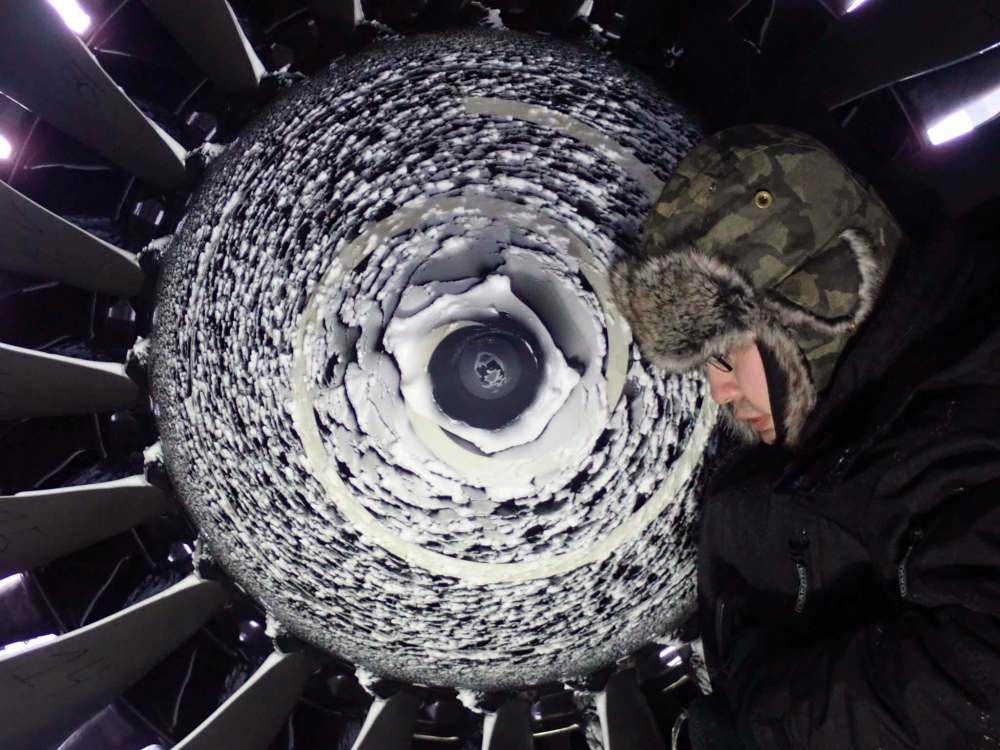
The next generation of Rolls-Royce jet engines have been getting their first taste of extreme cold temperatures and icy conditions in Manitoba this winter.
The so-called Advanced Low Emissions Combustion System that Rolls Royce is developing for its new aircraft engines has been undergoing icing tests in minus-20 C at Thompson’s Global Aerospace Centre for Icing and Environmental Research (GLACIER), a limited partnership between Rolls-Royce and Pratt & Whitney.
The demonstrator engine that was in Thompson features a new lean-burn and low-emissions combustion system for future jet-engine programs. The ultimate goal is the development of engines that are more powerful, more fuel efficient and quieter.
“That is the holy trinity of what we are after,” said Oliver Walker-Jones, Rolls-Royce’s U.K.-based head of communications who was in the U.S. this week to celebrate the delivery of Singapore Airlines’ first Boeing 787-10 Dreamliner, powered by Trent 1000 Rolls-Royce engines.
Walker-Jones said the new UltraFan engines Rolls-Royce is developing are planned to be ready for market in 2025.
Rolls-Royce has been on a record pace of introducing new engines with a series of current generation engines that are just entering service now, including variants of existing engines. The UltraFan engines are the next generation.
“What we have been testing in Thompson is one of the first bits of that engine,” Walker-Jones said. “We test them bit by bit — a new fan at the front or a compressor in the middle — then bit by bit we put it all together. It takes a long time to prove it out.”
David Simpson, the head of an organization called EnviroTrec, a non-profit organization that is partnered with GLACIER to help develop qualified personnel and stimulate the development of technology programs which are required to support the operation of the facility in Thompson, said the six year-old, $50-million test facility is working as designed.
“It has been even busier than originally planned,” Simpson said. “These tests are fundamental to the development of these new engines.”
Simpson said the partnership between Rolls-Royce and Pratt &Whitney, in an industry with valuable proprietary technologies that is famously secretive, has been working very well.

He said there was a recent scenario where one of the companies had to get an engine back on the test stand to repeat a previous test after the other company had already commenced its own testing as per a schedule. Simpson said the one company co-operated completely to let the other company finish what it had to do.
‘It has been even busier than originally planned. These tests are fundamental to the development of these new engines’– David Simpson
GLACIER is operated by a Manitoba company called MDS Aero Test that has a permanent staff in Thompson of about 15 people. Both Rolls-Royce and Pratt & Whitney bring staffs of between two and 10 people to Thompson with their engines and are there for weeks at a time.
In addition to GLACIER in Thompson, GE Aircraft’s Engine Testing, Research and Development Centre at the Richardson International Airport in Winnipeg does cold weather and engine icing tests for GE engines.
While the equipment manufacturers keep their proprietary information close to the vest, Simpson said EnviroTrec and a similar organization attached to the GE facility work closely with each other developing third-party programs and university research projects.
martin.cash@freepress.mb.ca
History
Updated on Tuesday, March 27, 2018 9:38 AM CDT: Corrects subheadline