

Commitments from apology not met: chiefs
Cite lack of action from government
Advertisement
Read this article for free:
or
Already have an account? Log in here »
To continue reading, please subscribe:
Monthly Digital Subscription
$0 for the first 4 weeks*
- Enjoy unlimited reading on winnipegfreepress.com
- Read the E-Edition, our digital replica newspaper
- Access News Break, our award-winning app
- Play interactive puzzles
*No charge for 4 weeks then price increases to the regular rate of $19.95 plus GST every four weeks. Offer available to new and qualified returning subscribers only. Cancel any time.
Monthly Digital Subscription
$4.99/week*
- Enjoy unlimited reading on winnipegfreepress.com
- Read the E-Edition, our digital replica newspaper
- Access News Break, our award-winning app
- Play interactive puzzles
*Billed as $19.95 plus GST every four weeks. Cancel any time.
To continue reading, please subscribe:
Add Free Press access to your Brandon Sun subscription for only an additional
$1 for the first 4 weeks*
*Your next subscription payment will increase by $1.00 and you will be charged $16.99 plus GST for four weeks. After four weeks, your payment will increase to $23.99 plus GST every four weeks.
Read unlimited articles for free today:
or
Already have an account? Log in here »
Hey there, time traveller!
This article was published 12/06/2009 (6049 days ago), so information in it may no longer be current.
OTTAWA — A year after Canada formally apologized for the tragic policy of residential schools, aboriginal leaders called on the government to do more to live up to the commitments made in the apology.
"We have heard and accepted gracious apologies from the churches and government," said Assembly of First Nations National Chief Phil Fontaine. "Now, it is time for action."
First Nations people danced and celebrated on Parliament Hill, and across the country Thursday, a Day of Reconciliation that coincided with the first anniversary of the apology.
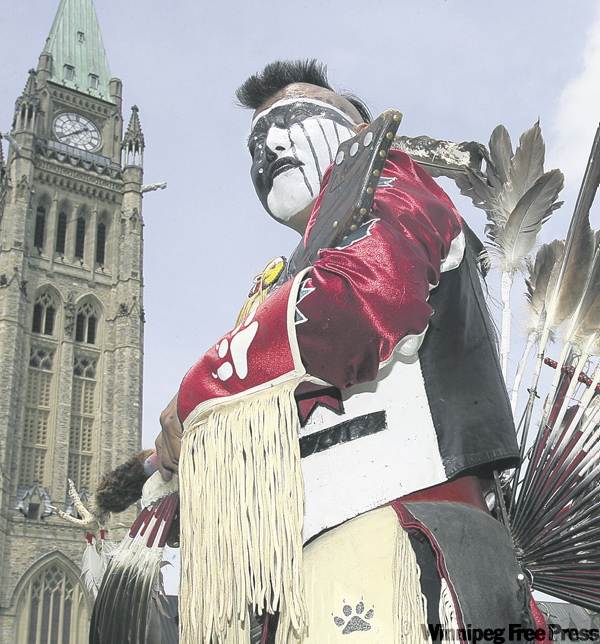
Fontaine said it was a day to celebrate the apology again, which he called a "watershed moment" for Canada. But he and other residential school survivors also lamented the lack of progress in the year since.
Much of the expected action was halted last fall when the chair of the Truth and Reconciliation Commission suddenly resigned in an unresolvable dispute with the other two commissioners, who resigned a few months later.
They were all replaced this week, with Manitoba Justice Murray Sinclair selected as the new chair by Indian Affairs Minister Chuck Strahl.
Strahl, who walked beside Fontaine in a procession of about 1,000 people through downtown Ottawa, said he was personally disappointed by the delays.
"I am delighted that we have been able to rekindle that process with a new chairperson and commissioners," he said in a statement. "I know there is an urgency to capture the statements of the survivors, and we are fully committed to the successful implementation of the TRC."
Assembly of Manitoba Chiefs Grand Chief Ron Evans said more needs to be done to restore aboriginal languages, traditions, culture and spirituality.
"The very things that were meant to be destroyed, more needs to be done to begin to restore those things that make who we are as a people," Evans said at an event in Winnipeg to mark Ottawa’s apology. "There’s a lot of work that needs to be to be done to begin the work of restoration."
Evans also said issues still persist around compensation for residential school survivors with many still not being paid.
Raymond Mason, chair of Spirit Wind, the Manitoba residential school survivors’ society, said so far there has been very little impact since the apology.
"I haven’t noticed anything," said Mason, who was a student in three different residential schools over 12 years, starting when he was six years old. "There has been be no action on anything."
Mason is particularly critical of the slow process of getting compensation to survivors who were abused during their years in residential school. He said he was interviewed last July but still hasn’t heard if his claim was accepted.
But Mason, like many others, is hopeful Sinclair’s appointment to the Truth and Reconciliation Commission will light a fire under everything.
Fontaine said ending First Nations poverty should be Canada’s new dream.

"The children, grandchildren, and great-grandchildren of the survivors are still suffering," he said.
Fontaine said some great improvements have been seen, including a tripling of the number of aboriginal students in university and college programs but that the 30,000 students enrolled is still 60,000 less than there should be.
"Can you imagine what 90,000 (students would do)," he asked.
"It would be an enormous benefit for Canada."
mia.rabson@freepress.mb.ca bruce.owen@freepress.mb.ca