Reconciliation and reality

Brief treatise on Indian Act makes our difficult history accessible

Advertisement

Advertise with us

Scan the online comments section of any major media outlet following an article about Indigenous issues and you will inevitably encounter some variation of “Why don’t they just get over it?”

Read this article for free:

or

Already have an account? Log in here »

To continue reading, please subscribe:

Subscribe and receive a limited-edition Free Press branded hat or tote.

Digital Subscription

One year of digital access for only $205*

  • Enjoy unlimited reading on winnipegfreepress.com
  • Read the E-Edition, our digital replica newspaper
  • Access News Break, our award-winning app
  • Play interactive puzzles

*First annual payment billed as $205.00 + GST for one year. This annual subscription will automatically renew at $233.00 + GST every 52 weeks (10% off the regular annual price of $259.35). Offer available to new and qualified returning subscribers only. Cancel any time.

To continue reading, please subscribe:

Add Free Press access to your Brandon Sun subscription for only an additional

$1 for the first 4 weeks*

  • Enjoy unlimited reading on winnipegfreepress.com
  • Read the E-Edition, our digital replica newspaper
  • Access News Break, our award-winning app
  • Play interactive puzzles
Start now

*Your next Brandon Sun subscription payment will increase by $1.00 and you will be charged $17.95 plus GST for four weeks. After four weeks, your payment will increase to $24.95 plus GST every four weeks.

Hey there, time traveller!
This article was published 14/04/2018 (3035 days ago), so information in it may no longer be current.

Scan the online comments section of any major media outlet following an article about Indigenous issues and you will inevitably encounter some variation of “Why don’t they just get over it?”

Bob Joseph has the definitive response to that racially charged rhetorical question — and, more importantly, to the ignorance behind it — that the Indian Act has made “getting over” colonialism impossible.

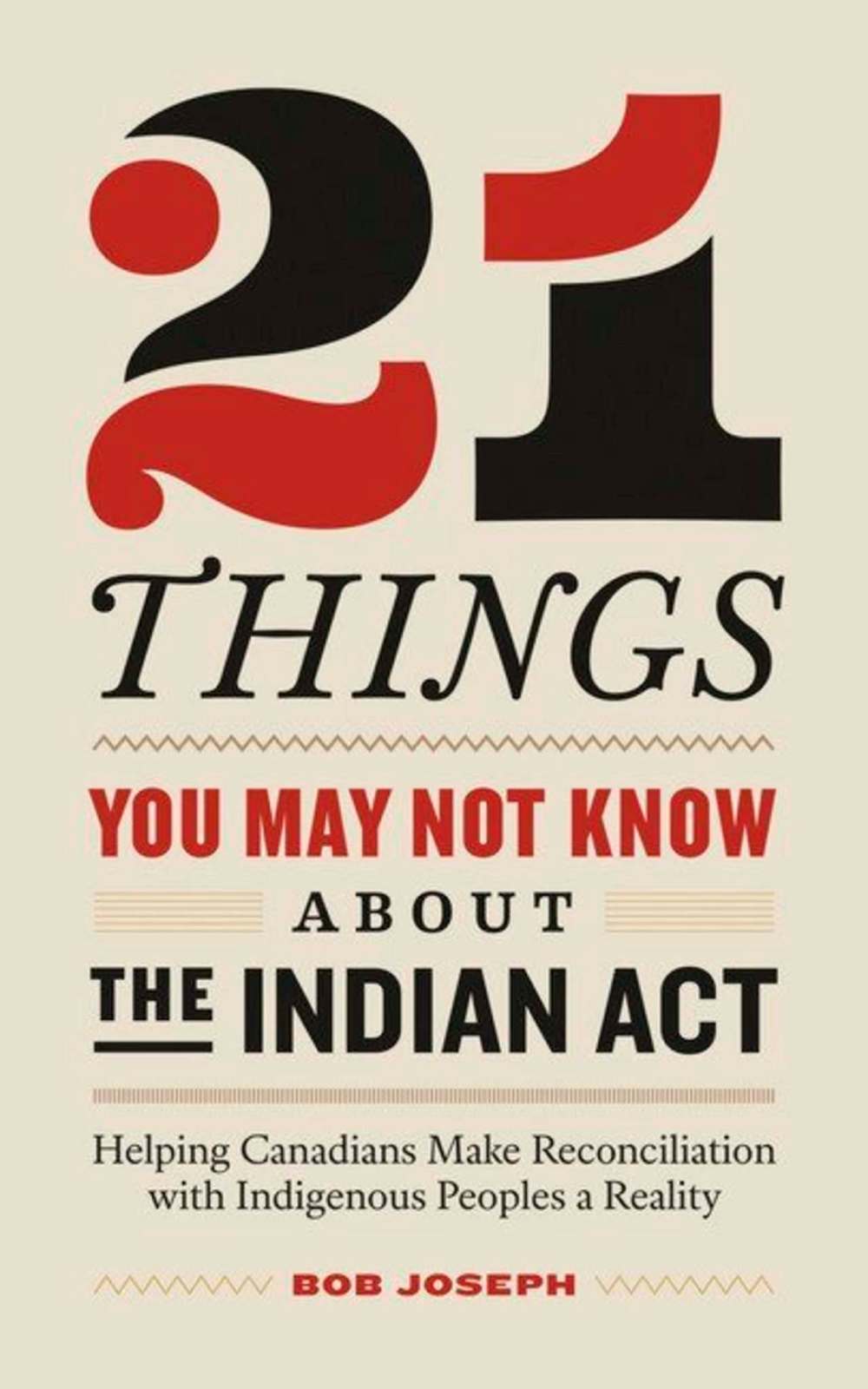
In his slim but powerful new book 21 Things You May Not Know About the Indian Act, Joseph documents the harsh discrimination, controls, humiliations, political dysfunctions and “catch-22s” successive Canadian governments have imposed on Indigenous peoples for the purpose of subjugating and assimilating them.

Supplied photo
Bob Joseph illustrates ways the Indian Act has affected generations of Indigenous people.
Supplied photo Bob Joseph illustrates ways the Indian Act has affected generations of Indigenous people.

Joseph is a member of the Gwawaenuk Nation in the Queen Charlotte Strait region of British Columbia. A certified trainer, Joseph is the CEO and president of Indigenous Corporate Training Inc., which he founded in 2002. His father is Chief Dr. Robert Joseph, who is the Hereditary Chief of the Gwawaenuk First Nation and member of the National Assembly of First Nations Elders Council.

Yet like his father and many others in the Gwawaenuk Nation, “Bob Joseph” owes his legal name to the assimilationist requirements of the Act and an unknown Indian agent who travelled through Joseph’s ancestral region decades ago, imposing Christian names on the band and thereby erasing their traditional hereditary and clan names.

Joseph shows how this was just one of the many ways the Indian Act controlled and harmed the lives of generations of Indigenous people. Since its passage in 1876, the act (with its various amendments) was responsible for creating the reserve system and residential schools, stripping women of their Indian status if they married a non-status man and denying Indigenous people the vote — or granting them the vote at the cost of their status.

The Indian Act imposed European-style farming practices on reserves, but made it impossible for bands to sell their produce to non-Indian customers. Even if these sales had been permitted, it would have required leaving the reserve by obtaining written permission of the Indian agent, which was rarely granted.

Joseph makes this difficult history quite accessible, methodically describing these and other human rights violations in a highly readable prose over a brief 160 pages. Following the main text is a glossary of terms, a chronology of the history of residential schools and the text of the 94 Calls to Action of the Truth and Reconciliation Commission. The book also includes discussion questions and suggested further reading, making it ideal for book club or classroom use.

WAYNE GLOWACKI/WINNIPEG FREE PRESS files
In this 2008 photo, Ron Evans, then-Grand Chief of the Assembly of Manitoba Chiefs, listens to the apology from prime minister Stephen Harper on behalf of the Canadian government for the residential schools program.
WAYNE GLOWACKI/WINNIPEG FREE PRESS files In this 2008 photo, Ron Evans, then-Grand Chief of the Assembly of Manitoba Chiefs, listens to the apology from prime minister Stephen Harper on behalf of the Canadian government for the residential schools program.

In the book’s closing pages, Joseph offers a selection of damning quotes from former prime minister Sir John A. MacDonald and Duncan Campbell Scott (who oversaw the cruelties of the residential school system between 1913 and 1932 and made attendance compulsory), including the latter’s fervent wish that “Indians… finally disappear as a separate and distinct people” through their assimilation.

The book’s final chapter sets out what Canada must do next: dismantle the act and instead work with Indigenous people on forms of self-government and self-determination, allowing First Nations to generate their own revenues through development royalties and taxes and thereby become self-reliant.

We may not as Canadians ever be able to “get over” our colonial past — nor should we — but in the future, Joseph prescribes, Indigenous and non-Indigenous Canadians will be able to transcend it and build true nation-to-nations relationships in the spirit of reconciliation.

Michael Dudley is the librarian for Indigenous Studies at the University of Winnipeg.
Report Error Submit a Tip

More Stories

Crews respond to fire at former restaurant on Main Street

1 minute read Updated: Yesterday at 4:31 PM CDT

For the second time in less than a year, fire broke out in a former restaurant on Main Street.

Winnipeg Fire Paramedic Service crews responded to reports of fire at Boujee Restaurant and Bar, a vacant, single-storey building on the 100 block of Main Street at 5:38 p.m. Sunday. The same building was previously damaged in an October 2025 fire.

Heavy smoke was coming from the building when firefighters arrived on scene. Crews declared the fire under control at 9:40 p.m. No one was found inside the building and no injuries were reported.

The fire is under investigation. No damage estimates were available, but the Winnipeg Fire Paramedic Service stated in a news release Sunday the building sustained significant damage from smoke, fire and water.

18-year-old woman shot by Winnipeg police officer

1 minute read Updated: Yesterday at 12:28 PM CDT

A police officer shot and injured an 18-year-old woman early Monday morning while investigating a College Avenue shooting.

A north district unit officer was in the area of Aikins Street and College Avenue at 2:27 a.m. Aug. 3 when he heard multiple gunshots nearby, the Winnipeg Police Service stated in a news release Monday.

The officer went to investigate and "was confronted by a woman and a 16-year-old youth." The officer discharged his gun and the young woman was injured, the police service stated. The woman was taken to hospital in unstable condition and was later upgraded to stable.

Police recovered a gun from the suspects and investigators later linked the 18-year-old woman and 16-year-old male to a shooting that occurred outside of a home in the 300 block of College Avenue. The 16-year-old was arrested.

Canadian centre adds size to Sea Bears playoff push

Joshua Frey-Sam 4 minute read Preview

Canadian centre adds size to Sea Bears playoff push

Joshua Frey-Sam 4 minute read 6:33 PM CDT

The Winnipeg Sea Bears have added some size ahead of the playoffs.

The club announced the signing of 6-10 Canadian centre Ben Stevens on Tuesday. Stevens was released by the Montreal Alliance on July 30 and scooped up by the Sea Bears ahead of the Aug. 3 transaction deadline.

The 27-year-old from Halifax appeared in 10 games for the Alliance this summer, where he played a limited role off the bench, averaging 1.9 points and two rebounds per game in 7.5 minutes per game. Stevens had a more elevated role with Montreal in 2025, where he appeared in 20 contests, started five, and averaged 5.4 points and 3.8 rebounds in 13.2 minutes of action per game.

Stevens, at worst, adds some height and physicality off the bench that has been lacking for the Sea Bears this season. The club has struggled with rebounds for many stretches and appeared outmatched by teams with larger personnel.

Read
6:33 PM CDT

Toronto’s alternative crisis response model deemed a success

Scott Billeck 4 minute read Preview

Toronto’s alternative crisis response model deemed a success

Scott Billeck 4 minute read 2:01 AM CDT

A Toronto emergency response program that helped inspire Winnipeg’s proposed alternative crisis response model has already expanded city-wide, just four years after launching as a pilot project.

The Toronto Community Crisis Service, launched in 2022, has become the city’s fourth emergency service, providing a 24-7, community-based response to people experiencing mental health crises. The service has handled nearly 50,000 calls through 911 and 211, dispatched mobile crisis teams to more than 41,000 incidents, made more than 11,600 referrals to health and social services and resolved the majority of eligible 911 calls without police involvement.

Winnipeg Mayor Scott Gillingham last week proposed creating a similar “fourth crisis response pathway” that would allow 911 calls that aren’t violent or criminal in nature to be transferred to community-based crisis teams.

Under the proposal, which has support from both the Winnipeg Police Service and the Winnipeg Fire Paramedic Service, a centralized crisis dispatch and co-ordination hub would receive triaged calls and match them with citywide response teams, staffed in part through existing community organizations, including the Downtown Community Safety Partnership and The Link’s mobile crisis teams. The goal is to divert appropriate calls away from the WPS and WFPS.

Read
2:01 AM CDT

Bell sheds 19 more Manitoba employees

Gabrielle Piché 3 minute read Preview

Bell sheds 19 more Manitoba employees

Gabrielle Piché 3 minute read 6:30 PM CDT

At least 19 Manitoba jobs were lost recently during Bell Canada’s ongoing restructuring.

Parent company BCE Inc. confirmed in June it’d axe nearly 700 jobs through organizational changes. Those changes began last year.

A dozen Manitoba staff were laid off on July 30, according to Team-IFPTE Local 161, the union representing the workers.

Another seven union members left voluntarily though a departure program, the union reported Tuesday.

Read
6:30 PM CDT

Concordia doctor denies responsibility for Calgary man’s permanent disability

Erik Pindera 4 minute read Preview

Concordia doctor denies responsibility for Calgary man’s permanent disability

Erik Pindera 4 minute read 3:52 PM CDT

A Concordia Hospital doctor accused in a negligence lawsuit after a Calgary man was left permanently disabled when he was given a massive overdose of a powerful sedative has denied she ordered he be given the drug.

Zachary Hoogerdyk’s father, Edward Hoogerdyk, and the Alberta government filed their statement of claim earlier this year in Court of King’s Bench naming the Winnipeg Regional Health Authority, provincial health agency Shared Health, Concordia Hospital, Dr. Anna Ziomek and two other hospital staff as defendants.

Hoogerdyk, who was 23 at the time, went to Concordia’s urgent-care centre with flu-like symptoms and worsening breathing difficulties on March 25, 2024 while he was in Winnipeg on business and to visit family, the lawsuit says.

The claim alleges Ziomek diagnosed Hoogerdyk with low levels of oxygen in his blood and a strain of the flu, before ordering him to be intubated.

Read
3:52 PM CDT