

Manitobans divided on whether justice system is fair to Indigenous people: poll

Advertisement
Read this article for free:
or
Already have an account? Log in here »
To continue reading, please subscribe:
Monthly Digital Subscription
$1 per week for 24 weeks*
- Enjoy unlimited reading on winnipegfreepress.com
- Read the E-Edition, our digital replica newspaper
- Access News Break, our award-winning app
- Play interactive puzzles
*Billed as $4.00 plus GST every four weeks. After 24 weeks, price increases to the regular rate of $19.95 plus GST every four weeks. Offer available to new and qualified returning subscribers only. Cancel any time.
Monthly Digital Subscription
$4.99/week*
- Enjoy unlimited reading on winnipegfreepress.com
- Read the E-Edition, our digital replica newspaper
- Access News Break, our award-winning app
- Play interactive puzzles
*Billed as $19.95 plus GST every four weeks. Cancel any time.
To continue reading, please subscribe:
Add Free Press access to your Brandon Sun subscription for only an additional
$1 for the first 4 weeks*
*Your next subscription payment will increase by $1.00 and you will be charged $16.99 plus GST for four weeks. After four weeks, your payment will increase to $23.99 plus GST every four weeks.
Read unlimited articles for free today:
or
Already have an account? Log in here »
Hey there, time traveller!
This article was published 16/04/2018 (2931 days ago), so information in it may no longer be current.
In the wake of two recent high-profile murder trials involving young Indigenous victims, Manitobans are split on whether Canada’s justice system is fair to Indigenous Peoples. A slim majority — 56 per cent — believe it is. Indigenous Peoples, those who have low incomes and women are more likely to believe it isn’t fair, a Winnipeg Free Press/Probe Research poll has found.
Surveyed last month, after the Colten Boushie and Tina Fontaine cases resulted in acquittals for Gerald Stanley in Saskatchewan and Raymond Cormier in Winnipeg, 44 per cent of respondents said the justice system treats Indigenous Peoples unfairly.
!function(e,t,n,s){var i=”InfogramEmbeds”,o=e.getElementsByTagName(t)[0],d=/^http:/.test(e.location)?”http:”:”https:”;if(/^/{2}/.test(s)&&(s=d+s),window[i]&&window[i].initialized)window[i].process&&window[i].process();else if(!e.getElementById(n)){var a=e.createElement(t);a.async=1,a.id=n,a.src=s,o.parentNode.insertBefore(a,o)}}(document,”script”,”infogram-async”,”https://e.infogram.com/js/dist/embed-loader-min.js”);
Responses showed an urban-rural divide as well as political differences: Winnipeggers were more likely than rural residents to view the justice system as unfair. Progressive Conservative party supporters were more than twice as likely as NDP supporters to say it is fair for Indigenous Peoples.
A sample of 1,000 Manitobans, including 92 who self-identified as Indigenous, participated in the survey. It’s considered to be an accurate reflection of the adult population in Manitoba, plus or minus 3.1 percentage points, 95 per cent of the time.
Forty-seven per cent of Indigenous respondents said they believed the justice system is generally fair, while 58 per cent of non-Indigenous respondents said the same.
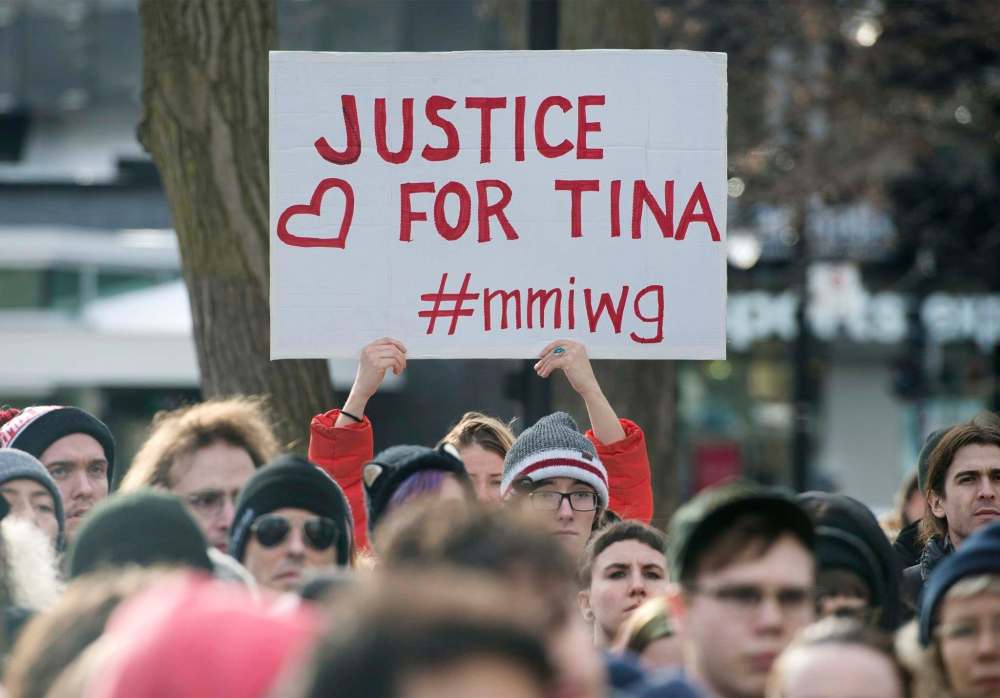
In the Prairies and in cities across Canada, people marched in the streets to show support for 22-year-old Boushie and 15-year-old Tina after both of their accused killers were found not guilty of second-degree murder by juries in February. A public outcry for justice in both of those cases was met with resistance from others who believed the justice system had functioned properly. The federal government recently proposed reforms it says are aimed at making the jury-selection process fairer and reducing the disproportionate rate of Indigenous Peoples who are incarcerated.
The survey results are a signal the national issue has resonated with Manitobans, said Mary Agnes Welch, senior researcher at Probe Research.
“Especially after those two cases, there was a huge national debate about the justice system, and about how juries are chosen and about how victims are treated in really high-profile court cases. Even from politicians and from corners you might not expect, there was this sense that perhaps this system is not entirely fair to Indigenous People,” she said.
“I think it’s really important to test the silent majority on that question. There are a lot of really loud voices on both sides of that issue. What does the average person think about this? Is this issue resonating with them? Do they have a strong opinion one way or the other? And it turns out, they actually do.”
The poll doesn’t measure how many people may have changed their minds after learning about the cases of Boushie and Tina, or whether their opinions about the justice system have been long-held.
“Even if there might have been a recent shift in opinion, I would still expect a sizable portion of the Canadian population to, I’m sorry to put it this way but, to be blind to the issues that Indigenous Peoples are faced with in the justice system,” said University of Manitoba law Prof. David Milward.
“It continues to signal the need for reform,” he said.
It’s clear public awareness is increasing about how the justice system treats Indigenous people, said Chantell Barker. The former probation officer developed culturally appropriate programs for Manitoba Justice before she took on her current role as community justice development co-ordinator with the Southern Chiefs’ Organization.
If more Manitobans understood the systemic discrimination that’s often embedded within the justice system, the number of people who think it’s unfair would likely be higher, Barker said.
The survey respondents weren’t asked whether they ever had any contact with the justice system, but Barker said that would be key to shaping their perception of it.
“I would say that there’s not enough information and awareness out there regarding the justice system and the different dynamics that Indigenous people have to face, right from the beginning with racial profiling from policing, to having to use Legal Aid, especially for low-income people,” she said.
“It’s really hard for them to get proper legal representation because of the high quantity of files that legal aid lawyers have. So that would be another thing that in the public, most people wouldn’t be aware of,” she said.
Many Manitobans are likely unaware risk assessments probation officers use during the court process tend to further criminalize Indigenous people, who can be labelled higher risk for reasons such as lacking family support or being distantly associated with people who’ve committed crimes, she added.
In a statement, Justice Minister Heather Stefanson said the province is trying to make changes. She placed blame on the former NDP government.
“We recognize there is much work to be done to improve the criminal justice system in Manitoba. Our government inherited significant challenges from the previous administration and we are working hard to improve the delivery of justice in the province.

“I was proud to introduce our government’s criminal justice system modernization strategy last month, which will address many of the challenges we have inherited, including high crime and incarceration rates, particularly for Indigenous people in our province. We are committed to building safer communities and ensuring timely access to justice for all Manitobans,” the statement said.
NDP justice critic Nahanni Fontaine said Manitoba could offer more public education about the ways in which the justice system may not be fair to Indigenous people and people of colour so everyone can understand their role in making it fairer.
“Anywhere you go in Canada, most people of colour… would suggest to you that the justice system is not fair to them as well. It can’t be that we’re all wrong across the country. So I think that we need to do more public education,” Fontaine said. “We have an opportunity to better understand that system, and we have an opportunity coming out of these two trials to better work together.”
katie.may@freepress.mb.ca
Twitter: @thatkatiemay
Katie May is a multimedia producer for the Free Press.
Our newsroom depends on a growing audience of readers to power our journalism. If you are not a paid reader, please consider becoming a subscriber.
Our newsroom depends on its audience of readers to power our journalism. Thank you for your support.
Katie May is a multimedia producer for the Free Press.
Our newsroom depends on a growing audience of readers to power our journalism. If you are not a paid reader, please consider becoming a subscriber.
Our newsroom depends on its audience of readers to power our journalism. Thank you for your support.
Advertisement Advertise With Us
Advertisement Advertise With Us