

Getting to the core of the matter
Architecture students offer vision to attract thousands of residents downtown

Advertisement
Read this article for free:
or
Already have an account? Log in here »
To continue reading, please subscribe:
Monthly Digital Subscription
$1 per week for 24 weeks*
- Enjoy unlimited reading on winnipegfreepress.com
- Read the E-Edition, our digital replica newspaper
- Access News Break, our award-winning app
- Play interactive puzzles
*Billed as $4.00 plus GST every four weeks. After 24 weeks, price increases to the regular rate of $19.95 plus GST every four weeks. Offer available to new and qualified returning subscribers only. Cancel any time.
Monthly Digital Subscription
$4.99/week*
- Enjoy unlimited reading on winnipegfreepress.com
- Read the E-Edition, our digital replica newspaper
- Access News Break, our award-winning app
- Play interactive puzzles
*Billed as $19.95 plus GST every four weeks. Cancel any time.
To continue reading, please subscribe:
Add Free Press access to your Brandon Sun subscription for only an additional
$1 for the first 4 weeks*
*Your next subscription payment will increase by $1.00 and you will be charged $16.99 plus GST for four weeks. After four weeks, your payment will increase to $23.99 plus GST every four weeks.
Read unlimited articles for free today:
or
Already have an account? Log in here »
Hey there, time traveller!
This article was published 18/04/2018 (2909 days ago), so information in it may no longer be current.
Put a halt to highrises, scrap surface parking lots and make more livable low- to mid-rise places for twice as many people to live downtown.
University of Manitoba planning and architecture students pitched that vision to city planners, councillors and developers Wednesday.
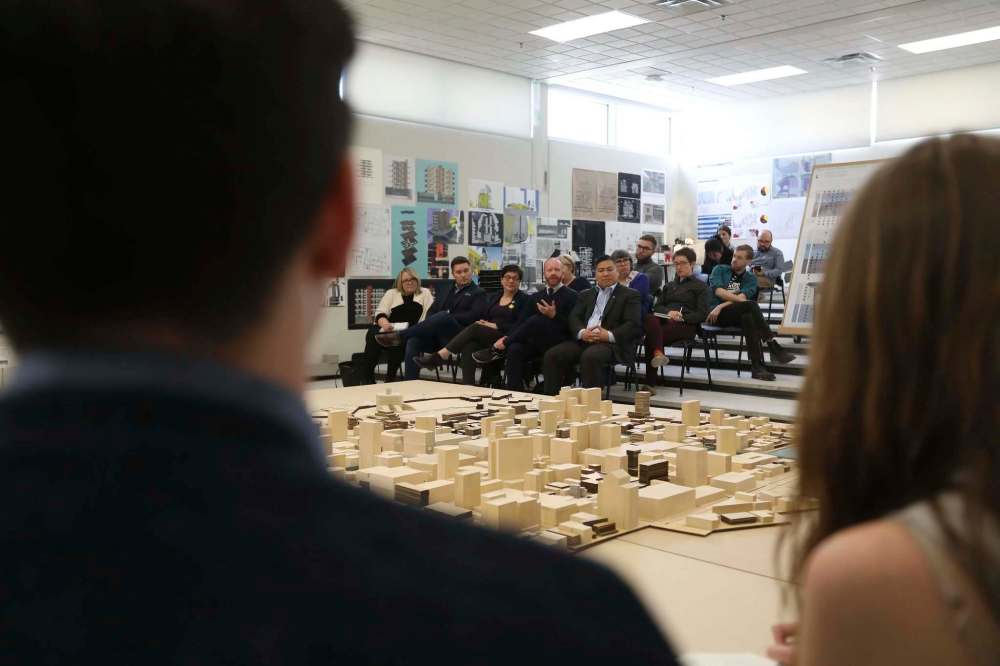
Prof. Richard Milgrom, head of the city planning department at the University of Manitoba, said the students’ urban design studio aims to show what’s possible.
They laid out their vision for a healthy downtown with 36,000 more residents than there are now, and a lot more public spaces and amenities to attract them.
A target of 36,000 more downtown residents “is actually a reasonable, aspirational goal,” CentreVenture Development Corp. president and CEO Angela Mathieson told them Wednesday. “By 2035, Winnipeg’s population is expected to hit one million people.”
She applauded the students for tackling the redevelopment of a sprawling downtown. “It’s so daunting.”
The students have been seeking appropriate scales of development and questioning the idea of building larger “skyline” projects that consist of hundreds of units and take years to build, Milgrom said.
With the relatively slow growth of Winnipeg, the concentration of population in large buildings may undermine attempts to fill in vacant property and surface parking lots that hinder downtown growth, he said.
The students looked at the possibilities and challenges of encouraging smaller-scale development that can provide downtown housing, accommodate higher residential densities, but also enhance streets as public places. They envisioned downtown as a destination, as well as neighbourhoods and places for everyday living.
Seeing a skyline dotted with new highrises might make people feel Winnipeg is more prosperous, but spreading out the 16,000 additional residential units required for 36,000 more people in low- and mid-rise buildings would revitalize more of downtown and make for more livable places, the students showed.
A downtown with a full-service grocery store and elementary schools within walking distance are key, as well as better active transportation so people won’t need cars. Right now, 49 per cent of the land downtown is geared to car-oriented development, they said.

To make downtown better in winter, there’d be colourful facades on more buildings. There would be an emphasis on sunlight preservation and wind reduction in planning and design. In the summer, there’d be stormwater management features, more green space and fewer paved surface parking lots that absorb the heat and make for a sweltering downtown. The students want to keep the same number of parking spaces but incorporate them in the design of buildings and get rid of the surface lots.

City Coun. Jenny Gerbasi, who was first elected in 1998, said surface parking lots have long haunted urban planners and developers. “It’s been talked about for years.” Unless the tax structure changes — such as taxing the properties based on the real potential value of the lots — or there is some incentive to sell the money-making land, owners won’t give them up.
She encouraged the students to take their ideas and run with them by getting elected to public office. The councillor for Fort Rouge-East Fort Garry has decided not to run again in the election this fall.
“Does anyone want to run for council? The seat’s available in Fort Rouge,” she said.
carol.sanders@freepress.mb.ca
Carol Sanders
Legislature reporter
Carol Sanders is a reporter at the Free Press legislature bureau. The former general assignment reporter and copy editor joined the paper in 1997. Read more about Carol.
Every piece of reporting Carol produces is reviewed by an editing team before it is posted online or published in print — part of the Free Press‘s tradition, since 1872, of producing reliable independent journalism. Read more about Free Press’s history and mandate, and learn how our newsroom operates.
Our newsroom depends on a growing audience of readers to power our journalism. If you are not a paid reader, please consider becoming a subscriber.
Our newsroom depends on its audience of readers to power our journalism. Thank you for your support.
Carol Sanders
Legislature reporter
Carol Sanders is a reporter at the Free Press legislature bureau. The former general assignment reporter and copy editor joined the paper in 1997. Read more about Carol.
Every piece of reporting Carol produces is reviewed by an editing team before it is posted online or published in print — part of the Free Press‘s tradition, since 1872, of producing reliable independent journalism. Read more about Free Press’s history and mandate, and learn how our newsroom operates.
Our newsroom depends on a growing audience of readers to power our journalism. If you are not a paid reader, please consider becoming a subscriber.
Our newsroom depends on its audience of readers to power our journalism. Thank you for your support.
Advertisement Advertise With Us
Advertisement Advertise With Us