Compellingly watchable feminist TV
Handmaid's Tale, Season 2, should be interesting as it goes off-book

Advertisement
Read this article for free:
or
Already have an account? Log in here »
To continue reading, please subscribe:

Digital Subscription
One year of digital access for only $205*
- Enjoy unlimited reading on winnipegfreepress.com
- Read the E-Edition, our digital replica newspaper
- Access News Break, our award-winning app
- Play interactive puzzles
*First annual payment billed as $205.00 + GST for one year. This annual subscription will automatically renew at $233.00 + GST every 52 weeks (10% off the regular annual price of $259.35). Offer available to new and qualified returning subscribers only. Cancel any time.
To continue reading, please subscribe:
Add Free Press access to your Brandon Sun subscription for only an additional
$1 for the first 4 weeks*
- Enjoy unlimited reading on winnipegfreepress.com
- Read the E-Edition, our digital replica newspaper
- Access News Break, our award-winning app
- Play interactive puzzles
*Your next Brandon Sun subscription payment will increase by $1.00 and you will be charged $17.95 plus GST for four weeks. After four weeks, your payment will increase to $24.95 plus GST every four weeks.
Read unlimited articles for free today:
or
Already have an account? Log in here »
Hey there, time traveller!
This article was published 28/04/2018 (3053 days ago), so information in it may no longer be current.
After a timely and often exquisitely tortuous first season, The Handmaid’s Tale begins its increasingly brutal second round this week (Sunday night on Bravo and streaming on iTunes, streaming Monday night on Crave TV).
Adapted from Margaret Atwood’s 1985 novel, Season 1 was a beautifully constructed and brilliantly acted endurance test. Imagining the United States overtaken by a fascist theocracy called Gilead, in which the few remaining fertile women are used as breeding stock for powerful men and their wives, the series coincided with the amped-up culture wars and hard-right political turn of 2017 America.
The main section of the book concludes with a scene of utter Atwoodian ambiguity, as Offred, the titular handmaid, is packed into a van, unsure whether she is being arrested or rescued, whether she is stepping up “into the darkness within; or else the light.”
That’s also where the first TV season ended, and where the second series starts up. Showrunner Bruce Miller is now going off-book, which raises possibilities but also potential pitfalls, as Atwood’s tendency to stern Canadian understatement gives way to the plot-heavy imperatives of serial television.
So, what works in the new season? And what doesn’t?
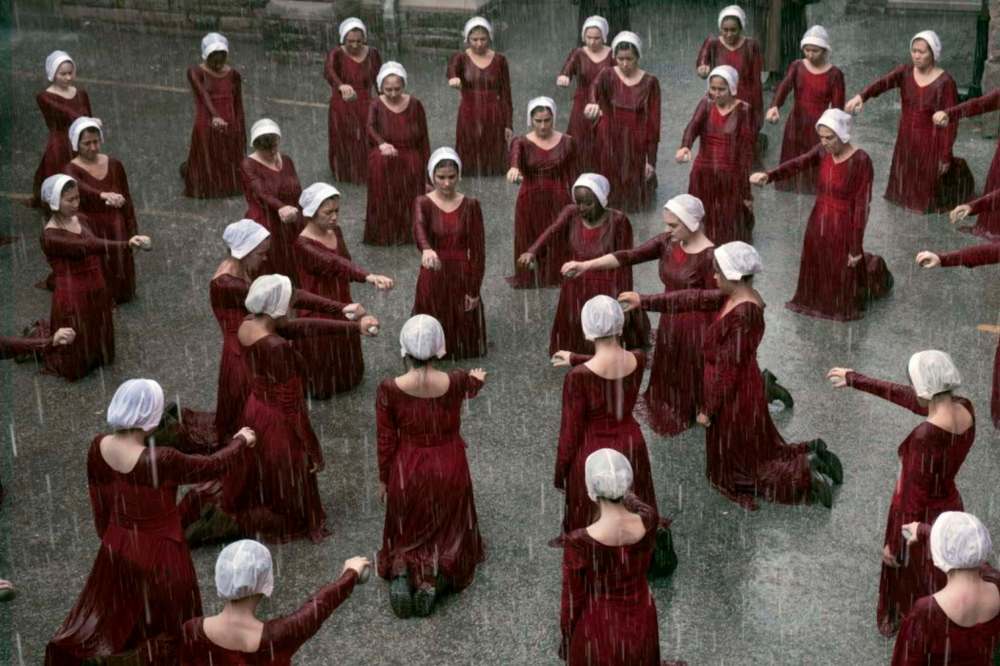
Played with piercing emotional power by Elisabeth Moss, handmaid Offred (literally “of-Fred,” named for the man who owns her) was once June Osborne. In the second season we get even more flashbacks to this previous life, as we see June juggling work and home — as one does — even as her world creeps incrementally toward oppression.
The show often achieves a queasy fascination when it looks to the past — which is to say, a period that looks very much like our present. We see how taken-for-granted norms are violated, and then how these violations gradually, insidiously become the new norms. (Hmm, does this sound familiar?)
The best flashbacks in Season 2, then, are the ones in which things seem ordinary but also just a little off, as when June is accused of negligent parenting by a passive-aggressive, clipboard-wielding nurse, a scene that takes recognizable maternal guilt and adds a cranked-up level of mommy-shaming mixed with creepy state surveillance.
Flashbacks also offer new angles on Serena Joy (Yvonne Strahovski), an enigma with her fabulous New Look dresses and cool, Ivanka-ish poise. The wife of Commander Fred Waterford, Serena Joy used her voice to usher in the regime that has now left her silenced, and she becomes a more interesting character as we apprehend her bleak understanding of that irony.
Along with these widening windows into the past, we also see the plot moving forward into an unknown future. The opening episodes drag us into prisons, slaughterhouses and forced labour camps, making for some unremittingly difficult viewing.
We follow Emily (Alexis Bledel doing absolutely the best work of her career — sorry, Rory Gilmore fans) to the Colonies, previously an ominous threat but now fully realized as a sulphurous landscape of toxic sludge, where “Unwomen” — the “deviant,” the dangerous or the merely middle-aged — toil until their teeth fall out and their skin peels off.
We follow June to a dark, deserted structure that turns out to be the old offices of the Boston Globe newspaper, an eerie setting that eventually reveals the (literal) death of the free press in the new Republic of Gilead.
And we get even more Aunt Lydia (Ann Dowd), whose training of the handmaids is twisting into an increasingly tight knot of religious hysteria and pathological sadism. (Who knows what clammy fears might be revealed by Aunt Lydia’s eventual flashbacks?)

There are problems. Last season, the political overlaps were fortuitous, the series having been conceived before the American presidential election. This season the scripting sometimes strains too hard for relevance, with #Resistance grafitti and talk about “liberal bubbles.” The series also continues to struggle with the issue of race. Having created an authoritarian regime that is profoundly misogynistic but curiously post-racial, the scripters are now in a box.
And while the first season relied on an atmosphere of unrelenting psychological dread, Season 2 heads toward full-blown physical horror tropes, with much more graphic and bloody violence. Reed Morano, who directed much of the first season, was deft at tracking the objectification of women without herself objectifying them. Here, we sometimes slide into the gratuitous nastiness of torture porn.
There are momentary respites, as in a scene where June, forced into hiding, binge-watches Friends on DVD. (Survivors of hellish dystopias: They’re just like us!) This is the kind of funny, quirky, human moment the series could use more of.
Still, no matter how grim the going, The Handmaid’s Tale remains a righteously angry and compellingly watchable feminist television series. Praise be.
alison.gillmor@freepress.mb.ca
Studying at the University of Winnipeg and later Toronto’s York University, Alison Gillmor planned to become an art historian. She ended up catching the journalism bug when she started as visual arts reviewer at the Winnipeg Free Press in 1992.
Our newsroom depends on a growing audience of readers to power our journalism. If you are not a paid reader, please consider becoming a subscriber.
Our newsroom depends on its audience of readers to power our journalism. Thank you for your support.
TV Preview
The Handmaid’s Tale
Starring Elisabeth Moss
● Sunday, 8 p.m. ● Bravo
Studying at the University of Winnipeg and later Toronto’s York University, Alison Gillmor planned to become an art historian. She ended up catching the journalism bug when she started as visual arts reviewer at the Winnipeg Free Press in 1992.
Our newsroom depends on a growing audience of readers to power our journalism. If you are not a paid reader, please consider becoming a subscriber.
Our newsroom depends on its audience of readers to power our journalism. Thank you for your support.
Advertisement Advertise With Us
Advertisement Advertise With Us