Why are butterflies’ wings colourful?
U of M researchers discover how the insects organize their colour patterns
Advertisement
Read this article for free:
or
Already have an account? Log in here »
To continue reading, please subscribe:

Digital Subscription
One year of digital access for only $205*
- Enjoy unlimited reading on winnipegfreepress.com
- Read the E-Edition, our digital replica newspaper
- Access News Break, our award-winning app
- Play interactive puzzles
*First annual payment billed as $205.00 + GST for one year. This annual subscription will automatically renew at $233.00 + GST every 52 weeks (10% off the regular annual price of $259.35). Offer available to new and qualified returning subscribers only. Cancel any time.
To continue reading, please subscribe:
Add Free Press access to your Brandon Sun subscription for only an additional
$1 for the first 4 weeks*
- Enjoy unlimited reading on winnipegfreepress.com
- Read the E-Edition, our digital replica newspaper
- Access News Break, our award-winning app
- Play interactive puzzles
*Your next Brandon Sun subscription payment will increase by $1.00 and you will be charged $17.95 plus GST for four weeks. After four weeks, your payment will increase to $24.95 plus GST every four weeks.
Read unlimited articles for free today:
or
Already have an account? Log in here »
Hey there, time traveller!
This article was published 05/05/2018 (2996 days ago), so information in it may no longer be current.
Evolutionary biologist Jeff Marcus calls butterflies “self-propelled flowers” — an apt phrase first used by author Robert A. Heinlein in his novel, The Cat Who Walks Through Walls.
Marcus has had a long fascination with those colourful insects. Many years before his career in science began, as a child growing up in New York, he would watch with delight as they alighted on flowers in the family’s small garden.
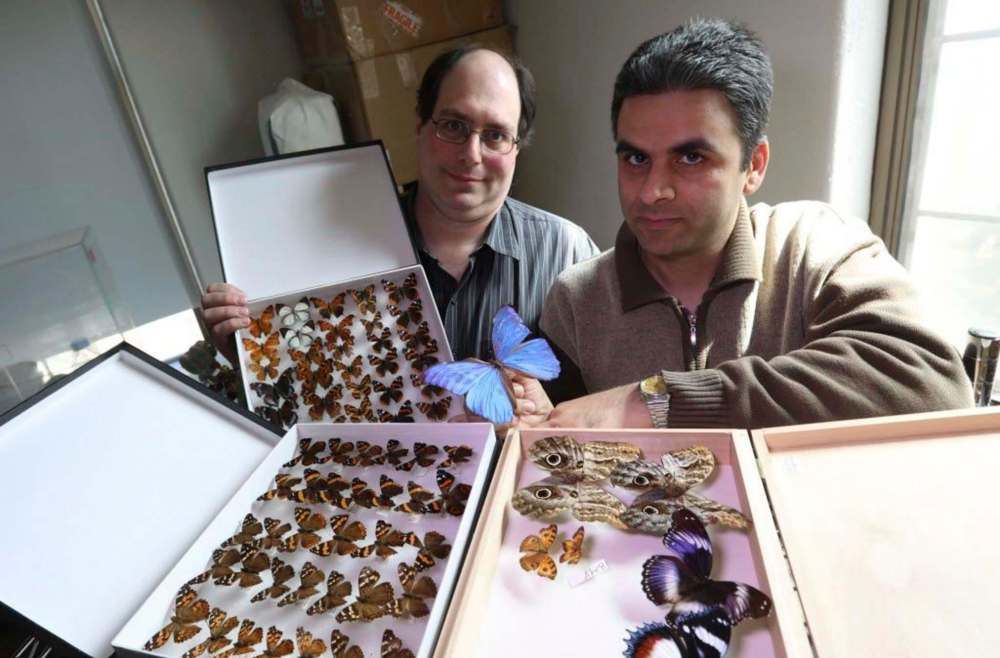
Now, Marcus, an associate professor at the University of Manitoba’s department of biological sciences, and his former PhD student, Roohollah Abbasi, who now is doing post-doctoral research at another U of M lab, have figured out the genetic code by which butterflies assign colour patterns to different parts of their wings during development.
It’s a mystery scientists have been trying to solve for many years.
Their findings were published in the journal Scientific Reports, under the arcane heading, A new A-P compartment boundary and organizer in holometabolous insect wings, on Nov. 27, 2017.
Abbasi, who is from Iran, is listed as the lead author on the study.
This assignment of colour patterns occurs during the insect’s transition from caterpillar to chrysalis, Marcus explains during a recent interview, along with Abbasi, in Marcus’s laboratory on the fifth floor of the U of M’s Buller Building that is cluttered with scientific equipment.
“The code is based on a common set of transcription factors that turn other genes on and off, and are used to establish a series of developmental compartments in most, and perhaps all, insect wings,” Marcus says.
“Prior to our work, it was believed based on four decades of work in Drosophila (fruit flies) that there were only two wing compartments in insects, but we have shown that both butterflies and Drosophila have three compartments in each wing.”
This research provides a key piece to the puzzle of how butterflies have managed to produce such a diversity of colour patterns, Abbasi added.
Marcus commended the work done by the soft-spoken Abbasi.
“What Roohollah did in this paper is find groups of cells in this wing that no other researchers had recognized,” he said. “He did most of the real work.”
For his part, Abbasi, 36, who has lived in Winnipeg for almost eight years, said the research was very deliberate and systematic. He used painted lady and red admiral butterflies in his research.
All the butterflies in the lab are neatly pinned in black Schmidt boxes, which are about the size of a large jewelry box.
“To make a phylogeny (evolutionary tree), we needed to extract DNA from all of these samples,” says Abbasi, who caught some of the butterflies himself on the U of M campus by the Red River. “There’s a lot of diversity in terms of their colour pattern. Butterflies have much more complete and elaborate wings than other insects.”
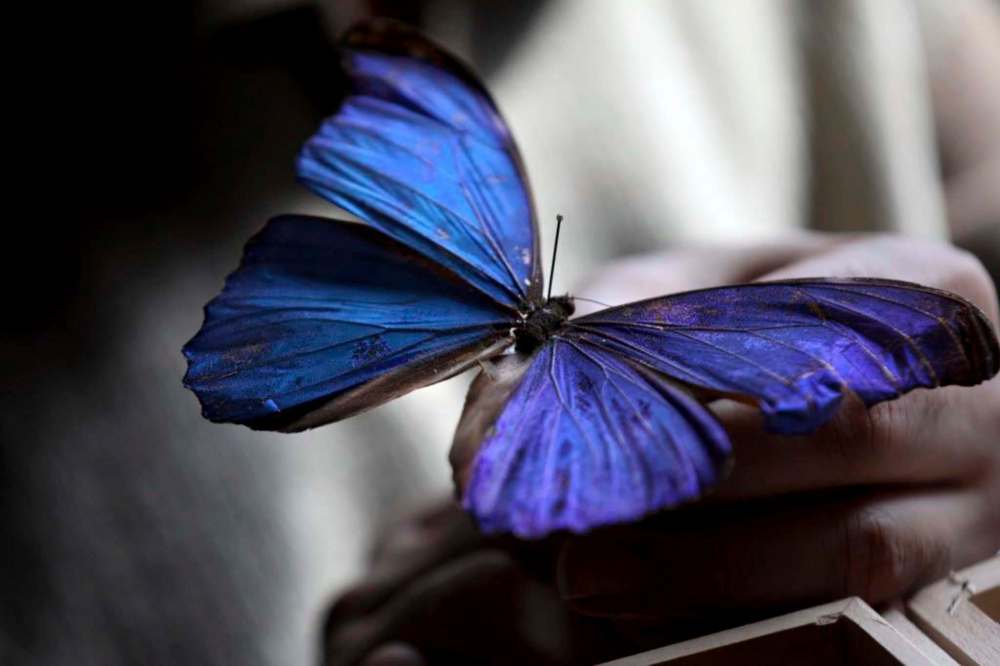
One of the key aspects in doing research is to work on something that is simple to understand yet complex enough to be interesting, Abbasi says. Who hasn’t wondered why butterflies are so colourful?
“We now have insight into the genetic mechanisms that determine how many eyespots are made on each wing surface, their positions on the wing, and whether a species makes uniform or variable eyespots,” Marcus said.
“The ability to produce diverse colour patterns has enormous consequences for the ecology of butterflies, which use these patterns to select mates, for camouflage and to avoid or intimidate predators.”
The butterfly’s capacity to produce colour-pattern diversity is the reason why so many beautifully different species of butterflies have evolved, Abbasi emphasizes.
Abbasi and Marcus’s work also shows research “using non-traditional model organisms” has the potential to teach the scientific community many fundamental aspects of developmental biology that may not be apparent from research into more traditional systems such as fruit flies, Marcus says.
“Fruit flies also possess the far-posterior developmental compartment in the wing that we discovered in butterflies; but because their wings are small and have fewer visible landmarks, four decades of research on wing development in fruit flies consistently missed it,” he says. “In butterflies, we can use the colour patterns as landmarks, making the underlying developmental architecture of all insect wings more obvious.”
Marcus also mentioned that people who study insects, other than fruit flies, have been very excited about these new findings.
“Our results are potentially of broad interest.”