

Fishing in Duck Mountains turns up nice trout
Swan Valley enhancement group's work nets results
Advertisement
Read this article for free:
or
Already have an account? Log in here »
To continue reading, please subscribe:
Monthly Digital Subscription
$1 per week for 24 weeks*
- Enjoy unlimited reading on winnipegfreepress.com
- Read the E-Edition, our digital replica newspaper
- Access News Break, our award-winning app
- Play interactive puzzles
*Billed as $4.00 plus GST every four weeks. After 24 weeks, price increases to the regular rate of $19.95 plus GST every four weeks. Offer available to new and qualified returning subscribers only. Cancel any time.
Monthly Digital Subscription
$4.99/week*
- Enjoy unlimited reading on winnipegfreepress.com
- Read the E-Edition, our digital replica newspaper
- Access News Break, our award-winning app
- Play interactive puzzles
*Billed as $19.95 plus GST every four weeks. Cancel any time.
To continue reading, please subscribe:
Add Free Press access to your Brandon Sun subscription for only an additional
$1 for the first 4 weeks*
*Your next subscription payment will increase by $1.00 and you will be charged $16.99 plus GST for four weeks. After four weeks, your payment will increase to $23.99 plus GST every four weeks.
Read unlimited articles for free today:
or
Already have an account? Log in here »
Hey there, time traveller!
This article was published 26/05/2018 (2877 days ago), so information in it may no longer be current.
As time goes by, fisheries come and go and destinations alter.
For years, I had not visited the Duck Mountains in west central Manitoba, but that has changed recently.
Aggressive fisheries management work by the Swan Valley enhancement group has allowed many of the lakes in this provincial park to survive and even thrive.
While Manitoba Fisheries has regional biologist Ian Kitch looking after that part of the province, a broad job description spreads his time over a huge area, almost all of the western side of Manitoba. While this is the new norm in government cutbacks, the Swan Valley group for years has taken the bull by the horns in making sure they help do the fisheries management work to maintain the world-class fishery in their part of the world.
This includes multiple projects, from lake assessment, to restocking and everything in between — including angler education.
This is a model that must be adapted provincewide through the formation of a new Crown agency like the Sport Fishing Institute of British Columbia.
It hasn’t been easy for Swan Valley, as there are always challenges. But research and knowledge are the key to great decisions on maintaining fish stocks.
I had the chance earlier this week to head up to the Ducks to fish with longtime friend Duane Whyte, who sits on the board of Swan Valley’s fishing group called the SVSFI.
It was a chance to catch up on new projects and, more importantly, get some fishing time in.
Our first day out to Laurie Lake didn’t turn out so well.
This lake holds an impressive population of lake trout, massive brown trout as well as splake. Unfortunately, we didn’t unlock the secret to catching them that day, instead landing seven good-sized northern pike that could one day threaten this fishery. Pike like eating stocked trout, thriving on those freshly introduced to a new body of water. That is why lake assessment on species makeup is extremely important in stocking decisions.
A case in point is the lake we fished on the second day of our trip, Two Mile.
This fertile body of water grows trout quickly, but a recent explosion of perch has area fisheries managers worried about a competition with stocked fish for available food sources.
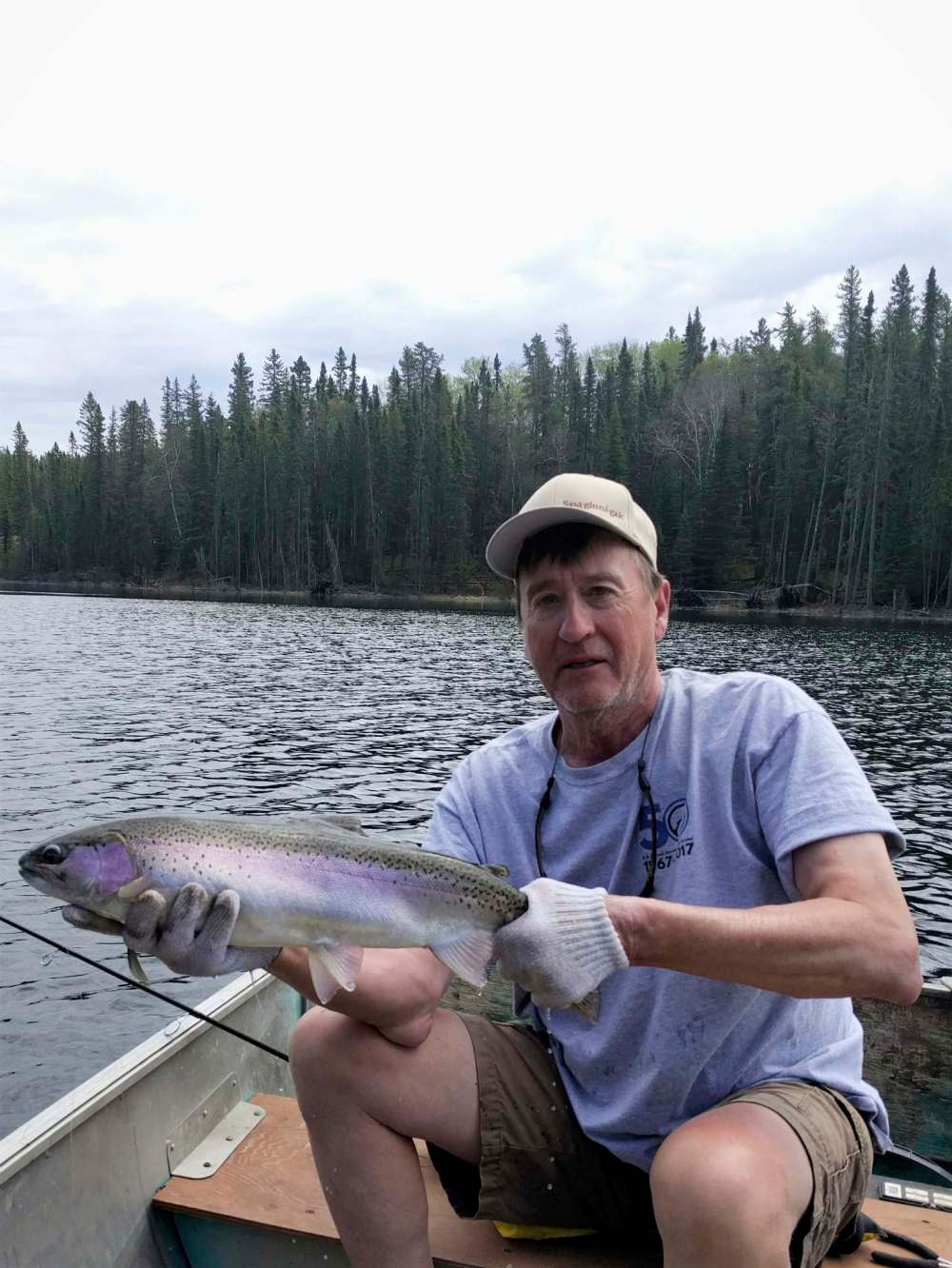
To reduce perch populations, the group decided to stock splake, a fish with a healthy appetite for small perch. While we didn’t catch any splake on this day, we did catch several small perch. That didn’t bother us, though, since we also landed several healthy rainbow trout in a variety of sizes — the largest about 53 centimetres that had me tied up in knots.
All were caught on small olive nymphs. In this case, I used a bead head while Duane had just a straight Olive Woolly Bugger.
While a few of the shallower lakes in the park suffered winterkill from reduced oxygen levels, there is such a variety of lakes that there are always great options to explore with a rod in hand.
Conditions in all sections of the province, except maybe the southeast corner, remain extremely dry.
The Duck Mountains and other regions have restricted backcountry travel. Dry conditions have also dramatically affected water levels, so much so that launching a boat in certain areas like Lake Dauphin and Lake Manitoba is becoming a huge issue.
I was hoping to get out to Lake Manitoba this week, but the launch on the Whitemud River is almost dry.
Friend Jim Price says they need a north wind for a couple of days to bring river levels up enough, so they can boat out to the mouth.
Angler’s notes: With the hot weather, temperatures in our lakes and rivers are heating up rapidly, changing fish location daily. Many species are already moving to shallow water to take advantage of the explosion of forage. If this hot, dry weather continues, this shallow water activity will not last long, as many species like pike, walleye and lake trout will drop back out to the cooler, more oxygenated water. The next two weeks will be a great time to get out on the water to catch post-spawn walleye as they go on a feeding frenzy in water shallower than four metres. Low water levels will also tend to concentrate fish in tighter schools when they do drop back out to deeper levels. This is especially the case in river systems with restricted flows. Fish will be found in deeper pools or in areas with some current flow. It becomes all about oxygen levels as well as temperature. Let’s keep our fingers crossed for some rain that will benefit everyone in this province.
dlamont46@gmail.com