

Remembering Mulroney’s fight against apartheid

Advertisement
Read this article for free:
or
Already have an account? Log in here »
To continue reading, please subscribe:
Monthly Digital Subscription
$1 per week for 24 weeks*
- Enjoy unlimited reading on winnipegfreepress.com
- Read the E-Edition, our digital replica newspaper
- Access News Break, our award-winning app
- Play interactive puzzles
*Billed as $4.00 plus GST every four weeks. After 24 weeks, price increases to the regular rate of $19.95 plus GST every four weeks. Offer available to new and qualified returning subscribers only. Cancel any time.
Monthly Digital Subscription
$4.99/week*
- Enjoy unlimited reading on winnipegfreepress.com
- Read the E-Edition, our digital replica newspaper
- Access News Break, our award-winning app
- Play interactive puzzles
*Billed as $19.95 plus GST every four weeks. Cancel any time.
To continue reading, please subscribe:
Add Free Press access to your Brandon Sun subscription for only an additional
$1 for the first 4 weeks*
*Your next subscription payment will increase by $1.00 and you will be charged $16.99 plus GST for four weeks. After four weeks, your payment will increase to $23.99 plus GST every four weeks.
Read unlimited articles for free today:
or
Already have an account? Log in here »
Hey there, time traveller!
This article was published 04/06/2018 (2872 days ago), so information in it may no longer be current.
It is an inescapable truth of politics that the legacy of any politician is more often defined by shortcomings than successes.
Take former prime minister Brian Mulroney. Bring up his name in conversation and you’re likely to get people talking about the various free trade agreements Mulroney championed, or the introduction of the GST. Or, perhaps you might remember Mulroney’s valiant but vain attempts to bring Quebec fully back into the federal fold in the failed Meech Lake and Charlottetown constitutional accords.
However, that’s hardly a complete accounting of the accomplishments of Mulroney and his Progressive Conservative government. In addition to all of the controversy and conflict, there were shining moments of courage and progress, some of which will be celebrated tonight at the Canadian Museum for Human Rights.
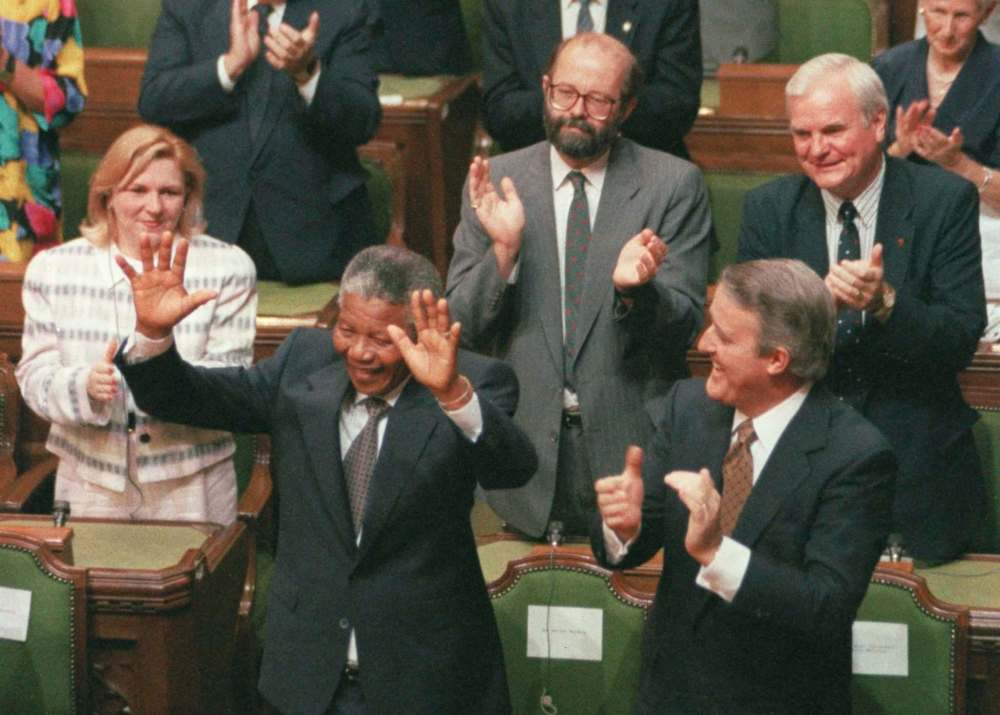
To mark the opening of a new exhibit on former South African president Nelson Mandela — a collaboration with the South African Apartheid Museum in Johannesburg — Mulroney will be honoured at a gala dinner for his contributions to the global campaign against apartheid.
In the late 1980s and into the early 1990s, as university campuses across Canada were in the grips of sometimes violent protests against apartheid, the Mulroney government did play a key role in helping to mobilize international pressure against South Africa to free Mandela and end its official policy of segregation.
“Canada was very vocal and effective in specific moments with its stand against apartheid within the Commonwealth,” said Isabelle Masson, the curator of the Mandela exhibit at the museum.
The origins of Mulroney’s passionate interest in South Africa go back more than two decades before he became Canada’s first minister.
Mulroney has frequently told a story about how he went to the Chateau Laurier hotel in the spring of 1961 with a bunch of other university students to welcome then-prime minister John Diefenbaker back from the seminal Commonwealth of Nations heads of state conference in London, where Canada had played a key role in the expulsion of South Africa.
South Africa was in the process of becoming a republic following a referendum on a new constitution in which black citizens were prevented from voting. As a result, South Africa’s continued membership in the Commonwealth was being challenged by many African nations and India. Diefenbaker was the only white Commonwealth leader to join in condemning South Africa and demanding that it publicly denounce official apartheid.
Mulroney has said that Diefenbaker’s courageous stand helped motivate him to take up the anti-apartheid cause when he became prime minister 23 years later. History confirms that just three months after he won a thunderous majority government in the fall of 1984, Mulroney met with South African Bishop Desmond Tutu in Ottawa, where he encouraged Canada to push other nations to exert pressure on South Africa.
In a 2015 article he wrote for the Globe and Mail, Mulroney said he told his new cabinet shortly after taking power that “it would be a priority of my government to press the case for Nelson Mandela’s liberation, the destruction of the apartheid system, the unbanning of the African National Congress… and the building of a non-racial democratic society in South Africa.”
Mulroney used Canada’s unique global network at the time to encourage other nations to join the cause. Then-foreign affairs minister Joe Clark, and Stephen Lewis, Canada’s ambassador to the United Nations, exerted quiet diplomatic pressure.
Mulroney also wrote of using Canada’s profile as the only industrialized nation to be a member of the G-7, the United Nations, the Commonwealth, La Francophonie and the Organization of American States.
Mulroney’s stand on South Africa was not without its risks. He has admitted over the years that British prime minister Margaret Thatcher and U.S. president Ronald Reagan, both of whom were close to Mulroney, did not appreciate Canada’s anti-apartheid efforts.
However, Canada’s middle-power influence did not go unnoticed by Mandela, who called Mulroney personally the day after he was released in February 1990. And in June, just four months after his release, he visited Ottawa and became the last dignitary who was not a head of state to address Parliament. “Canada is an important presence in much of what we have achieved, and what we are building,” Mandela told Parliament that day.
Mulroney’s relationship with Mandela, and with the people of South Africa, would continue to be celebrated. Mandela would make two additional trips to Canada, including 2001 when then-prime minister Jean Chrétien made him the first-ever honorary Canadian. The Mulroney-Mandela relationship was again referenced in 2016, when 300 South African firefighters travelled to Fort McMurray, Alta., to help battle wildfires.
Longtime friend Stuart Murray, who worked as staff for Mulroney in the mid-1990s, said he remembers there was a pressing interest in seeking progress on South Africa shortly after the Tories won a majority in the 1984 election. Murray, who was instrumental in arranging for Mulroney to attend the opening of the museum’s Mandela exhibit, said Mulroney has always been “very passionate” about Mandela and considered him a friend for many years after his release.
“When Mandela came to Canada, it was his way of saying to Mulroney and the people of Canada, ‘thank you for your support,” said Murray, who also served as the CEO of the museum at its inception. “It was one of his greatest honours.”
The Mandela exhibit and the Mulroney gala may not be celebrated by all Canadians. Throughout the 1980s and 1990s when Canada was doing what it could to help campaign against apartheid, many student protesters found the diplomatic approach espoused by western nations too tepid. And many of Canada’s indigenous people found Mulroney’s interest in South African apartheid maddeningly ironic given the severe poverty and dysfunction that was a part of life for those living on reserves.
Many Manitobans will remember former Peguis chief Louis Stevenson’s controversial 1987 invitation to Glenn Babb, then South Africa’s ambassador to Canada. Babb toured the impoverished First Nation north of Winnipeg with a legion of national and international reporters in tow as part of a concerted effort to embarrass the Mulroney government into taking action to improve on-reserve living conditions.

Still, the exhibit and the gala serve as a good example of the good work that the museum itself can do to help Canadian understand complex issues and Canada’s role in the world.
Often maligned for being too arcane or academic, the events of this week are an excellent reminder of how the museum can play an important role in reviving important debates over issues like racism, segregation and foreign relations.
And also to remind Canadians that despite our own shortcomings, the country and its leaders have at times played an important role in promoting human rights.
dan.lett@freepress.mb.ca
Dan Lett is a columnist for the Free Press, providing opinion and commentary on politics in Winnipeg and beyond. Born and raised in Toronto, Dan joined the Free Press in 1986. Read more about Dan.
Dan’s columns are built on facts and reactions, but offer his personal views through arguments and analysis. The Free Press’ editing team reviews Dan’s columns before they are posted online or published in print — part of the our tradition, since 1872, of producing reliable independent journalism. Read more about Free Press’s history and mandate, and learn how our newsroom operates.
Our newsroom depends on a growing audience of readers to power our journalism. If you are not a paid reader, please consider becoming a subscriber.
Our newsroom depends on its audience of readers to power our journalism. Thank you for your support.
Dan Lett is a columnist for the Free Press, providing opinion and commentary on politics in Winnipeg and beyond. Born and raised in Toronto, Dan joined the Free Press in 1986. Read more about Dan.
Dan’s columns are built on facts and reactions, but offer his personal views through arguments and analysis. The Free Press’ editing team reviews Dan’s columns before they are posted online or published in print — part of the our tradition, since 1872, of producing reliable independent journalism. Read more about Free Press’s history and mandate, and learn how our newsroom operates.
Our newsroom depends on a growing audience of readers to power our journalism. If you are not a paid reader, please consider becoming a subscriber.
Our newsroom depends on its audience of readers to power our journalism. Thank you for your support.
Related Articles
Human rights museum's new exhibition lets visitors relive the struggles and triumphs of Nelson Mandela
Advertisement Advertise With Us
Advertisement Advertise With Us
History
Updated on Monday, June 4, 2018 7:38 AM CDT: Corrects typos