Senate approves marijuana legalization with amendments
Bill heads back to House of Commons
Advertisement
Read this article for free:
or
Already have an account? Log in here »
To continue reading, please subscribe:

Digital Subscription
One year of digital access for only $205*
- Enjoy unlimited reading on winnipegfreepress.com
- Read the E-Edition, our digital replica newspaper
- Access News Break, our award-winning app
- Play interactive puzzles
*First annual payment billed as $205.00 + GST for one year. This annual subscription will automatically renew at $233.00 + GST every 52 weeks (10% off the regular annual price of $259.35). Offer available to new and qualified returning subscribers only. Cancel any time.
To continue reading, please subscribe:
Add Free Press access to your Brandon Sun subscription for only an additional
$1 for the first 4 weeks*
- Enjoy unlimited reading on winnipegfreepress.com
- Read the E-Edition, our digital replica newspaper
- Access News Break, our award-winning app
- Play interactive puzzles
*Your next Brandon Sun subscription payment will increase by $1.00 and you will be charged $17.95 plus GST for four weeks. After four weeks, your payment will increase to $24.95 plus GST every four weeks.
Read unlimited articles for free today:
or
Already have an account? Log in here »
Hey there, time traveller!
This article was published 07/06/2018 (3023 days ago), so information in it may no longer be current.
Canada inched closer to legalizing cannabis for recreational use on Thursday, as the Senate passed the federal government’s Cannabis Act, with four dozen amendments.
The Cannabis Act had been with the Senate since November 28, one day after it was passed by the House of Commons. Since then, senators have debated the bill and studied it at five separate committees.
Prior to the vote, senators spent almost six hours giving impassioned, final pitches for and against legalization.
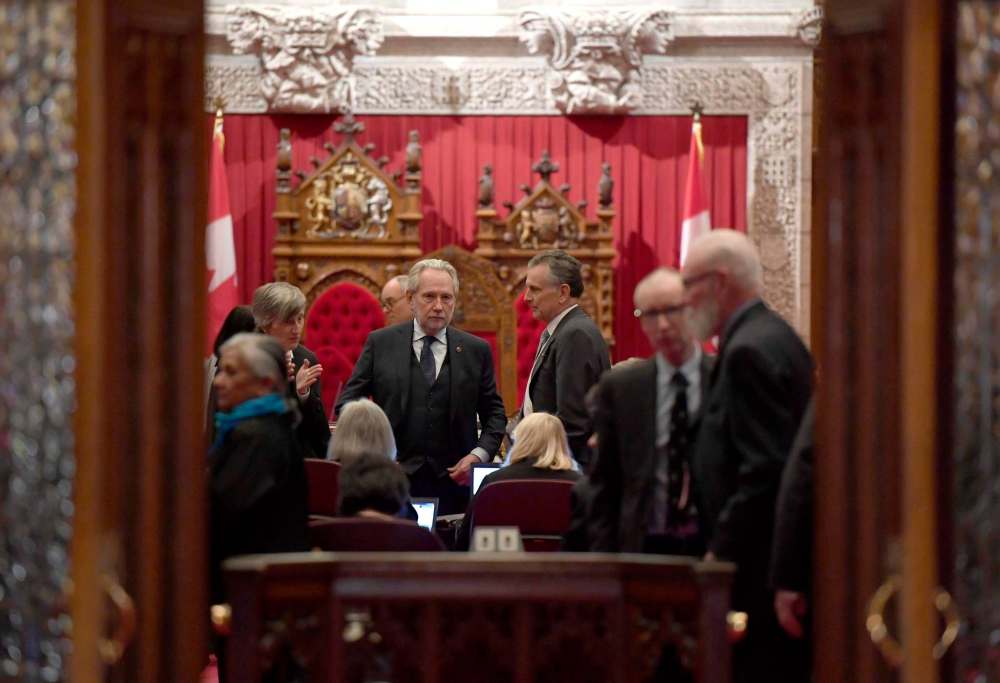
Most of the concerns raised — worries about the social impacts of home cannabis cultivation, fears about road safety, a belief that organized crime will infiltrate the legal market, and warnings that legalization would be in violation of international drug treaties — had been bandied about in Senate debates for months. In many cases, senators relied on competing statistical and scientific claims to back up their arguments for and against the bill, creating a polarized and sometimes confusing discourse.
Even after months of deliberation, many senators appeared unmoved from their original positions.
“While I do believe that senators have made some modest improvements to this legislation, the bill remains fundamentally flawed,” said Conservative Senate leader Larry Smith, whose caucus voted against the bill in March.
“The government has been focused on ensuring that marijuana would be made legal by this summer instead of ensuring that Canadians are duly protected.”
Liberal Sen. Art Eggleton acknowledged that legalization could have unknown consequences, but echoed the government’s message that Bill C-45 represents “a step toward a better approach” to regulating the drug.
Independent Sen. André Pratte said the prohibition on cannabis and war on drugs have failed.
“C-45 is a pragmatic approach, one which respects Canadians’ intelligence and undertakes to inform them on the risks of cannabis, rather than threaten them away from a product that millions legitimately enjoy,” said Pratte.
”Do we take a deep breath, close our eyes and stick with a demonstrably failed, hypocritical, unhealthy, prohibitionist approach of the past or do we move forward, eyes wide open, and choose the alternative? … I choose to open my eyes, rather than put on blinders,” he said.
The bill will return to the House of Commons for a final vote. Although the majority Liberals could push through the bill with all the Senate’s amendments intact, it’s more likely the government will choose to keep some amendments and reject others. That would require further negotiations between Parliament’s lower and the upper chambers, until both the House and the Senate agree on the final text of the bill.
Even after the House passes that final version, cannabis still won’t be legal for recreational use. The federal and provincial governments will take two to three to prepare for the new legal cannabis regime, meaning legalization won’t come into force until August or September.
Most of the Senate’s amendments are minor, but about a dozen are significant, including one to allow provinces to prohibit home cultivation of cannabis if they choose, rather than accept the four marijuana plants per dwelling allowed under the bill. Quebec and Manitoba have already chosen to prohibit home-grown weed, but the amendment would erase the possibility of legal challenges to their constitutional authority to do so.
Other amendments passed in the Senate chamber this week could also change the shape of the law. One amendment, proposed by Conservative Sen. Claude Carignan, would require the government to make public the names of all investors in legal cannabis producers, along with any directors, parent corporations, and trusts involved. (The amendment was framed as a way to prevent organized crime from investing in the legal cannabis industry.)

Another late amendment, from Conservative Sen. Judith Seidman, would ban cannabis companies from using their branding elements on any kind of promotional “swag,” like T-shirts. Conservative Sen. Vern White successfully moved an amendment that would free police from any responsibility to care for seized cannabis plants.
In early May, the Senate’s Aboriginal peoples committee called for the bill to be delayed for up to a year to address what they described as inadequate consultation with Indigenous communities across Canada.
An amendment being considered by Conservative Sen. Dennis Patterson earlier this week would have delayed implementation of the Cannabis Act until the government provided a report on its actions to address Indigenous peoples’ concerns. After the ministers of health and Indigenous services sent a letter to the Aboriginal peoples committee promising to provide such reports in the future, Patterson decided not to introduce the amendment.
— With files from the Canadian Press
solomon.israel@theleafnews.com @sol_israel
History
Updated on Thursday, June 7, 2018 9:23 PM CDT: Adds background photo