In a world where one leader uses film to court another

Advertisement
Read this article for free:
or
Already have an account? Log in here »
To continue reading, please subscribe:

Digital Subscription
One year of digital access for only $205*
- Enjoy unlimited reading on winnipegfreepress.com
- Read the E-Edition, our digital replica newspaper
- Access News Break, our award-winning app
- Play interactive puzzles
*First annual payment billed as $205.00 + GST for one year. This annual subscription will automatically renew at $233.00 + GST every 52 weeks (10% off the regular annual price of $259.35). Offer available to new and qualified returning subscribers only. Cancel any time.
To continue reading, please subscribe:
Add Free Press access to your Brandon Sun subscription for only an additional
$1 for the first 4 weeks*
- Enjoy unlimited reading on winnipegfreepress.com
- Read the E-Edition, our digital replica newspaper
- Access News Break, our award-winning app
- Play interactive puzzles
*Your next Brandon Sun subscription payment will increase by $1.00 and you will be charged $17.95 plus GST for four weeks. After four weeks, your payment will increase to $24.95 plus GST every four weeks.
Read unlimited articles for free today:
or
Already have an account? Log in here »
Hey there, time traveller!
This article was published 16/06/2018 (3002 days ago), so information in it may no longer be current.
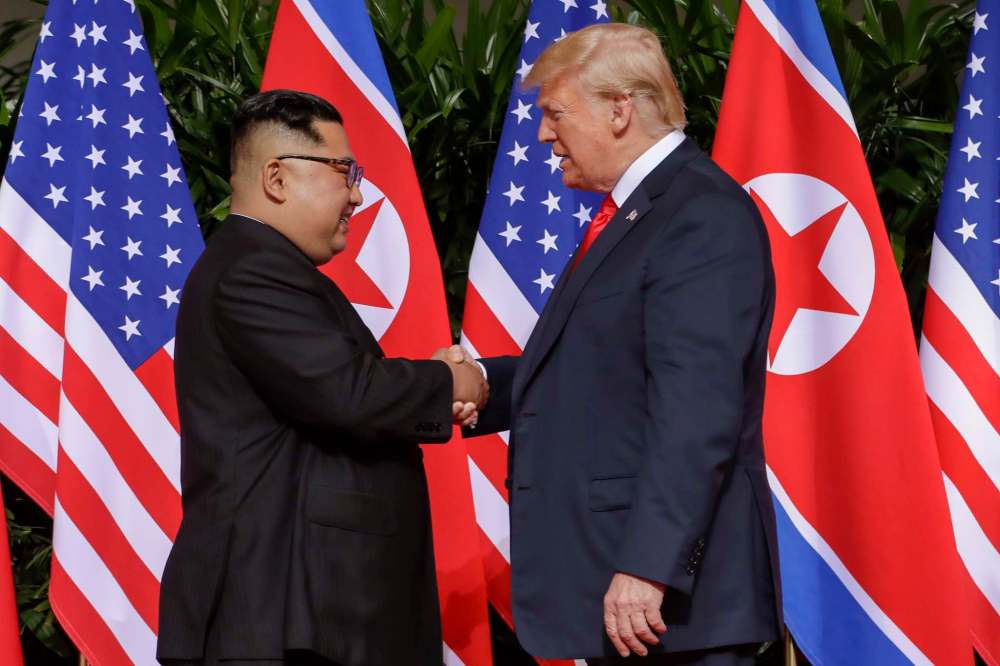
At last week’s Singapore summit between the United States and North Korea, the press conference took a strange detour when two large screens began showing a Korean-language video set up like a faux movie trailer. Many baffled journalists assumed it was a Pyongyang propaganda short, with its fawning images of Beloved Comrade Kim Jong-un and its bright, shiny pictures of his totalitarian state. Then it played a second time in English, and the assembled reporters found out it had been produced by the White House.
“I hope you liked it,” U.S. President Donald Trump told them. “I thought it was good.”
Trump then explained he had shown it to members of the North Korean delegation “on cassette” (nope, not on cassette), and they were fascinated.
“I think he loved it,” Trump said, speaking of the reaction of murderous dictator Kim.
So, what were the reactions from the non-dictator demographic? The next day — and probably after some quick checks to make sure the four-minute video wasn’t a parody from the Onion — the reviews started coming in. (“Sensational Idiocy.” “Totalitarian kitsch.” “Full of inspirational nonsense.” “Harebrained.”)
The New York Times did an Honest Trailers-style takedown (this time with more prison camp footage!). The Late Show with Stephen Colbert offered a comic pastiche titled “The Summit of All Fears: Mission Kimpossible 2: Singapore Drift.”
Political analysts and Koreanologists weighed in, but so did pop culture writers and film reviewers.
The summit itself was light on the difficult, tangible work of diplomacy and heavy on entertainment-type spectacle, from the pre-conference cliff-hangers to the flag-waving photo ops to a cameo appearance by former NBA star Dennis Rodman, so it makes some sense to look at the event in movie terms.
In this sense, the video (“Destiny Pictures presents… a story of opportunity”) makes an apt encapsulation.
The content is bizarre, and the form is slipshod and slapdash, inconsistent and incompetent. One of the many puzzles of the Trump presidency is how an administration so obsessed with appearances ends up with such crappy production values.
This supposedly stirring story of world-historical destiny suffers from monkey-with-a-knife editing, random graphics and terrible typefaces. This, in an era when the average teenager can produce a perfectly workable little film on a phone in a day.
Mixing propaganda with weird little stylistic touches from cheap promotional videos, late-night infomercials, 1980s public access television, 1990s action movies and bad buddy comedies, the trailer feels like a surprise gift for a tyrant who has murdered and enslaved hundreds of thousands of his own people (and is still described by Trump in gushing first-date terms as “smart” and “funny,” with “a great personality.”)
Viewed from a certain angle, the video also offers a Dr. Strangelove vibe — as if it’s satire but doesn’t realize it — with its odd, Orwellian phrasing and arbitrary, absurdist editing. Fans of the paranoid-movie genre might also see echoes of the brainwashing montage from the 1974 thriller The Parallax View.
The filmmaker — whoever this Ed Wood of political videos might be — leans hard on stock footage. There are galloping horses, dancing children and sunrises. (So many sunrises.) Meanwhile, a narrator in the movie-trailer style of Don LaFontaine (the “In a world…” guy) delivers the stilted storyline of “two men, two leaders, one destiny.”
Pumping up the Great Man theory of history, the film informs us that among the billions of people on Earth today, very few will leave a lasting mark on their era. (Cue images of the Taj Mahal, the Colosseum, the Egyptian pyramids, the Lincoln Memorial — basically all the recognized world landmarks that get blown up in Michael Bay sci-fi flicks.) Two of these history-changers are shown in a split-screen shot — Kim is seen waving to adoring-slash-terrified crowds, while Trump gives his trademark thumbs-up.

One man — that would be Kim — has a choice to make, the film suggests. He can go back to the past, which is pictured in black-and-white. (And not good, Guy Maddin-style black-and-white but bad, war atrocity black-and-white.) Or he can go forward into a Technicolor future of peace and prosperity — with speedboats, fancy food and waterfront condo construction. (As Trump has memorably said about the prospects for peace in North Korea: “Think of it from the real estate perspective.” All those undeveloped beaches.)
Near the end of this strange, short cinematic exercise, in which a complex geopolitical situation is transformed into a Hollywood-style trailer about two men, the narrator asks: “But what will be their sequel?”
As movie fans know, sequels usually suck. But even Trump haters better hope this one is successful.
alison.gillmor@freepress.mb.ca
Studying at the University of Winnipeg and later Toronto’s York University, Alison Gillmor planned to become an art historian. She ended up catching the journalism bug when she started as visual arts reviewer at the Winnipeg Free Press in 1992.
Our newsroom depends on a growing audience of readers to power our journalism. If you are not a paid reader, please consider becoming a subscriber.
Our newsroom depends on its audience of readers to power our journalism. Thank you for your support.
Studying at the University of Winnipeg and later Toronto’s York University, Alison Gillmor planned to become an art historian. She ended up catching the journalism bug when she started as visual arts reviewer at the Winnipeg Free Press in 1992.
Our newsroom depends on a growing audience of readers to power our journalism. If you are not a paid reader, please consider becoming a subscriber.
Our newsroom depends on its audience of readers to power our journalism. Thank you for your support.
Advertisement Advertise With Us
Advertisement Advertise With Us