WEATHER ALERT

Giraffe’s tale has long legs

Advertisement

Advertise with us

Now, before you stop and ask yourself why you’re reading a story about a giraffe — one who may be pregnant, but hasn’t even been confirmed to be — you need to travel back to the winter of 2017.

Read this article for free:

or

Already have an account? Log in here »

To continue reading, please subscribe:

Subscribe and receive a limited-edition Free Press branded hat or tote.

Digital Subscription

One year of digital access for only $205*

  • Enjoy unlimited reading on winnipegfreepress.com
  • Read the E-Edition, our digital replica newspaper
  • Access News Break, our award-winning app
  • Play interactive puzzles

*First annual payment billed as $205.00 + GST for one year. This annual subscription will automatically renew at $233.00 + GST every 52 weeks (10% off the regular annual price of $259.35). Offer available to new and qualified returning subscribers only. Cancel any time.

To continue reading, please subscribe:

Add Free Press access to your Brandon Sun subscription for only an additional

$1 for the first 4 weeks*

  • Enjoy unlimited reading on winnipegfreepress.com
  • Read the E-Edition, our digital replica newspaper
  • Access News Break, our award-winning app
  • Play interactive puzzles
Start now

*Your next Brandon Sun subscription payment will increase by $1.00 and you will be charged $17.95 plus GST for four weeks. After four weeks, your payment will increase to $24.95 plus GST every four weeks.

Hey there, time traveller!
This article was published 26/06/2018 (2940 days ago), so information in it may no longer be current.

Now, before you stop and ask yourself why you’re reading a story about a giraffe — one who may be pregnant, but hasn’t even been confirmed to be — you need to travel back to the winter of 2017.

April, the giraffe in question, was then an unknown giraffe, maybe even a little-down-on-her-luck giraffe, having ended up at a roadside zoo in Harpursville, N.Y., a hamlet of 3,500 people about 290 kilometres northwest of New York City, at the age of 15. For the uninitiated, that’s solidly approaching middle age in giraffe-years, and for this story’s purpose, we may guess that the animals share feelings similar to ours about the inexorable march of time, the feelings of futility that recognition sometimes evokes, and the ultimate inevitability that awaits us all.

But the park’s trainers had done April a favour by pairing her with another giraffe, Oliver — at five years old, practically jailbait and, ahem, likely inexperienced. In the wild, the young lad would have been lucky to have had a female giraffe even so much as glance at him. But here they were, two lonely giraffes together at the Animal Adventure Park in this out-of-the-way corner of the Earth, and well, you might be able to surmise what happened next.
Animal Adventure Park
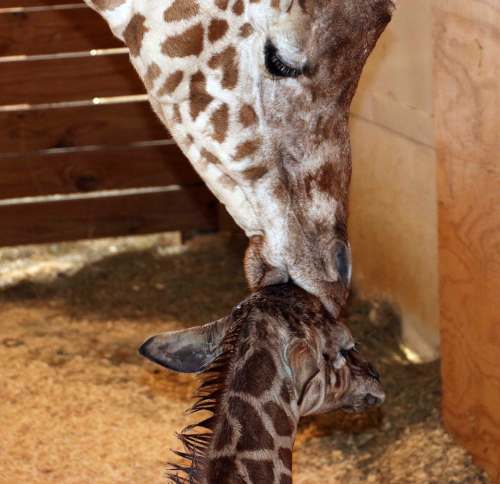
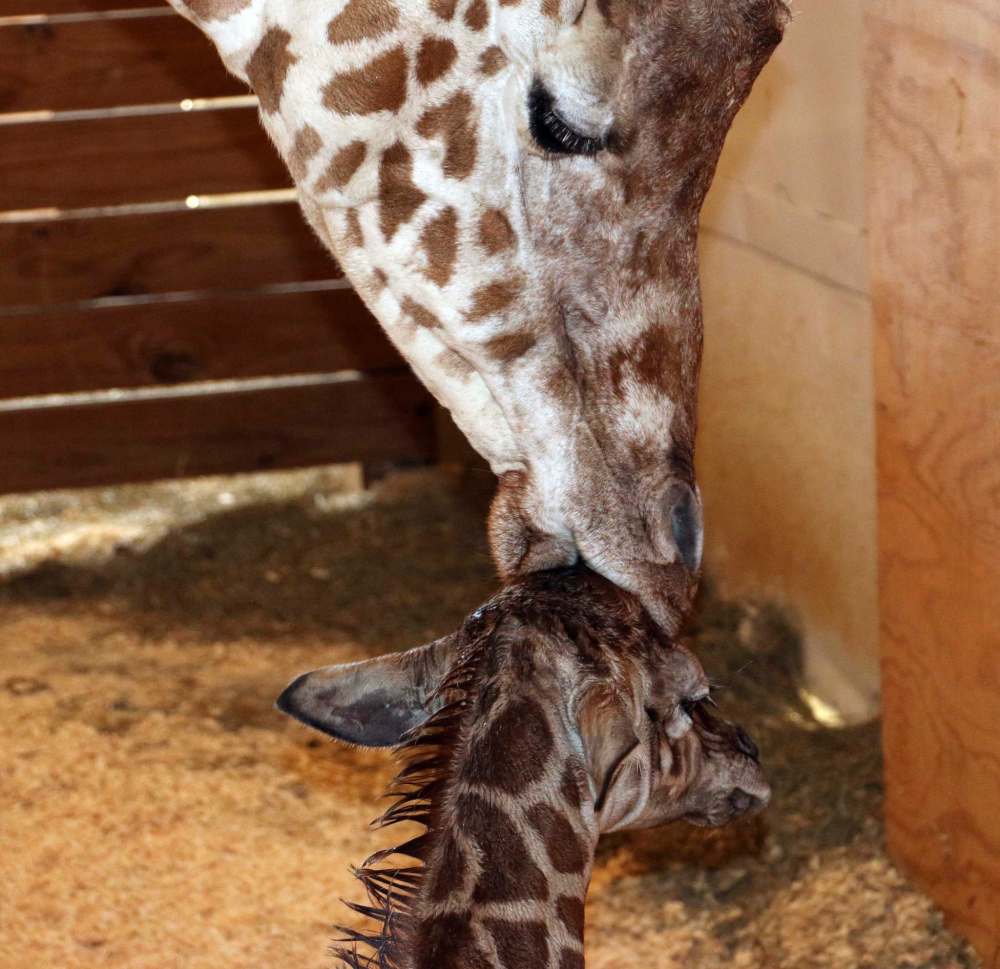
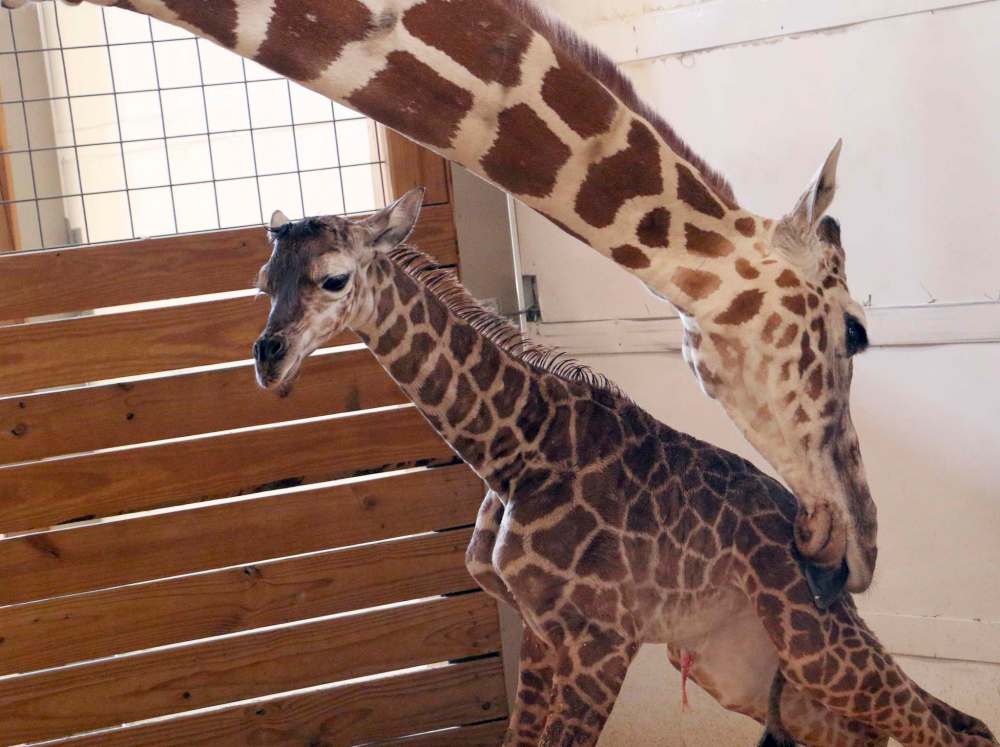
A giraffe named April kisses her new calf.
Animal Adventure Park A giraffe named April kisses her new calf.

April became pregnant with the calf who would be her fourth, and it is safe to say nothing was ever quite the same for her again. After her owners decided to livestream her pregnancy, April became an internet phenom, a YouTube starlet, the latest digital unknown to leap to worldwide fame without ever leaving the bedroom.

There were detractors, of course. But her fame only grew after the feed was briefly taken down in February 2017 by YouTube after some people, suspected to be animal rights activists, complained it displayed nudity and sexual content.

They couldn’t stop the sensation that was April. Millions of people tuned in from around the world to watch her as she paced around her pen, eagerly awaiting the calf’s birth, weathering frustration, boredom, ennui and eventually countless conspiracy theories as she blew past due dates in January, February and March. The BBC, no stranger to the intricacies of the gestation periods of royalty, called it the “most anticipated birth” since Prince George was born to William and Kate.

At its peak, April’s live stream drew more than five million views per day. And the attention raised hopes her fame could translate into a financial boost in Harpursville, where a once-thriving manufacturing sector had seen the harsh realities of the globalized economy in recent years.

Nearby hotels booked packages which included admission to the animal park; signs were installed along the highway by a local business development group. Finally, in her namesake month last year, the giraffe gave birth to Tajiri, now three metres tall at just over a year old.

And this week, April’s trainers said she might be pregnant again.

The act of conceiving is a typically sacred time, and one should give a couple space, to avoid prying and speculating — or worse, rumour-mongering — and wait patiently for the good news. But April lives in public now, to paraphrase the 2009 documentary about early internet livestreaming, and thus everything is perhaps on the table.

It’s certainly online, in the form of Animal Adventure Park’s Giraffe Cam.

Jordan Patch, the owner of the animal park, said in a video published on Facebook this week that another zoo was helping them complete tests to determine whether April was pregnant again.

“We have some exciting news,” he said.
Animal Adventure Park
A giraffe named April licks her new calf.
Animal Adventure Park A giraffe named April licks her new calf.

It was not exactly clear what the news was.

“We’ve done a lot of watching, a lot of looking, and we all have our opinions,” another zoo employee said in the video. But she noted they were not 100 per cent sure the giraffe was pregnant.

In a previous era, perhaps the story of an unconfirmed pregnancy of a giraffe, fair as she is, at a small zoo in, respectfully, the middle of nowhere, would have hardly made a splash. Perhaps the editors at places like Fox News, USA Today and the Washington Post would have cast their weary eyes at the subject matter and said firmly, “Next.”

Perhaps you would have moved on, too, saved a click, opened a book, gone outside.

But this is not an era like the ones before it. The livestream continues. The Facebook video got 870,000 views. And here we are.

— Washington Post
Report Error Submit a Tip

More Stories

Structural flaws affect health-care performance

Alan H. Menkis 6 minute read Preview

Structural flaws affect health-care performance

Alan H. Menkis 6 minute read 2:00 AM CDT

The record is not background. It is the forecast.

Past performance is the best available indicator of future performance. That principle belongs to every field in which the conditions producing a result are more durable than the result itself.

It belongs equally to health system governance. When the structural conditions that produced failure remain intact, the failure is not a risk. It is a probability.

Manitoba’s cardiac care program has been examined repeatedly and formally reviewed twice by the profession’s own experts, separated by more than a decade.

Read
2:00 AM CDT

Giraffe’s tale has long legs

Eli Rosenberg 5 minute read Preview

Giraffe’s tale has long legs

Eli Rosenberg 5 minute read Tuesday, Jun. 26, 2018

Now, before you stop and ask yourself why you’re reading a story about a giraffe — one who may be pregnant, but hasn’t even been confirmed to be — you need to travel back to the winter of 2017.

April, the giraffe in question, was then an unknown giraffe, maybe even a little-down-on-her-luck giraffe, having ended up at a roadside zoo in Harpursville, N.Y., a hamlet of 3,500 people about 290 kilometres northwest of New York City, at the age of 15. For the uninitiated, that’s solidly approaching middle age in giraffe-years, and for this story’s purpose, we may guess that the animals share feelings similar to ours about the inexorable march of time, the feelings of futility that recognition sometimes evokes, and the ultimate inevitability that awaits us all.

But the park’s trainers had done April a favour by pairing her with another giraffe, Oliver — at five years old, practically jailbait and, ahem, likely inexperienced. In the wild, the young lad would have been lucky to have had a female giraffe even so much as glance at him. But here they were, two lonely giraffes together at the Animal Adventure Park in this out-of-the-way corner of the Earth, and well, you might be able to surmise what happened next.

April became pregnant with the calf who would be her fourth, and it is safe to say nothing was ever quite the same for her again. After her owners decided to livestream her pregnancy, April became an internet phenom, a YouTube starlet, the latest digital unknown to leap to worldwide fame without ever leaving the bedroom.

Read
Tuesday, Jun. 26, 2018

The Manitoba Quiz Part 1

0 minute read Preview

The Manitoba Quiz Part 1

0 minute read Updated: Yesterday at 7:51 AM CDT

How well do you know our province? Part 1 of a two-part, 20-question quiz. Part 2 will come on Monday, July 20.

Read
Updated: Yesterday at 7:51 AM CDT

Would-be mayors respond to extreme heat

Marsha McLeod 3 minute read Preview

Would-be mayors respond to extreme heat

Marsha McLeod 3 minute read Yesterday at 7:00 AM CDT

With Winnipeg in the midst of an intense heat wave, the city has yet to introduce maximum heat legislation for rental housing.

In 2023, the Free Press and the Narwhal reported on calls by tenants and environmental advocates to enact a law that would require indoor temperatures in rental units not exceed 26 C. It would be similar to how Winnipeg landlords, under the city’s neighbourhood livability bylaw, must maintain a minimum daytime temperature of 21 C during cold weather.

On Sunday, the Free Press emailed all nine registered mayoral candidates asking for their policy plans to tackle the dangers of extreme heat, and specifically, whether they would support a change to the city’s bylaw to create heat protections for renters.

Eight candidates responded, and of them, six — Noah Redden, Don Woodstock, Mazher Alam, Christopher Clacio, Michael Vogiatzakis and Umar Hayat — said they would support (or support exploring) a bylaw amendment to establish a maximum indoor temperature threshold.

Read
Yesterday at 7:00 AM CDT

Folk fest donates leftover food to Siloam Mission

Scott Billeck 2 minute read Preview

Folk fest donates leftover food to Siloam Mission

Scott Billeck 2 minute read Updated: Yesterday at 5:14 PM CDT

Thousands of meals will be served at Siloam Mission this week thanks to a massive food donation from the Winnipeg Folk Festival.

More than 4,200 pounds — about two tonnes — of surplus food from the four-day festival that wrapped up Sunday was delivered to the mission on Monday.

The donation, consisting of prepared food, protein, dairy and fresh produce, is expected to provide enough ingredients to prepare about 6,000 meals for people experiencing homelessness and poverty.

“We are part of the Winnipeg community and when we can give back, we do,” said folk festival executive director Valerie Shantz.

Read
Updated: Yesterday at 5:14 PM CDT

If it works in Ontario, why not in Manitoba?

James Wilt 5 minute read Preview

If it works in Ontario, why not in Manitoba?

James Wilt 5 minute read Yesterday at 2:00 AM CDT

Grid-scale battery storage has fundamentally changed the global energy landscape — and Manitoba needs to get on board.

Battery systems store large amounts of excess electricity for when it’s most needed. While they can be charged from any generation source, they are especially beneficial for integrating wind and solar power, which vary with weather and time of day. Batteries allow electrical grids to meet the need for firm, dispatchable and affordable capacity using renewable energy, rather than relying on coal, nuclear and fossil gas. They also provide numerous other benefits, including reducing overloading of transmission infrastructure and helping to regulate the grid’s frequency and voltage.

Average costs for grid-scale batteries plummeted by more than half between 2023 and 2025 and installations have skyrocketed in China, the U.S., Australia and Europe. Texas now has 16,500 megawatts (MW) of battery storage, while California has 15,200 MW. Closer to home, Ontario recently awarded 640 MW of contracts to three battery storage projects in a competitive auction, with batteries beating out fossil gas-fired power plants on cost every time. One of these projects will be built near Dryden, only four hours east of Winnipeg.

Each battery system will provide eight hours of capacity but will cost considerably less than Ontario’s previous battery procurements, which provide only four hours of capacity. With this latest auction, Ontario has now secured 3,600 MW of battery storage capacity, including the operational Oneida (250 MW), Hagersville (300 MW) and Napanee (250 MW) projects. Almost all have significant Indigenous participation, with the latest procurements boasting 50 per cent First Nations ownership.

Read
Yesterday at 2:00 AM CDT