Blending history, legend and myth
FemFest welcomes Indian dance collective

Advertisement
Read this article for free:
or
Already have an account? Log in here »
To continue reading, please subscribe:

Digital Subscription
One year of digital access for only $205*
- Enjoy unlimited reading on winnipegfreepress.com
- Read the E-Edition, our digital replica newspaper
- Access News Break, our award-winning app
- Play interactive puzzles
*First annual payment billed as $205.00 + GST for one year. This annual subscription will automatically renew at $233.00 + GST every 52 weeks (10% off the regular annual price of $259.35). Offer available to new and qualified returning subscribers only. Cancel any time.
To continue reading, please subscribe:
Add Free Press access to your Brandon Sun subscription for only an additional
$1 for the first 4 weeks*
- Enjoy unlimited reading on winnipegfreepress.com
- Read the E-Edition, our digital replica newspaper
- Access News Break, our award-winning app
- Play interactive puzzles
*Your next Brandon Sun subscription payment will increase by $1.00 and you will be charged $17.95 plus GST for four weeks. After four weeks, your payment will increase to $24.95 plus GST every four weeks.
Read unlimited articles for free today:
or
Already have an account? Log in here »
Hey there, time traveller!
This article was published 13/09/2018 (2878 days ago), so information in it may no longer be current.
Even if you didn’t know Sowmya and Shyamala Dakshinamurti were lifelong dancers, you might be able to guess by watching them talk.
The Winnipeg sisters both use their hands dramatically while they speak, but there’s no wild gesticulating, just graceful elegance in service of telling a story, so it’s not surprising to learn that Sowmya, 49, and Shyamala, 50, have been dancing almost since they were able to walk.
The siblings are founding members of the Indian dance collective Manohar Performing Arts of Canada, specialists in a classical style of dance renowned for its narrative power.
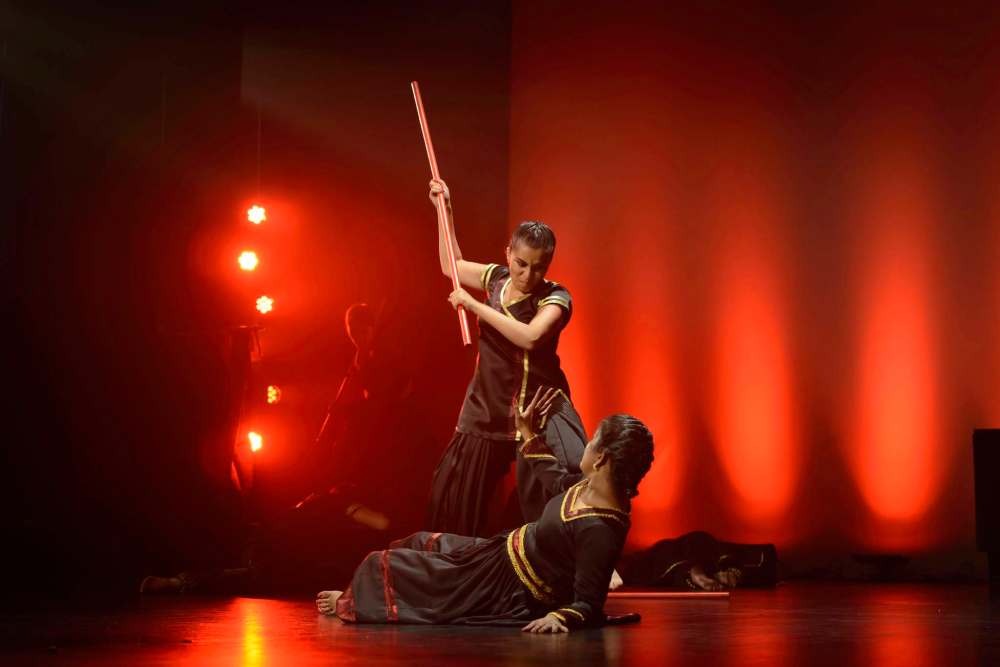
And The Game, the story they will tell onstage at this year’s FemFest, is an ancient, much-told tale, part of the Mahabharata, an epic Sanskrit poem that forms part of the backbone of Hindu philosophy. It resonates even today in the #MeToo era, asking pertinent questions about a woman’s agency and the authority she has over her own story.
It’s not new material to the women — with Manohar, they wrote and choreographed a version featuring a pre-recorded narrative that was blended with music to make a soundscape, which they performed in 2006 and 2012.
Manohar has been performing shows in Winnipeg since the 1990s, but this marks its first appearance at FemFest, Sarasvati Productions’ annual theatre festival with a focus on female playwrights.
After finding out their submission to present The Game at FemFest had been accepted, the Dakshinamurtis decided to take up Sarasvati’s Hope McIntyre on her suggestion to rework the play as a collaboration, incorporating dance elements with a narrative script performed by live actors; they both wrote, choreographed and perform in this new version.
“In way, it’s the sort of story that is best told through theatre, but it’s the sort of emotions that are best captured by dance,” Shyamala says. “Because some things are just too painful to be put into words.”
The play’s title refers to high-stakes game of dice between two warring families that spirals out of control when Draupadi, the collective wife of the Pandava brothers (it’s complicated), is dragged before the court, publicly shamed and disrespected.
Over the years, this epic poem has been reinterpreted and rewritten; Sowmya compares it to the story of King Arthur in the way it blends history, legend and myth.
“The story itself has one pivotal scene, and all the action in the second half turns on this moment, what happened there,” Shyamala explains. “And yet what’s written in the text is literally a beginning and an ending, and what happens in the middle feels blank when you read it.
“It feels blank because elements of that scene were interpolated centuries later, including a canonical miracle which had become, over the years, the centre of a lot of religious symbolism. You can’t touch that, but it was inserted later.”
“It’s like, was the Holy Grail originally part of the Arthurian legend?” Sowmya says. “We don’t know. It is now.”
That miracle — which sees the god Krishna come to Draupadi’s aid — is a bit of a smokescreen that covers up the essential violence of what happens to her; The Game strips that away.
“Reading it as a modern reader, if the laws of physics hold, there could be no miracle,” Shyamala says. “So how could you deconstruct that moment — what could have happened? What could have given rise to a legend? Using that very deconstructionist approach, we are retelling that story, but in a way what we wound up doing is telling the story five different ways.”
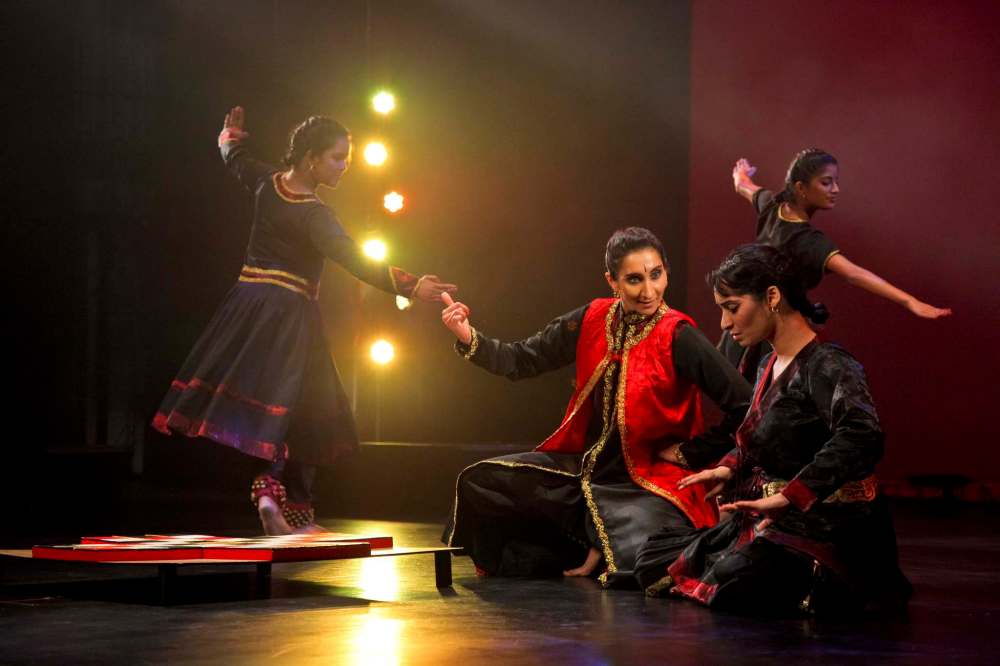
The Dakshinamurtis decided to write the play from the perspectives of many witnesses of what happened to Draupadi, each one with his or her own interpretation of the event. This Rashomon approach to the story allowed them seamlessly to integrate dance into the narrative.
“(In the show), when you’re walking into a dance, you’re walking into a person’s memories,” Shyamala says.
“The dancers are like the thought bubble that appears over someone’s head,” Sowmya explains.

“So the actor is saying, ‘Let me tell you how I remember it,’ and then the dancers are creating that person’s description.”
The sisters relished the opportunity FemFest provided to tell a story from outside the Eurocentric theatrical canon to Winnipeg audiences — and to the performers in their collaboration.
“It’s the universal feeling of engagement, of recognition — that character is myself,” Shyamala says. “Everyone finding their own ways into this material and recognizing… we all have different tellings of the same story.”
The Game has three performances: Sunday, Sept. 16, at 7 p.m.; Monday, Sept. 17 at 9 p.m.; and Saturday, Sept. 22, at 4 p.m.
jill.wilson@freepress.mb.ca Twitter: @dedaumier
Jill Wilson is the editor of the Arts & Life section. A born and bred Winnipegger, she graduated from the University of Winnipeg and worked at Stylus magazine, the Winnipeg Sun and Uptown before joining the Free Press in 2003. Read more about Jill.
Jill oversees the team that publishes news and analysis about art, entertainment and culture in Manitoba. It’s part of the Free Press‘s tradition, since 1872, of producing reliable independent journalism. Read more about Free Press’s history and mandate, and learn how our newsroom operates.
Our newsroom depends on a growing audience of readers to power our journalism. If you are not a paid reader, please consider becoming a subscriber.
Our newsroom depends on its audience of readers to power our journalism. Thank you for your support.
Theatre Preview
The Game
FemFest, Asper Centre for Theatre & Film
Sept. 16, 17 and 22
Tickets $15 at sarasvati.ca/femfest
FemFest 2018
The theme for Sarasvati Productions’ annual theatre festival celebrating the work of female playwrights is Staging Resistance. As always, the fest’s goal is to celebrate and promote women who make theatre, while presenting work that’s thought-provoking, socially conscious and transformative.
This year’s lineup includes White Man’s Indian by Darla Contois, Burnt by Ottawa’s Norah Paton, La Civilisation, ma mère, an adaptation of the novel by Driss Chraibi, presented by Compagnie du Jour & Compagnie L’Aparté in collaboration with Cercle Molière, a reading of Our Home & Native Land by Jo MacDonald and The Sound of the Beast by Torontonian and two-time Governor General’s Award nominee Donna-Michelle St. Bernard.
This year’s Bake-Off — a challenge for local playwrights, who had eight hours to create a five- to 10-minute scene using three provided ideas — will be held Monday, Sept. 17 at 7 p.m. and features works by Ntara Curry, Jo MacDonald, Allison Stier, Alissa Watson and Pamela Wolk. All the scenes will include these elements: a drone, children’s laughter and democracy for women.
FemFest runs Sept. 15-22. All performances take place at the Asper Centre for Theatre & Film (400 Colony St.). For a complete schedule, see sarasvati.ca.
Jill Wilson is the editor of the Arts & Life section. A born and bred Winnipegger, she graduated from the University of Winnipeg and worked at Stylus magazine, the Winnipeg Sun and Uptown before joining the Free Press in 2003. Read more about Jill.
Jill oversees the team that publishes news and analysis about art, entertainment and culture in Manitoba. It’s part of the Free Press‘s tradition, since 1872, of producing reliable independent journalism. Read more about Free Press’s history and mandate, and learn how our newsroom operates.
Our newsroom depends on a growing audience of readers to power our journalism. If you are not a paid reader, please consider becoming a subscriber.
Our newsroom depends on its audience of readers to power our journalism. Thank you for your support.
Advertisement Advertise With Us
Advertisement Advertise With Us