

Juba defied the odds to beat the incumbent
Advertisement
Read this article for free:
or
Already have an account? Log in here »
To continue reading, please subscribe:
Digital Subscription
One year of digital access for only $1.44 a week*
- Enjoy unlimited reading on winnipegfreepress.com
- Read the E-Edition, our digital replica newspaper
- Access News Break, our award-winning app
- Play interactive puzzles
*Billed as $5.77 plus GST every four weeks. After 52 weeks, price increases to the regular rate of $19.95 plus GST every four weeks. Offer available to new and qualified returning subscribers only. Cancel any time.
To continue reading, please subscribe:
Add Free Press access to your Brandon Sun subscription for only an additional
$1 for the first 4 weeks*
- Enjoy unlimited reading on winnipegfreepress.com
- Read the E-Edition, our digital replica newspaper
- Access News Break, our award-winning app
- Play interactive puzzles
*Your next Brandon Sun subscription payment will increase by $1.00 and you will be charged $17.95 plus GST for four weeks. After four weeks, your payment will increase to $24.95 plus GST every four weeks.
Read unlimited articles for free today:
or
Already have an account? Log in here »
Hey there, time traveller!
This article was published 25/09/2018 (2811 days ago), so information in it may no longer be current.
With a month or so to go until the civic election, the most recent poll suggests that many Winnipeggers have yet to make up their minds about who their choice for mayor will be. Still, Brian Bowman likely has a good chance of keeping his job and serving another four-year term.
Bowman also has history on his side, because every incumbent running for mayor of Winnipeg in the past 60 years has been victorious. As Free Press columnist Dan Lett has pointed out, incumbents for the mayoralty and city council have built-in advantages over their opponents: name recognition, constant media attention and financial resources.
The last time a sitting mayor lost an election was on Oct. 24, 1956, when George Sharpe, a genial 49-year-old electrical engineer and head of his family’s electrical business, was defeated by 42-year-old Stephen Juba, arguably the most colourful and lovable character to ever serve as the city’s mayor. This marked the beginning of Juba’s unprecedented 20-year reign as Winnipeg’s mayor.
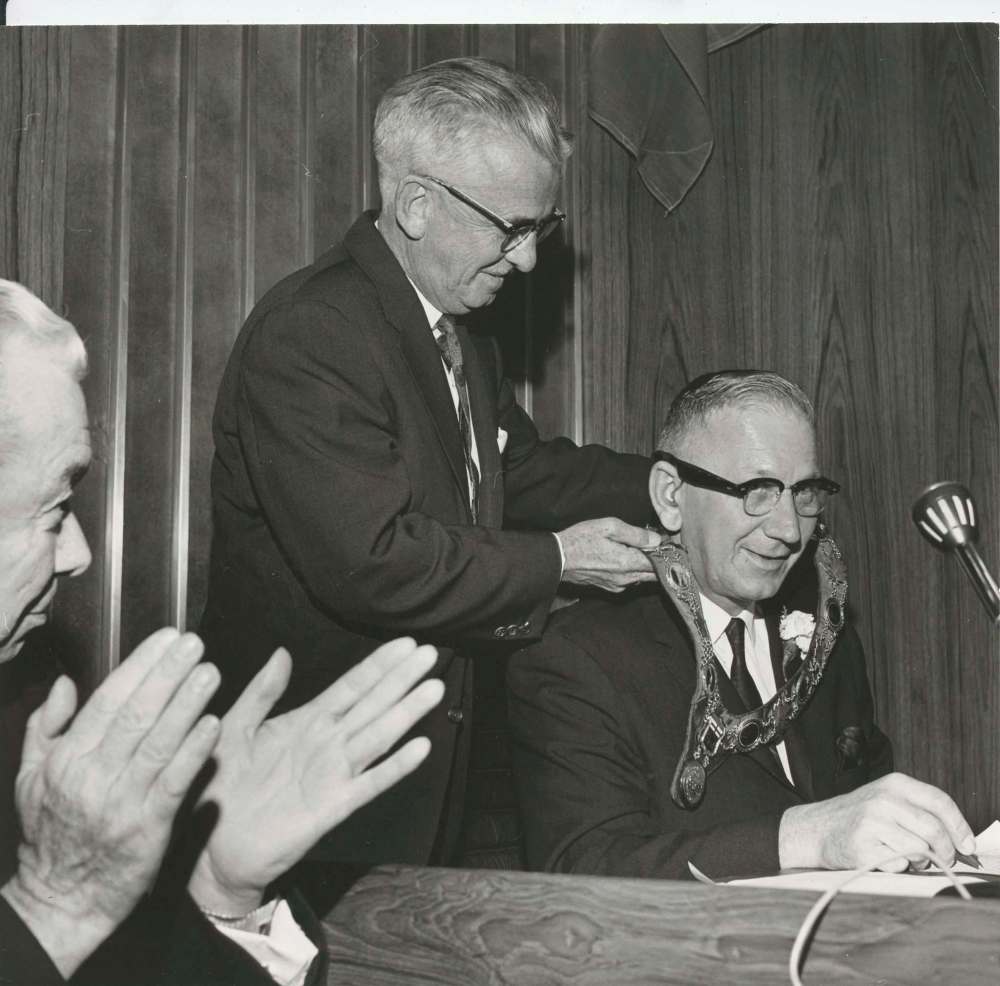
Sharpe was expected to beat Juba, just as he had done in the 1954 election. Sharpe was a typical anglophone Winnipeg leader of his day.
His father, Thomas, had served as the city’s mayor from 1903 to 1905 and later was the president of the Winnipeg Conservative Association. Following in his footsteps, George had been elected as a city alderman in 1946.
He was a member of the Winnipeg Winter Club, St. Charles Country Club and the Manitoba Club. Moreover, he had been endorsed by the city’s business establishment and former mayor Garnet Coulter. Former Manitoba premier Douglas Campbell had helped Sharpe’s campaign by promising a new site for city hall.
Juba, on the other hand, was the son of Ukrainian immigrants and had grown up in Brooklands. He had dropped out of school after completing Grade 10. He became an entrepreneur, hawking car alarms and paint before eventually establishing Keystone Supply, a plumbing and electrical distributor, in 1945. Juba chalked up more losses than wins until he finally won a seat in the provincial legislature in 1953.
During the mayoralty contest against Sharpe, Juba made exactly one speech and distributed 40,000 pamphlets. He only announced his candidacy at the beginning of October. With nearly unlimited resources, Sharpe spent about $15,000 (with a purchasing power today of approximately $140,000) on his campaign, while Juba’s expenses were less than $1,000.
Sharpe also refused to participate in a major public debate eight days before the vote. Juba, on the other hand, was a visionary — if only Winnipeg had a monorail today, as Juba proposed two decades later — and took advantage of Sharpe’s absence at the public forum to offer his ideas about reforming the city government.
Sharpe remained the choice of both the Free Press and the Tribune. A few days before the election, the Free Press’s editors concluded that Juba “would be a larger risk than the citizens of Winnipeg should wisely take.”
A sufficient number of voters, however, did not heed that advice. Juba only defeated Sharpe by 1,931 votes — 46,197 to 44,266 — yet his victory was a significant moment in Winnipeg history. Juba was perceived as a “man of the people,” an image he fostered for the next two decades. In subsequent elections, no opponent ever came close to beating him.

Moreover, like the election of William Hawrelak, who was also of Ukrainian heritage, as mayor of Edmonton in 1951, and the elections of the first Jewish mayors in Toronto and Halifax — Nathan Phillips in Toronto 1954 and Leonard Kitz in Halifax in 1955 — Juba’s victory was evidence that Canadian attitudes were changing and that a slight power shift was taking place in all four cities as the so-called “ethnic” middle class asserted itself politically.
During a typical Winnipeg civic campaign, candidates for mayor, including the incumbent, offer voters big plans to accomplish much: removing the barriers at Portage and Main, freezing property taxes, cleaning up the rivers, fixing roads — the list is endless and very expensive.
After the votes are counted, reality sets in and the new mayor soon learns that, unlike a prime minister or premier, his or her power is limited. Not only is the mayor dependent on the support of (in theory) independent and non-partisan city councillors, but more importantly, the mayor must adhere to provincial dictates.
The overriding factor in civic politics is that the City of Winnipeg is a creature of the province, and for the most part, its finances and ability to effect change is entirely in the hands of the provincial government. Ontario Premier Doug Ford’s unilateral decision to cut Toronto city council in half is an example. On Oct. 24, Winnipeg voters should keep that political reality in mind and temper their expectations, because whatever grand promises have been made, the odds are high that most of them will not be delivered upon by the next election four years from now.
Now & Then is a column in which historian Allan Levine puts the events of today in a historical context.