

Rail union calls for independent investigation of derailment deaths
Advertisement
Read this article for free:
or
Already have an account? Log in here »
To continue reading, please subscribe:

Digital Subscription
One year of digital access for only $205*
- Enjoy unlimited reading on winnipegfreepress.com
- Read the E-Edition, our digital replica newspaper
- Access News Break, our award-winning app
- Play interactive puzzles
*First annual payment billed as $205.00 + GST for one year. This annual subscription will automatically renew at $233.00 + GST every 52 weeks (10% off the regular annual price of $259.35). Offer available to new and qualified returning subscribers only. Cancel any time.
To continue reading, please subscribe:
Add Free Press access to your Brandon Sun subscription for only an additional
$1 for the first 4 weeks*
- Enjoy unlimited reading on winnipegfreepress.com
- Read the E-Edition, our digital replica newspaper
- Access News Break, our award-winning app
- Play interactive puzzles
*Your next Brandon Sun subscription payment will increase by $1.00 and you will be charged $17.95 plus GST for four weeks. After four weeks, your payment will increase to $24.95 plus GST every four weeks.
Read unlimited articles for free today:
or
Already have an account? Log in here »
Hey there, time traveller!
This article was published 01/10/2018 (2930 days ago), so information in it may no longer be current.
OTTAWA — Canada’s main rail union is claiming paramedics were delayed access to last month’s deadly derailment along the railway leading to Churchill, calling for a fourth body to investigate the incident.
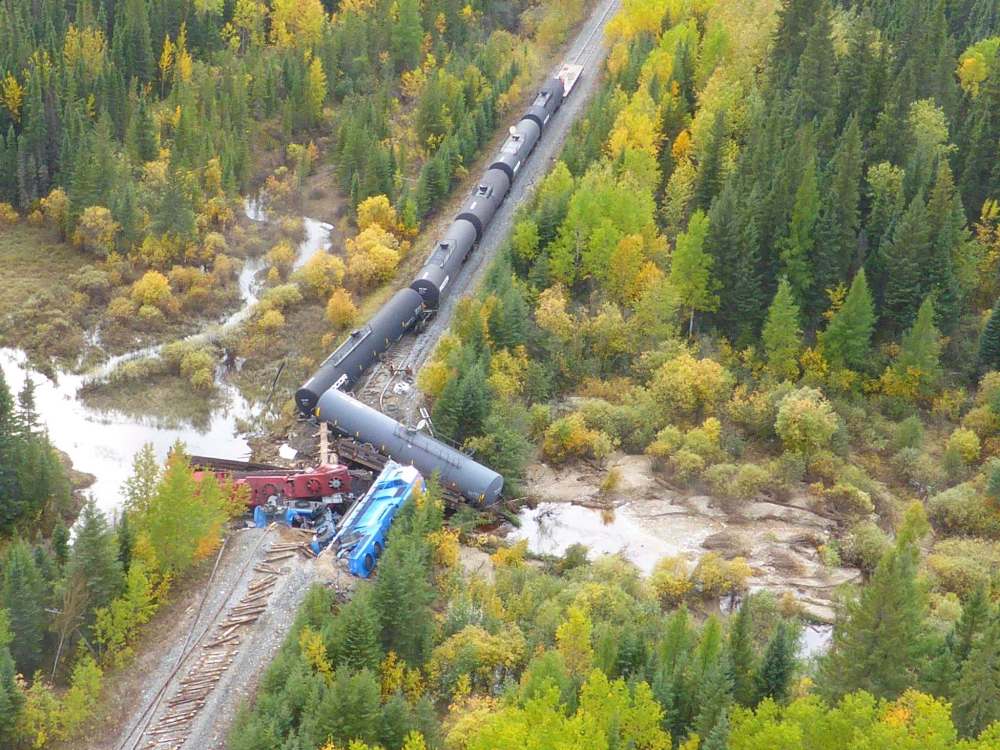
On Sept. 15, a train along the Hudson Bay Railway derailed south of Thompson, hundreds of miles away from the repairs being made between Churchill and Gillam. Two men were crushed; officials pronounced a 38-year-old conductor dead at the scene, and airlifted a 59-year-old engineer to Winnipeg.
On Monday, Teamsters Canada Rail Conference asked Manitoba’s chief medical examiner to do a coroner’s inquest. In an open letter, the union claims paramedics in a nearby town were not allowed to attend the scene for more than nine hours, and the man who died bled out as a result of his injuries.
“Paramedics, despite being in Ponton, where not allowed to attend the wreck and administer emergency treatment to the injured crew, apparently due to concerns about diesel fuel leakage,” reads the letter.
“The injuries sustained by the conductor were entirely survivable, assuming reasonable medical care. None was forthcoming.”
They even claim a helicopter crew only arrived at the scene through “a fluke observation,” when they were picking up a prospector two hours after the derailment and saw the collapsed train.
The union would not publicly specify the source of that allegation, but its letter paints a vivid detail from the scene.
It claims the helicopter landed on a narrow sandbar, and a prospector and two colleagues “climbed through the bush and wreckage” to look for people.
“The prospector heard the shouts of the injured crew members and observed a hand sticking out of the window. He climbed down to the crushed locomotive and found the two men, trapped, injured, but alive. The others climbed on top of the wreckage, trying to find higher ground and (cellphone) service,” the letter reads.
That letter claims the helicopter pilot was able to bring Mounties and some supplies, but not paramedics nor medicine. It claims an autopsy found the conductor had bled to death; the Free Press was not able to obtain that report.
“The engineer was cut loose and first saw paramedic treatment more than nine hours after help was called,” the letter claims.
Teamsters spokesman Christopher Monette said he couldn’t publicly reveal the source of the information, but the letter cites “firsthand, contemporaneous reports” of what happened.
“One of our members died of injuries, and nobody should die of a fracture, as it seems,” Monette said in an interview.
The Transportation Safety Board is still investigating the incident, but its Manitoba head said the train derailed because a flush of water “possibly related to beaver activity” washed out two culverts.

The union claims Omnitrax, which owned the railway until a month ago, “eliminated the beaver control program some three years ago” despite other carriers maintaining similar programs “to ensure that there are not significant buildups of water caused by beaver dams in the backcountry.”
In addition to the TSB, Transport Canada is probing whether labour rules were followed, and the railway’s new owner, Arctic Gateway, is doing its own probe. The new firm says safety is paramount and the ongoing Churchill repairs will be done right, even if that means rail service isn’t restored by the winter freeze-up.
Yet the union letter ominously claims the railway is not safe. “There are dozens of similar structures across the HBR system, all potentially at risk.”
The train spanned 25 cars, and three locomotives derailed along with four cars carrying gravel for the Churchill repairs and fuel. The train has leaked diesel into the Metishto River, and it was also carrying gasoline, liquid propane gas and butane.
dylan.robertson@freepress.mb.ca
Related Articles
Lack of details hampered response to remote derailment, fire chief tells inquest into 2018 fatality
Advertisement Advertise With Us
Advertisement Advertise With Us
History
Updated on Monday, October 1, 2018 7:16 PM CDT: Fixes pdf link