Spotlight shines on first man on the moon
Movie offers gripping account of Armstrong's life

Advertisement
Read this article for free:
or
Already have an account? Log in here »
To continue reading, please subscribe:

Digital Subscription
One year of digital access for only $205*
- Enjoy unlimited reading on winnipegfreepress.com
- Read the E-Edition, our digital replica newspaper
- Access News Break, our award-winning app
- Play interactive puzzles
*First annual payment billed as $205.00 + GST for one year. This annual subscription will automatically renew at $233.00 + GST every 52 weeks (10% off the regular annual price of $259.35). Offer available to new and qualified returning subscribers only. Cancel any time.
To continue reading, please subscribe:
Add Free Press access to your Brandon Sun subscription for only an additional
$1 for the first 4 weeks*
- Enjoy unlimited reading on winnipegfreepress.com
- Read the E-Edition, our digital replica newspaper
- Access News Break, our award-winning app
- Play interactive puzzles
*Your next Brandon Sun subscription payment will increase by $1.00 and you will be charged $17.95 plus GST for four weeks. After four weeks, your payment will increase to $24.95 plus GST every four weeks.
Read unlimited articles for free today:
or
Already have an account? Log in here »
Hey there, time traveller!
This article was published 06/10/2018 (2925 days ago), so information in it may no longer be current.
TORONTO — Assuming you don’t believe the moon landing was faked by a Stanley Kubrick-led film crew, you should be fairly confident that the first man to set foot on the moon was astronaut Neil Armstrong.
But if you primarily know history from what you see at the movies, you probably know little about the Ohio aviator, the most famous astronaut of all. Even in the guise of an actor, he did not appear in The Right Stuff (1983) and an actor plays Armstrong in a brief appearance in Apollo 13 (1985), other celebrated films about space travel.
Armstrong, who died in 2012, remained an enigmatic and private man. The challenge of bringing him to the screen fell to filmmaker Damien Chazelle, the Oscar-winning director of films that previously centred around music: La La Land, the 2016 movie musical for which he won the Oscar for best director, and Whiplash (2015), the story of a drummer’s fractious relationship with a malevolent jazz instructor.
It is tricky to ascertain the through-line that led Chazelle from those films to First Man, his screen portrait of Armstrong starring La La Land leading man Ryan Gosling as Armstrong.
At the Toronto International Film Festival, where the film had a gala screening in September, Chazelle offered a clue as to how his fascination with Armstrong links with his previous films.
“In some way, I’ve always been interested in people who have a hard time communicating their emotions in the ‘normal way,’” Chazelle said.
“With a musical, you can resort to song and dance to communicate those emotions in a way that words can’t,” he said.
“With Neil, there was such poetry in looking at his life, in the story of someone who seemed to sublimate his emotions into his work, into this passion he had ever since he was a little boy — a passion for aviation.
“This is someone who learned how to fly before he learned how to drive.”
Chazelle met with Gosling to discuss taking the role before he even cast the Canadian actor as the lead in La La Land, Chazelle said.
“The first time we ever met initially was to talk about this movie,” Chazelle said. “I was in the early stages of getting La la Land off the ground. I had just done Whiplash and I saw this movie initially as almost an opportunity to explore a similar theme: the cost of a goal, the cost of certain kinds of ambition. So, I met with Ryan and talked about it and the conversation segued to Gene Kelly very quickly. And then we did La La Land together. But right from the get-go, I knew I wanted to work with him on this.”
For his part, Gosling was entranced with the subject, although he admitted to not knowing much about Armstrong.
“As soon as I learned what the moon was, I learned that a man named Neil Armstrong walked on it,” Gosling said. “He was always synonymous with the moon. But, like the moon, I knew very little about him. When I met with Damien, he told me that he wanted to uncover the man behind the myth, and once I started to learn about Neil and his wife, Janet, I realized this incredible life was deserving of the tribute that Damien wanted to pay to it.”
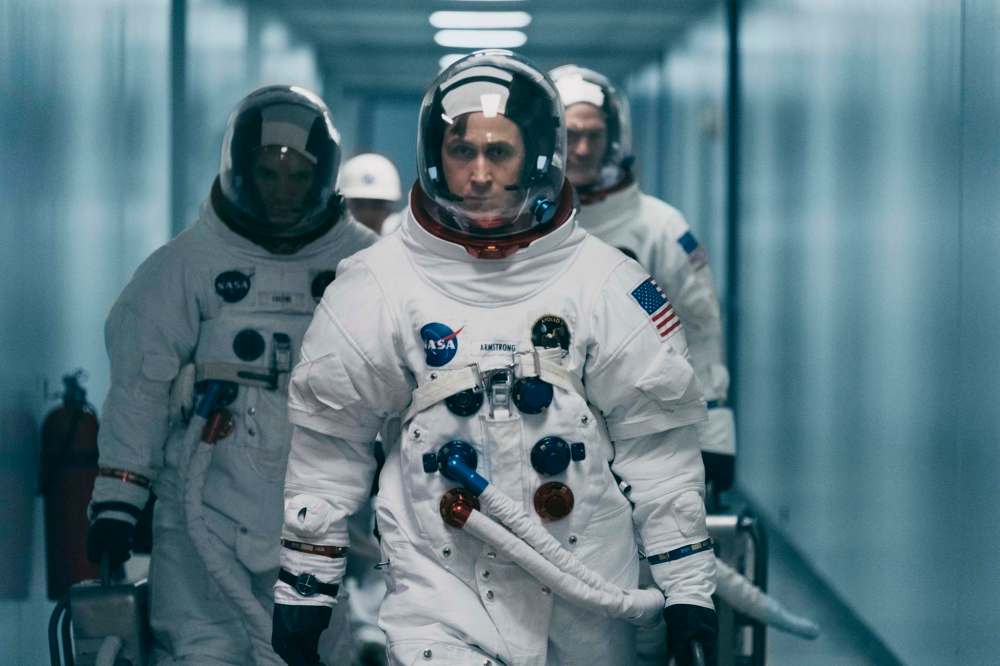
Chazelle and the producers got access to Janet (who died a few months ago), Armstrong’s two sons and a host of people who knew him and worked with him. But he also gained some insight into the man just from seeing his origins.
“Ryan and I went to the cornfields in Ohio where he grew up in this old farmhouse. It’s not in the movie, but it informed a lot of what we did in the movie,” Chazelle said.
“You go there and you see this sea of flat cornfields and this giant sky and you can suddenly understand why Ohio produces more astronauts than any other state in the U.S. and any other part in the world,” he said.
“This idea of someone who was just continually drawn… up there.
“He couldn’t even communicate why necessarily, but he needed to find answers up there,” Chazelle said.
“It became the real through-line for us, about how difficult it is for someone whose eyes are locked on the sky, how difficult it can be to lock his eyes down on the earth, to engage and communicate on earth.”
randall.king@freepress.mb.caTwitter: @FreepKing
Our newsroom depends on a growing audience of readers to power our journalism. If you are not a paid reader, please consider becoming a subscriber.
Our newsroom depends on its audience of readers to power our journalism. Thank you for your support.
Movie preview
First Man
● Starring Ryan Gosling
● Opens Oct. 12
Our newsroom depends on a growing audience of readers to power our journalism. If you are not a paid reader, please consider becoming a subscriber.
Our newsroom depends on its audience of readers to power our journalism. Thank you for your support.
Advertisement Advertise With Us
Advertisement Advertise With Us