WEATHER ALERT

Repeat outbreaks pressure produce industry to step up safety

Advertisement

Advertise with us

NEW YORK - After repeated food poisoning outbreaks linked to romaine lettuce, the produce industry is confronting the failure of its own safety measures in preventing contaminations.

Read this article for free:

or

Already have an account? Log in here »

To continue reading, please subscribe:

Subscribe and receive a limited-edition Free Press branded hat or tote.

Digital Subscription

One year of digital access for only $205*

  • Enjoy unlimited reading on winnipegfreepress.com
  • Read the E-Edition, our digital replica newspaper
  • Access News Break, our award-winning app
  • Play interactive puzzles

*First annual payment billed as $205.00 + GST for one year. This annual subscription will automatically renew at $233.00 + GST every 52 weeks (10% off the regular annual price of $259.35). Offer available to new and qualified returning subscribers only. Cancel any time.

To continue reading, please subscribe:

Add Free Press access to your Brandon Sun subscription for only an additional

$1 for the first 4 weeks*

  • Enjoy unlimited reading on winnipegfreepress.com
  • Read the E-Edition, our digital replica newspaper
  • Access News Break, our award-winning app
  • Play interactive puzzles
Start now

*Your next Brandon Sun subscription payment will increase by $1.00 and you will be charged $17.95 plus GST for four weeks. After four weeks, your payment will increase to $24.95 plus GST every four weeks.

Hey there, time traveller!
This article was published 29/11/2018 (2800 days ago), so information in it may no longer be current.

NEW YORK – After repeated food poisoning outbreaks linked to romaine lettuce, the produce industry is confronting the failure of its own safety measures in preventing contaminations.

The E. coli outbreak announced just before Thanksgiving follows one in the spring that sickened more than 200 people and killed five, and another last year that sickened 25 and killed one. No deaths have been reported in the latest outbreak, but the dozens of illnesses highlight the challenge of eliminating risk for vegetables grown in open fields and eaten raw, the role of nearby cattle operations that produce huge volumes of manure and the delay of stricter federal food safety regulations.

A contested aspect of the regulation, for example, would require testing irrigation water for E. coli. The Food and Drug Administration put the measure on hold when the produce industry said such tests wouldn’t necessarily help prevent outbreaks. Additional regulations on sanitation for workers and equipment — other potential sources of contamination — only recently started being implemented.
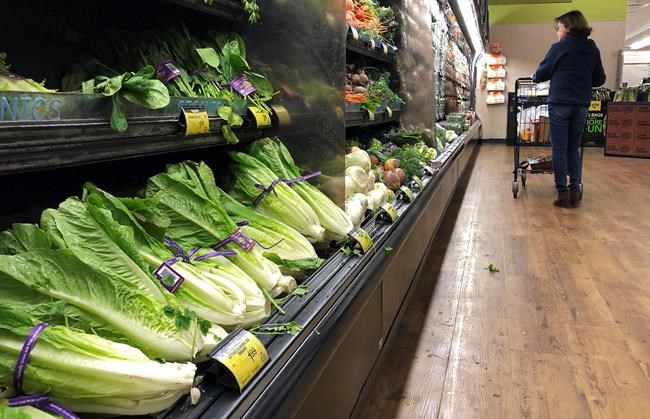
FILE - In this Nov. 20, 2018 file photo, romaine lettuce sits on the shelves as a shopper walks through the produce area of an Albertsons market in Simi Valley, Calif. After repeated food poisoning outbreaks linked to romaine lettuce, the produce industry is confronting the failure of its own safety measures in preventing contaminations. The latest outbreak underscores the challenge of eliminating risk for vegetables grown in open fields and eaten raw. It also highlights the role of nearby cattle operations and the delay of stricter federal food safety regulations. (AP Photo/Mark J. Terrill, File)

FDA Commissioner Scott Gottlieb said he thinks the combination of rules, once fully in place, will make vegetables safer to eat.

“I don’t think any one element of this is going to be the magic bullet,” Gottlieb said.

Health officials say improved detection may make outbreaks seem more frequent. Still, that is intensifying pressure on growers and regulators to prevent, catch and contain contamination.

PREVENTION

It’s not yet known how romaine got contaminated in the latest outbreak.

The spring outbreak was traced to romaine from Yuma, Arizona. Irrigation water tainted with manure was identified as a likely culprit, and investigators noted the presence of a large animal feeding operation nearby.

Subsequently, an industry agreement in Arizona and California was adjusted to expand buffer zones between vegetable fields and livestock. The industry says the change was in place for lettuce now being grown in Yuma, which hasn’t been implicated in the latest outbreak. But Trevor Suslow of the Produce Marketing Association said there isn’t consensus about the exact distances that might effectively prevent contamination.

He noted specific buffer zones aren’t required by the new federal rules on produce safety.

“They look to the industry to determine what is the appropriate distance,” Suslow said.

Growers in Yuma also started treating irrigation water that would touch plant leaves with chlorine to kill potential contaminants, Suslow said. But he said such treatment raises concerns about soil and human health.

Meanwhile, the proximity of produce fields to cattle operations is likely to continue posing a problem. Travis Forgues of the milk producer Organic Valley noted consolidation in the dairy industry is leading to bigger livestock operations that produce massive volumes of manure.

TESTING

Already, the industry agreement in Arizona and California requires leafy green growers to test water for generic E. coli.

But James Rogers, director of food safety research at Consumer Reports, said it’s important to make water testing a federal requirement. Since romaine is often chopped up and bagged, a single contaminated batch from one farm that skips testing could make a lot of people sick, he said.

Teressa Lopez of the Arizona Leafy Greens Marketing Agreement also said federal regulation can ensure greater compliance, even though the industry agreement has stricter measures.

Despite industry measures implemented after a spinach outbreak more than a decade ago, health officials noted this month there have been 28 E. coli outbreaks linked to leafy greens since 2009.

The produce industry says the failure to prevent the Yuma outbreak could also reflect the limitations of testing water for generic E. coli.

Elizabeth Bihn, a food science expert at Cornell University, said the tests look for the amount of fecal matter in water. The problem is, “some feces has pathogens in it, some feces doesn’t,” said Bihn, who is part of a federal program helping farmers comply with the new produce regulations.

Testing for specific E. coli strains that are harmful is more difficult, and it doesn’t rule out the possibility of other harmful bacteria, Bihn said.

CONTAINING

Whole-genome sequencing is making it easier to detect outbreaks, which is pressuring the produce industry.

The FDA warned against all romaine last week because it said it was able to identify it as a likely source early enough. The agency narrowed its warning to romaine from California’s Central Coast after the produce industry agreed to label romaine with harvest dates and regions, so people know what’s OK to eat.

The labeling is voluntary, and the industry said it will evaluate whether to extend it to other leafy greens. Gottlieb said improving traceability would allow targeted health alerts that don’t hurt the entire industry. The FDA recently hired a former Walmart executive who used blockchain technology to improve traceability in the retailer’s supply chain.

Stephen Basore, director of food safety at a Florida romaine grower, said he expects more regulations and self-imposed industry guidelines.

“Anytime there is an issue, the immediate response is saying our protocols aren’t enough,” he said.

___

AP reporter Josh Replogle contributed from Florida.

___

The Associated Press Health & Science Department receives support from the Howard Hughes Medical Institute’s Department of Science Education. The AP is solely responsible for all content.


Report Error Submit a Tip

More Stories

Mayor backs new way to handle 911 mental health, addiction calls

Malak Abas 7 minute read Preview

Mayor backs new way to handle 911 mental health, addiction calls

Malak Abas 7 minute read Updated: Yesterday at 5:47 PM CDT

Mayor Scott Gillingham is enthusiastically endorsing a proposal to change the city’s crisis-response system, potentially diverting 10,000 calls away from overburdened police, fire and paramedic services every year.

The “fourth crisis response pathway” would allow 911 calls that aren’t violent or criminal in nature to be transferred to citywide crisis-response teams, staffed in part through current community resources, which could include the Downtown Community Safety Partnership and The Link’s mobile crisis teams.

A community crisis dispatch and co-ordination hub would receive triaged calls and match them with the teams, which would move them out of the Winnipeg Police Service and Winnipeg Fire and Paramedic Service calls for service.

“Every day, our 911 dispatchers receive calls from Winnipeggers who are in distress, dealing with complex mental health struggles, addiction, or wellness concerns,” Gillingham said after releasing a report on the proposal Tuesday.

Read
Updated: Yesterday at 5:47 PM CDT

WAG wraps exhibition showcasing fine art of a sweet bike

Tiago Resko 4 minute read Preview

WAG wraps exhibition showcasing fine art of a sweet bike

Tiago Resko 4 minute read 7:49 PM CDT

Growing up in rural Manitoba, Allen Hildebrand was always tinkering with something. While on a flight to Mexico in 2016, it felt like an act of fate when he picked up a magazine and opened it to the ultimate project.

“It had this dirty old bike on it and I was like, ‘I want one of these in my life,’” Hildebrand says.

After 10 years, he is running out of space in his garage after filling it with four bikes, two of which are featured in a pop-up motorcycle exhibition at the WAG-Qaumajuq that ends Thursday.

The art gallery is broadening the perspective of what fine art can be with Art Moto: Where Design Meets the Road, featuring 25 motorbikes hand-built by local enthusiasts and set up in the gallery’s main hall and skylight.

Read
7:49 PM CDT

Autopsy confirms dog attack killed animal-rescue volunteer on First Nation

Free Press staff 3 minute read Preview

Autopsy confirms dog attack killed animal-rescue volunteer on First Nation

Free Press staff 3 minute read Yesterday at 3:48 PM CDT

An autopsy has confirmed an animal rescue volunteer died of a dog attack on Sandy Bay Ojibway Nation earlier this month, the Manitoba First Nations Police Service says.

Amanda Nobiss, a 37-year-old woman from Winnipeg, was found dead in Sandy Bay on July 17 after police were contacted by a friend trying to locate her.

She often visited the community 180 kilometres northwest of Winnipeg to save animals.

The police service said Tuesday that an autopsy confirmed her “injuries were consistent with a dog attack.”

Read
Yesterday at 3:48 PM CDT

Gaps in homecare leave Winnipeg man in perilous situation

Nicole Buffie 4 minute read Preview

Gaps in homecare leave Winnipeg man in perilous situation

Nicole Buffie 4 minute read 6:00 AM CDT

Tom Landy fears he won’t live long enough to receive adequate homecare.

The 49-year-old Winnipegger has spinal muscular atrophy, a degenerative disease, and requires 24-7 homecare, but gaps in his care leave him sitting in one spot for hours and lately he’s developed bed sores.

Landy was approved for around-the-clock care in June 2025, but staffing issues and an investigation into a homecare worker’s workplace injury have left him without help for periods of time throughout the day and forced his 76-year-old father to fill in.

“This is what they’re here for, to take care of me, and now it feels like I’m a burden,” he said from his home in the Maples.

Read
6:00 AM CDT

Rivers restoration projects get a funding boost

Alex Lambert 3 minute read Preview

Rivers restoration projects get a funding boost

Alex Lambert 3 minute read 6:36 PM CDT

RIVERS — The provincial government is providing $98,000 to help restore the Rivers train station, develop a bicycle museum on the site and expand bike trails in the community.

The train station is an important part of the province’s history, said Municipal Relations Minister Glen Simard, who was in Rivers on Wednesday.

“This project preserves a key piece of Manitoba’s heritage, and it creates new opportunities for tourism, culture and local economic and recreational development,” Simard, the MLA for Brandon East, told a gathering of about 25 people.

The funding, which is coming from the provincial program From the Ground Up — Safe Healthy Communities for All, is also being used toward researching and producing the Sekine bicycle story with Ryukoku University in Kyoto, Japan, for the planned museum.

Read
6:36 PM CDT

Preserving past, pondering future of 142-year-old downtown church

Chris Kitching 6 minute read Preview

Preserving past, pondering future of 142-year-old downtown church

Chris Kitching 6 minute read 6:55 PM CDT

A 142-year-old church in downtown Winnipeg needs about $7.7 million for upgrades and related costs, while an ongoing heritage renewal project aims to create a blueprint for its future.

Potential options include selling Holy Trinity Anglican Church and leasing it back for a decades-long term, or building an apartment or office tower on an existing surface parking lot to generate revenue, officials said Wednesday.

“I think that is part of the negotiation and ensuring we have the right partners, but it is hard to put down on paper precisely every aspect of the future of a place of worship,” project manager Stephen Borys said of the potential duration of a sale and leaseback agreement to ensure the church still exists generations from now.

Similar agreements with 50- or 100-year leases exist elsewhere in Canada, he said, noting the option has been on the table for Holy Trinity for a year.

Read
6:55 PM CDT