

Leo Mol: sculptor
Advertisement
Read this article for free:
or
Already have an account? Log in here »
To continue reading, please subscribe:
Monthly Digital Subscription
$1 per week for 24 weeks*
- Enjoy unlimited reading on winnipegfreepress.com
- Read the E-Edition, our digital replica newspaper
- Access News Break, our award-winning app
- Play interactive puzzles
*Billed as $4.00 plus GST every four weeks. After 24 weeks, price increases to the regular rate of $19.95 plus GST every four weeks. Offer available to new and qualified returning subscribers only. Cancel any time.
Monthly Digital Subscription
$4.99/week*
- Enjoy unlimited reading on winnipegfreepress.com
- Read the E-Edition, our digital replica newspaper
- Access News Break, our award-winning app
- Play interactive puzzles
*Billed as $19.95 plus GST every four weeks. Cancel any time.
To continue reading, please subscribe:
Add Free Press access to your Brandon Sun subscription for only an additional
$1 for the first 4 weeks*
*Your next subscription payment will increase by $1.00 and you will be charged $16.99 plus GST for four weeks. After four weeks, your payment will increase to $23.99 plus GST every four weeks.
Read unlimited articles for free today:
or
Already have an account? Log in here »
Hey there, time traveller!
This article was published 08/07/2009 (6143 days ago), so information in it may no longer be current.
WINNIPEG’S Leo Mol felt sometimes like a bit of an outcast, spurned by the artistic community and, in an interview, once equated what he did in art to the work of a bus driver, just doing his part. Few bus drivers have or could leave this town with as much as the expert of the bronze-cast sculpture who has imprinted a legacy on the artistic landscape of Manitoba. He died Saturday at 94.
Some in the art field, however, would agree with the self-deprecating assessment of the man that many others in this town came to know and love, largely through the sculptures that sit as the centrepiece of a much beloved Assiniboine Park garden.
And few would describe Mr. Mol as a trailblazer or unique in his craft, which cleaved closely to the classical style. But he was undoubtedly a master at his craft, and introduced the art of bronze casting to Manitoba. He chose Winnipeg as his adopted home in 1949 after fleeing the Russians who, at the end of the Second World War, entered Germany where he was influenced by Third Reich sculptor Arno Breker, a man he admired. That association dogged him, along with the fact he hid his past in the post-war years, out of fear, it was said, for repercussions to the family he left in his native Ukraine.
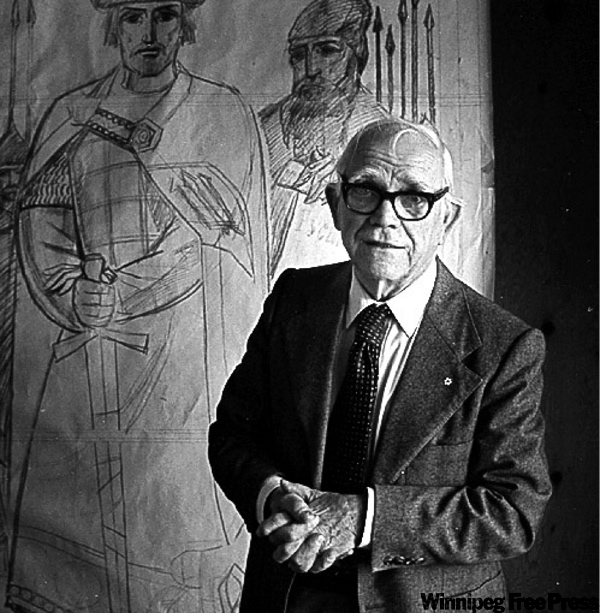
These facts underscored the life story of Leo Mol as perhaps a quintessentially immigrant experience: He struggled to get into Canada, landed in Saskatchewan but left quickly for Winnipeg where he persevered to make a life as an artist. Starting humbly, working at restoration and smaller projects in churches, he came to contribute mightily to the character and culture of this city, became ardently of the city, commemorating both local celebrities and other notable Canadians in bronze.
Mr. Mol was more than a sculptor, although his bronze monuments put him on the international stage, through the commissions for statues of the Ukraine cultural hero, poet Taras Shevchenko, in America, Brazil and Argentina. His religious iconography decorates numerous churches around Winnipeg in stain glass, for example.

For all of his brushes with fame, Leo Mol finally was a man whose work reached ordinary people at a very basic level. The statue of Moses in the park garden rears biblically from the greenery, while nearby the monument to bush pilot and Manitoba aviation icon Tom Lamb is realistically nostalgic.
It is the stuff that those who do not know art can appreciate because it does not seek to awe, or wrap its value in complexity. It is, as Mr. Mol would have said himself, doing its part to serve the needs of "the silent majority" who do not strive to make meaning of life’s mysteries, but simply want something to look at.