Artificial dyes fading, but food will still get colour boosts
Advertisement
Read this article for free:
or
Already have an account? Log in here »
To continue reading, please subscribe:

Digital Subscription
One year of digital access for only $205*
- Enjoy unlimited reading on winnipegfreepress.com
- Read the E-Edition, our digital replica newspaper
- Access News Break, our award-winning app
- Play interactive puzzles
*First annual payment billed as $205.00 + GST for one year. This annual subscription will automatically renew at $233.00 + GST every 52 weeks (10% off the regular annual price of $259.35). Offer available to new and qualified returning subscribers only. Cancel any time.
To continue reading, please subscribe:
Add Free Press access to your Brandon Sun subscription for only an additional
$1 for the first 4 weeks*
- Enjoy unlimited reading on winnipegfreepress.com
- Read the E-Edition, our digital replica newspaper
- Access News Break, our award-winning app
- Play interactive puzzles
*Your next Brandon Sun subscription payment will increase by $1.00 and you will be charged $17.95 plus GST for four weeks. After four weeks, your payment will increase to $24.95 plus GST every four weeks.
Read unlimited articles for free today:
or
Already have an account? Log in here »
Hey there, time traveller!
This article was published 10/12/2018 (2784 days ago), so information in it may no longer be current.
NEW YORK – Many companies including McDonald’s and Kellogg are purging artificial colours from their foods, but don’t expect your cheeseburgers or cereal to look much different.
Colours send important signals about food, and companies aren’t going to stop playing into those perceptions.
What’s accepted as normal can change, too, and vary by region. Up until the 1980s, Americans expected pistachios to be red because they were mostly imported from places where the nuts were dyed to cover imperfections.
“People used to get all the coloring all over their fingers. We now kind of laugh at that,” said Richard Matoian, executive director of the American Pistachio Growers, a trade association.
Now most pistachios sold in the U.S. are grown domestically and come in their naturally pale shells.
McDonald’s announced in September that it had removed artificial colours from many of its burgers and Kellogg has pledged to remove them from its cereals by the end of this year.
Americans, however, apparently aren’t entirely ready to part with the technicolour pieces that float around in milk. After removing artificial colours from Trix, General Mills poured them back in last year to bring back a “classic” version in response to customer demand.
But it’s not just processed and packaged foods that create illusions with colours.
CHEESE
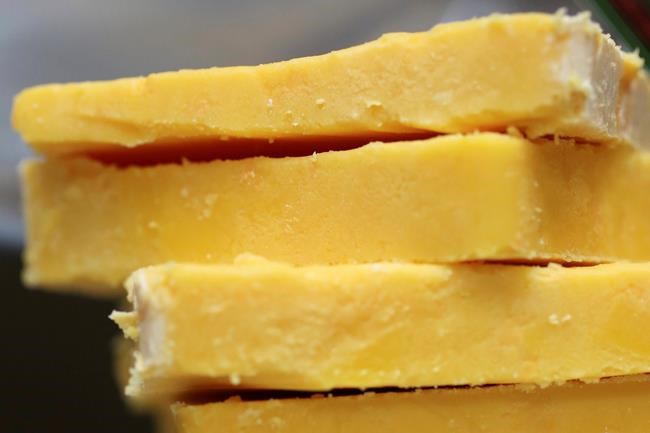
Boar’s Head, Cabot, Kraft, Tillamook. Check the packages of most cheddar cheeses, and they’ll likely list an ingredient called annatto, a plant extract commonly used for colour.
The practice reaches back to when cheesemakers in England skimmed the butterfat from milk to make butter, according to Elizabeth Chubbuck of Murray’s Cheese in New York. The leftover milk was whiter, so cheesemakers added pigments to recreate butterfat’s golden hue, she said.
Another cheese that sometimes gets cosmetic help: mozzarella.
Sara Burnett, director of food policy at Panera Bread, said mozzarella sometimes gets its bright white from titanium dioxide, a widely used ingredient in products like mints and doughnuts.
Without it, mozzarella would be beige or off-white.
The whitening is done because most U.S.-made mozzarella starts with cow’s milk, which can have yellow hues, said Cathy Strange, global cheese buyer at Whole Foods.
In Italy, she said, mozzarella is traditionally made with water buffalo milk, which is whiter because the animal can’t digest beta carotene.
EGG YOLKS
Many home cooks think darker egg yolks are fresher or more nutritious. But the colour may be the result of marigold petals, alfalfa or coloring products in chicken feed.
Yolk colour is primarily determined by the carotenoids — naturally occurring pigments in plants — that hens eat, according to Elizabeth Bobeck, a poultry nutrition professor at Iowa State University. It’s easy to change yolk colours by simply altering hens’ diet, she said.
Darker yolks aren’t necessarily healthier, Bobeck said. The belief that they are is likely rooted in the idea that yolks are darker when hens are fed a diet of fresh plants, which contain the pigments.
Marc Dresner, a spokesman for the American Egg Board, said yolk colours varied more when chickens were fed whatever was available in the barnyard. Commercial feed has made yolk colours more consistent, but synthetic colour additives are not allowed for chicken feed, Dresner said.
Bart Slaugh, a representative for Eggland’s, noted mayonnaise and pasta makers may prefer paler yolks.
SALMON
Bright pink flesh may signal freshness to shoppers eyeing salmon filets, which is why farmed salmon may have been fed synthetic astaxanthin, a version of a naturally occurring compound.
The Food and Drug Administration notes that manufacturers have to declare on labeling if colour additives were used for salmon. At Costco, farmed salmon is labeled with the disclosure “colour added through feed.”
It may not sound appetizing, but manufacturers know the difference colour can make.
Salmon with a darker flesh can command an extra 50 cents to $1 per pound when offered side by side with lighter salmon, according to research by animal feed maker DSM.
To help producers size up the desirability of their salmon, the company offers a “SalmoFan ” with varying shades of pink to help judge flesh colours.

Representatives for DSM did not respond to requests for comment.
___
Follow Candice Choi at www.twitter.com/candicechoi
___
The Associated Press Health & Science Department receives support from the Howard Hughes Medical Institute’s Department of Science Education. The AP is solely responsible for all content.