AP-NORC Poll: Edit baby genes for health, not smarts
Advertisement
Read this article for free:
or
Already have an account? Log in here »
To continue reading, please subscribe:

Digital Subscription
One year of digital access for only $205*
- Enjoy unlimited reading on winnipegfreepress.com
- Read the E-Edition, our digital replica newspaper
- Access News Break, our award-winning app
- Play interactive puzzles
*First annual payment billed as $205.00 + GST for one year. This annual subscription will automatically renew at $233.00 + GST every 52 weeks (10% off the regular annual price of $259.35). Offer available to new and qualified returning subscribers only. Cancel any time.
To continue reading, please subscribe:
Add Free Press access to your Brandon Sun subscription for only an additional
$1 for the first 4 weeks*
- Enjoy unlimited reading on winnipegfreepress.com
- Read the E-Edition, our digital replica newspaper
- Access News Break, our award-winning app
- Play interactive puzzles
*Your next Brandon Sun subscription payment will increase by $1.00 and you will be charged $17.95 plus GST for four weeks. After four weeks, your payment will increase to $24.95 plus GST every four weeks.
Read unlimited articles for free today:
or
Already have an account? Log in here »
Hey there, time traveller!
This article was published 28/12/2018 (2766 days ago), so information in it may no longer be current.
WASHINGTON – Most Americans say it would be OK to use gene-editing technology to create babies protected against a variety of diseases — but a new poll finds they’d draw the line at changing DNA so children are born smarter, faster or taller.
A month after startling claims of the births of the world’s first gene-edited babies in China, the poll by The Associated Press-NORC Center for Public Affairs Research finds people are torn between the medical promise of a technology powerful enough to alter human heredity and concerns over whether it will be used ethically.
Jaron Keener, a 31-year-old exhibit designer at Pittsburgh’s Carnegie Museum of Natural History, said he’s opposed to “rich people being able to create designer babies.”
But like the majority of Americans, Keener would support gene editing in embryos to prevent incurable diseases. His mother has lupus, an inflammatory disease that may have both environmental and genetic triggers.
Lupus has been “a looming presence my entire life. I’ve been around somebody with a chronic illness and I’ve seen the toll that has taken, not just on her life, but the life of my family,” he said.
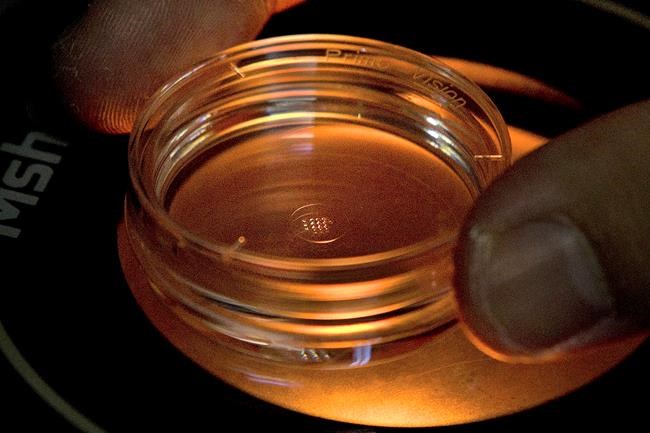
Gene editing is like a biological cut-and-paste program, letting scientists snip out a section of DNA to delete, replace or repair a gene. Altering adult cells would affect only the patient being treated.
But editing genes in eggs, sperm or embryos would alter the resulting child in ways that can be passed to future generations — a step with such profound implications that international science guidelines say it shouldn’t be tested in human pregnancies until more lab-based research determines it’s safe to try.
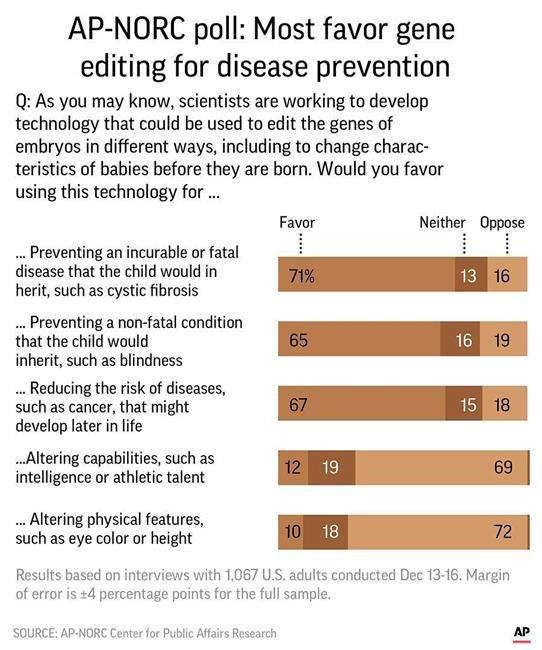
The AP-NORC poll shows about 7 in 10 Americans favour one day using gene-editing technology to prevent an incurable or fatal disease a child otherwise would inherit, such as cystic fibrosis or Huntington’s disease.
Roughly two-thirds of Americans also favour using gene editing to prevent a child from inheriting a non-fatal condition such as blindness, and even to reduce the risk of diseases that might develop later in life, such as cancers.
Side effects are possible, such as a gene-editing attempt that accidentally alters the wrong DNA spot, and the poll finds 85 per cent think that risk is at least somewhat likely.
But about 7 in 10 Americans oppose using gene editing to alter capabilities such as intelligence or athletic talent, and to alter physical features such as eye colour or height.
The poll highlights that if gene editing of embryos ever moves into fertility clinics, there will be some hard choices about what non-fatal disorders should qualify, said Columbia University bioethicist Dr. Robert Klitzman. What if scientists could pinpoint genes involved with depression or autism or obesity — would they be OK to edit?
“It’s one thing to look at the extremes of fatal diseases versus cosmetic things, but in the middle are going to be these very different issues,” Klitzman said.
That reported gene editing in China was an attempt to create babies resistant to HIV infection, a target that many scientists in the U.S. and elsewhere decried because there are effective ways to prevent the AIDS virus.
The poll shows most people think it is at least somewhat likely that gene editing could wipe out certain inherited diseases and lead to other medical advances.
Yet despite the medical enthusiasm, more Americans oppose than favour government funding for testing on human embryos to develop gene-editing technology — 48 per cent to 26 per cent. About another quarter of the population takes no stand.
Without that research, how could gene editing ever become a choice for families hoping to avoid a disease?
“That’s a good question,” said Keener, the Pittsburgh museum worker, who opposes such funding for fear that research would lead to designer babies rather than fighting disease.
“If there would be a way to narrow the scope of research, I would be OK with government funding,” he said. “I just don’t have a lot of confidence people wouldn’t use it for their own gain.”
Indeed, the poll uncovers a lack of trust in science: About a third think this kind of gene editing will be used before it’s adequately tested, as many scientists say happened in China. Nearly 9 in 10 people think the technology will be used for unethical reasons, including 52 per cent who say this is very likely to happen.
And roughly three-quarters of Americans say gene editing probably wouldn’t be affordable for the average person — raising the spectre of certain genetic diseases becoming a problem only for the poor.
“People appear to realize there’s a major question of how we should oversee and monitor use of this technology if and when it becomes available,” said Columbia’s Klitzman. “What is safe enough? And who will determine that? The government? Or clinicians who say, ‘Look, we did it in Country X a few times and it seems to be effective.'”
___
The AP-NORC poll of 1,067 adults was conducted Dec. 13-16 using a sample drawn from NORC’s probability-based AmeriSpeak Panel, which is designed to be representative of the U.S. population. The margin of sampling error for all respondents is plus or minus 4.1 percentage points.

Respondents were first selected randomly using address-based sampling methods, and later interviewed online or by phone.
___
AP reporters Carla K. Johnson in Seattle and Hannah Fingerhut in Washington contributed to this report.
___
The Associated Press Health & Science Department receives support from the Howard Hughes Medical Institute’s Department of Science Education. The AP is solely responsible for all content.