WEATHER ALERT

Experimental app might spot drug overdoses in time to help

Advertisement

Advertise with us

WASHINGTON - Too often people die of an opioid overdose because no one's around to notice they're in trouble. Now scientists are creating a smartphone app that beams sound waves to measure breathing — and summon help if it stops.

Read this article for free:

or

Already have an account? Log in here »

To continue reading, please subscribe:

Subscribe and receive a limited-edition Free Press branded hat or tote.

Digital Subscription

One year of digital access for only $205*

  • Enjoy unlimited reading on winnipegfreepress.com
  • Read the E-Edition, our digital replica newspaper
  • Access News Break, our award-winning app
  • Play interactive puzzles

*First annual payment billed as $205.00 + GST for one year. This annual subscription will automatically renew at $233.00 + GST every 52 weeks (10% off the regular annual price of $259.35). Offer available to new and qualified returning subscribers only. Cancel any time.

To continue reading, please subscribe:

Add Free Press access to your Brandon Sun subscription for only an additional

$1 for the first 4 weeks*

  • Enjoy unlimited reading on winnipegfreepress.com
  • Read the E-Edition, our digital replica newspaper
  • Access News Break, our award-winning app
  • Play interactive puzzles
Start now

*Your next Brandon Sun subscription payment will increase by $1.00 and you will be charged $17.95 plus GST for four weeks. After four weeks, your payment will increase to $24.95 plus GST every four weeks.

Hey there, time traveller!
This article was published 09/01/2019 (2756 days ago), so information in it may no longer be current.

WASHINGTON – Too often people die of an opioid overdose because no one’s around to notice they’re in trouble. Now scientists are creating a smartphone app that beams sound waves to measure breathing — and summon help if it stops.

The app is still experimental. But in a novel test, the “Second Chance” app detected early signs of overdose in the critical minutes after people injected heroin or other illegal drugs, researchers reported Wednesday.

One question is whether most drug users would pull out their phone and switch on an app before shooting up. The University of Washington research team contends it could offer a much-needed tool for people who haven’t yet found addiction treatment.
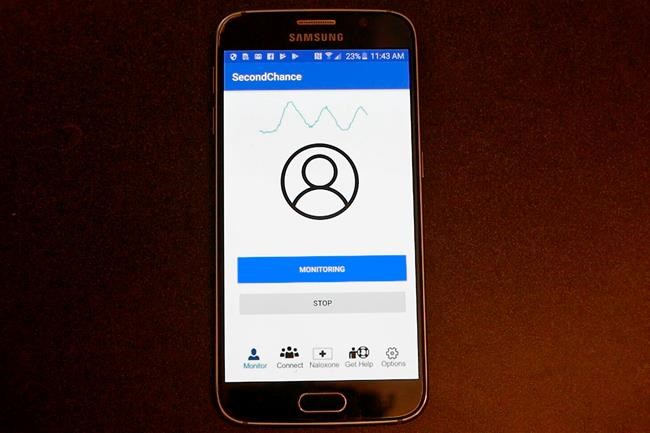
This image from video provided by the University of Washington in January 2019 shows a demonstration of the smartphone app developed by Rajalakshmi Nandakumar, Shyamnath Gollakota and Jacob E. Sunshine that uses sound waves to measure breathing. In first-step testing reported Wednesday, Jan. 9 the device detected early breathing problems in some people who’d just injected illegal drugs. (Mark Stone/University of Washington via AP)

“They’re not trying to kill themselves — they’re addicted to these drugs. They have an incentive to be safe,” said Shyamnath Gollakota, an engineering and computer science associate professor whose lab turns regular cellphones into temporary sonar devices.

But an emergency room physician who regularly cares for overdose patients wonders how many people really would try such a device.

“This is an innovative way to attack the problem,” said Dr. Zachary Dezman of the University of Maryland School of Medicine, who wasn’t involved in the research.

Still, “I don’t know if many folks who use substances are going to have the forethought to prepare,” he added.

More than 47,000 people in the U.S. died of opioid overdoses in 2017. The drugs suppress breathing but a medicine called naloxone often can save victims — if it reaches them in time. Usually, that means someone has to witness the collapse. Dr. Jacob Sunshine, a University of Washington anesthesiologist, notes that people have died with a relative in the next room unaware they were in trouble.

The research team settled on cellphones as potential overdose monitors because just about everyone owns one. They designed an app that measures how someone’s chest rises and falls to see if they’re slipping into the slow, shallow breaths of an overdose or stop breathing completely.

How? The software converts the phone’s built-in speaker and microphone to send out inaudible sound waves and record how they bounce back. Analyzing the signals shows specific breathing patterns.

It won’t work inside a pocket, and people would have to stay within 3 feet. The researchers are in the process of making the app capable of dialing for help if a possible overdose is detected.

They put the experimental gadget to the test at North America’s first supervised injection site in Vancouver, British Columbia, where people are allowed to bring in illegal drugs and inject themselves under medical supervision in case of overdose. Study participants agreed to have doctoral student Rajalakshmi Nandakumar place the app-running cellphone nearby during their regularly monitored visit.

The software correctly identified breathing problems that could signal an overdose — seven or fewer breaths a minute, or pauses in breathing — 90 per cent of the time, the researchers found. Most were near-misses; two of the 94 study participants had to be resuscitated.

For a bigger test, the researchers next turned to people who don’t abuse drugs but were about to receive anesthesia for elective surgery. Rendering someone unconscious for an operation mimics how an overdose shuts down breathing.

Measuring 30 seconds of slowed or absent breathing as those patients went under, the app correctly predicted 19 of 20 simulated overdoses, the researchers reported. The one missed case was a patient breathing slightly faster than the app’s cutoff.

The findings were reported in the journal Science Translational Medicine. The researchers have patented the invention and plan to seek Food and Drug Administration approval.

___

The Associated Press Health & Science Department receives support from the Howard Hughes Medical Institute’s Department of Science Education. The AP is solely responsible for all content.

Report Error Submit a Tip

More Stories

Bombers’ offence, defence, and special teams fail to show up against Stampeders

Taylor Allen 6 minute read Preview

Bombers’ offence, defence, and special teams fail to show up against Stampeders

Taylor Allen 6 minute read Saturday, Jul. 25, 2026

The Winnipeg Blue Bombers constantly preach the importance of playing three-phase football.

On Friday night, they went 0-for-3.

Their offence, defence, and special teams all played a significant role in losing 52-30 to the visiting Calgary Stampeders.

The team that erased a 17-point deficit to beat Ottawa last Sunday was nowhere to be found.

Read
Saturday, Jul. 25, 2026

Ref ‘dominates’ game in Sea Bears loss to Honey Badgers, says coach

Joshua Frey-Sam 7 minute read Preview

Ref ‘dominates’ game in Sea Bears loss to Honey Badgers, says coach

Joshua Frey-Sam 7 minute read Saturday, Jul. 25, 2026

Following a festive Christmas-in-July-themed Saturday afternoon inside Canada Life Centre, Winnipeg Sea Bears head coach Mike Raimbault didn’t mince words about who he thought was the Grinch in a hard-fought 88-86 loss to the visiting Brampton Honey Badgers that ended in controversy.

As the Sea Bears owned a one-point lead in Target Score Time, Brampton guard Sean East II was awarded three free throws — all of which he converted — after a questionable foul called on Teddy Allen by official Perry Stothart.

Raimbault, who has been known to bite his tongue on such topics, left nothing to the imagination about where he stood on the game-deciding judgment made in a game that had major post-season implications.

“I just felt like it was a fitting ending to the game where Perry Stothart had dominated the flow of the game from the start,” he said. “For him to call a bit of a guess foul and end the game on the foul, I felt like it’s disappointing that he can come in and dictate how the game’s going to be played and flow, and (that) continues to be a bit of an M.O. for him. So I think we’re disappointed with the fact that the league continues to let that happen.”

Read
Saturday, Jul. 25, 2026

What are we teaching children at the rodeo?

Danae Tonge 5 minute read 2:01 AM CDT

Every summer in Manitoba, rodeo season brings thousands of children to local rodeos and the Manitoba Stampede. They arrive with cowboy hats and cotton candy in hand, excitement in their eyes.

Yet, as a mother who works in education, I can’t help but wonder: what are we teaching them in those stands?

Inside classrooms, we teach children that kindness matters. We encourage empathy, discourage bullying and ask students to consider how their actions affect others. Students are taught that animals experience fear, pain and distress, just like us. Yet when school ends, we celebrate events built around chasing, restraining, roping and riding animals for entertainment.

This contradiction is difficult to ignore.

Take care of them; there is enough

David Driedger 5 minute read 2:01 AM CDT

The parable of the Good Samaritan is one of those stories that has endured far beyond its original context, far beyond religion itself. Someone is robbed, assaulted and left for dead.

Qualico celebrating 75 years of growth, success since its first development of 13 bungalows in River Heights

Aaron Epp 6 minute read Preview

Qualico celebrating 75 years of growth, success since its first development of 13 bungalows in River Heights

Aaron Epp 6 minute read 6:00 AM CDT

The first things staff and visitors see after ascending to the third floor of Qualico’s head office in Winnipeg are two statues — one each for company founders David and Katherine Friesen.

Flanking the doors to the integrated real estate company’s C-suite offices, the bronze sculptures are monuments to the couple and the vision, strength and integrity (as the plaques attached to the wooden pedestals attest) it took to start Qualico in 1951.

But imagine for a moment what it would be like if the sculptures were less reverent and more whimsical. Picture them outfitted with the kind of pull-string voice boxes one finds in a child’s toy. What might they say?

It’s possible one of David Friesen’s phrases would be: “No margin, no mission.”

Read
6:00 AM CDT

Together Project helps newcomers feel at home

AV Kitching 10 minute read Preview

Together Project helps newcomers feel at home

AV Kitching 10 minute read 6:00 AM CDT

When refugee families first arrive in Winnipeg they are plunged into an alien culture.

Often fleeing dangerous circumstances, discrimination or war, displaced families are forced to navigate bewildering societal norms and cultural expectations in an unfamiliar environment.

It can often feel utterly overwhelming.

And while government settlement agencies are an invaluable foundational resource, nothing can replace human connection and peer-to-peer guidance.

Read
6:00 AM CDT