WEATHER ALERT

New pen may allow sale of horses for slaughter

Advertisement

Advertise with us

RENO, Nev. - The U.S. Forest Service has built a new corral for wild horses in Northern California, which could allow it to bypass federal restrictions and sell the animals for slaughter.

Read this article for free:

or

Already have an account? Log in here »

To continue reading, please subscribe:

Subscribe and receive a limited-edition Free Press branded hat or tote.

Digital Subscription

One year of digital access for only $205*

  • Enjoy unlimited reading on winnipegfreepress.com
  • Read the E-Edition, our digital replica newspaper
  • Access News Break, our award-winning app
  • Play interactive puzzles

*First annual payment billed as $205.00 + GST for one year. This annual subscription will automatically renew at $233.00 + GST every 52 weeks (10% off the regular annual price of $259.35). Offer available to new and qualified returning subscribers only. Cancel any time.

To continue reading, please subscribe:

Add Free Press access to your Brandon Sun subscription for only an additional

$1 for the first 4 weeks*

  • Enjoy unlimited reading on winnipegfreepress.com
  • Read the E-Edition, our digital replica newspaper
  • Access News Break, our award-winning app
  • Play interactive puzzles
Start now

*Your next Brandon Sun subscription payment will increase by $1.00 and you will be charged $17.95 plus GST for four weeks. After four weeks, your payment will increase to $24.95 plus GST every four weeks.

Hey there, time traveller!
This article was published 15/01/2019 (2749 days ago), so information in it may no longer be current.

RENO, Nev. – The U.S. Forest Service has built a new corral for wild horses in Northern California, which could allow it to bypass federal restrictions and sell the animals for slaughter.

The agency acknowledged in court filings in a potentially precedent-setting legal battle that it built the pen for mustangs gathered in the fall on national forest land along the California-Nevada border because of restrictions on such sales at other federal holding facilities.

The agency denies claims by horse advocates it has made up its mind to sell the more than 250 horses for slaughter. But it also says it may have no choice because of the high cost of housing the animals and continued ecological impacts it claims overpopulated herds are having on federal rangeland.
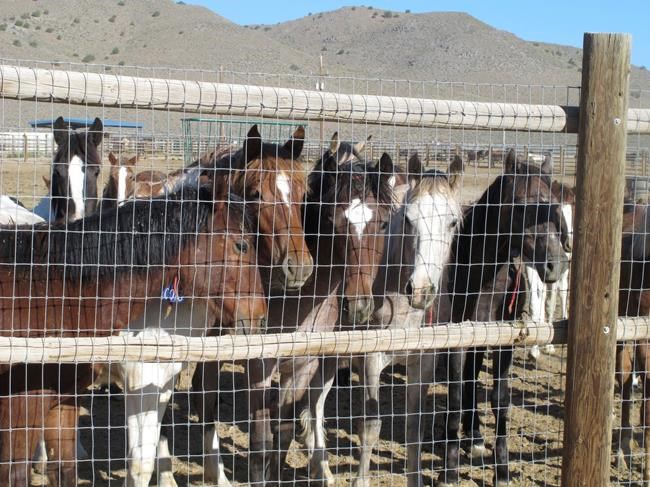
In this June 5, 2013 photo, some of the hundreds of mustangs the U.S. Bureau of Land Management removed from federal rangeland peer at visitors at the BLM's Palomino Valley holding facility about 20 miles north of Reno in Palomino Valley, Nev. The U.S. Forest Service has built a corral in California that could allow it to bypass federal restrictions and lead to the slaughter of wild horses. The agency acknowledged in court filings in a potentially precedent-setting legal battle that it built the new pen for mustangs gathered in the fall on national forest land along the California-Nevada line because horses held at other federal facilities cannot be sold for slaughter. (AP Photo/Scott Sonner)

“While slaughtering wild horses does not present a pleasant picture, the reality of this dire situation is not pleasant,” Justice Department lawyers representing the agency wrote in its most recent filing last month. “The Forest Service is taking a step to reduce what is universally recognized as a natural catastrophe.”

Horse advocates have been suing the government for two decades over mustang roundups that private ranchers say are necessary to curb growing herds that reduce the forage on federal lands they lease for cattle and sheep grazing across the U.S. West. The region holds roughly 90,000 wild horses.

A sharp reduction in demand in recent years for a federal program that offers the horses for adoption to the public has left little room in existing corrals. Horse advocates argue the mustangs are federally protected and that taxpayers subsidize the livestock grazing on U.S. land.

A hearing is scheduled Jan. 31 in federal court in San Francisco on a motion filed by the Animal Legal Defence Fund and American Wild Horse Campaign seeking an injunction to block the sale of the horses captured in the Modoc National Forest in October and November for possible slaughter. The new pen is in the forest, about 170 miles (273 kilometres) northwest of Reno.

Forest Service Chief Vicki Christiansen announced late last year she would postpone any sales for slaughter until at least Feb. 18.

The protection groups say it would be the first time in nearly a half-century the government has sold mustangs “without limitation,” or for any purpose, including slaughter.

Horse slaughterhouses are prohibited in the U.S. but legal in many other countries, including Canada, Mexico and parts of Europe where horse meat is considered a delicacy.

The Wild Free Roaming Horse and Burros Act that President Nixon signed into law in 1971 prohibits the inhumane destruction of wild horses. Congress approved an appropriations amendment in 2004 that allows the Forest Service, under its parent Agriculture Department, to sell horses without limitations if they’re over age 10 and have been offered for adoption three times unsuccessfully.

But in most years since then, Congress has specifically prohibited the Bureau of Land Management, under the Interior Department, from using any appropriations for such purposes. President Donald Trump proposed allowing such sales in his 2017 budget, but Congress refused to go along.

The Forest Service normally holds the horses it gathers at pens belonging to the BLM, which manages 385,000 square miles (997,000 square kilometres) of public lands in the West.

With few exceptions, lawsuits have targeted the bureau because it captures the vast majority of the horses. BLM lands hold an estimated 83,000 wild horses, while national forests managed by the Forest Service hold about 8,000.
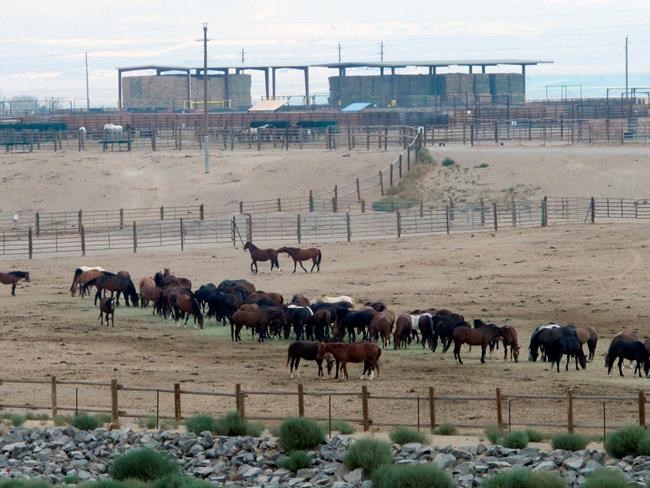
In this Sept. 4, 2013 file photo Mustangs recently captured on federal rangeland roam a corral at the U.S. Bureau of Land Management's holding facility north of Reno, in Palomino, Nev. The U.S. Forest Service has built a corral in California that could allow it to bypass federal restrictions and lead to the slaughter of wild horses. The agency acknowledged in court filings in a potentially precedent-setting legal battle that it built the new pen for mustangs gathered in the fall on national forest land along the California-Nevada line because horses held at other federal facilities cannot be sold for slaughter. (AP Photo/Scott Sonner).

The Forest Service gathered 932 horses in the Modoc National Forest late last year and shipped about 260 to the new corral, while placing about 650 at a BLM facility in nearby Susanville, California.

Justice Department lawyers acknowledged in the December filings “BLM is not permitted to humanely destroy healthy, unadopted horses or conduct any sale that could ultimately result in their destruction, which includes any Forest Service horse in BLM custody.”

“What has changed is that the Modoc now has its own short-term holding facility … which is not subject to congressional restrictions,” they wrote about the corral, which currently can hold up to 300 horses but has room for expansion to accommodate as many as 1,500. They said local ranchers “generally support these sales” because of the horses’ economic impact on leased grazing land.

The attorneys also said the opponents’ assertion the horses will be slaughtered “is only speculative, not concrete and imminent.”

Horse advocates say the government can’t have it both ways.

“It cannot both argue it is harmed by plaintiffs’ delay in bringing this action because of all the time and resources it has expended to allow the sale of horses without limitation, yet also insist to the court that it has not yet made any such decision,” their lawyers wrote Jan. 8. “In short, the record and defendants’ own statements make clear that the decision to sell horses without limitation is final and judicially reviewable.”

____

This story has been corrected to show the new corral is the first built by the U.S. Forest Service in California.

Report Error Submit a Tip

More Stories

Winnipeg Fringe Festival: 2026 show reviews

Winnipeg Free Press 1 minute read Preview

Winnipeg Fringe Festival: 2026 show reviews

Winnipeg Free Press 1 minute read Tuesday, Jul. 14, 2026

Not sure what to see at this year's Winnipeg Fringe Theatre Festival? All of the Free Press’s reviews will be published here.  Find a show and click to read its review.

Read
Tuesday, Jul. 14, 2026

Automation reaches new heights on farm

Laura Rance-Unger 4 minute read Preview

Automation reaches new heights on farm

Laura Rance-Unger 4 minute read Yesterday at 2:01 AM CDT

LANGHAM, Sask. — The thousands of farmers from across the Prairies who flock to the annual Ag in Motion show every July seem oblivious to the possibility the technology on display could one day replace many of them.

Families with children in tow, Hutterite colony workers, grandparents and young couples just starting out roamed through the 600 or more exhibitor displays, amazed at how everything about farming just keeps getting bigger, more efficient and increasingly more automated.

It’s now possible to seed using a 100-foot-wide drill — a 12-foot jump over the widest available a few years ago — provided the farmer can afford a tractor with enough horsepower to pull it. Those sell for around $850,000 and up.

Granted, the number of farms with enough acres to justify that kind of width and drawing power is still relatively small, but farms continue to grow. And it’s no secret the number of people who have the interest, skills and financial wherewithal to run them continues to shrink.

Read
Yesterday at 2:01 AM CDT

Sked dread a summer bummer for mom

Maureen Scurfield 5 minute read Yesterday at 2:01 AM CDT

DEAR MISS LONELYHEARTS: I’m a working mom in my 50s and I love Winnipeg in the summer — all the cultural festivals, concerts and crazy events it has to offer.

So I told my 20-something kids I would come out to our lake cabin for only a couple of June and July weekends, but then join them out there with their dad as well for an unbroken two-week stretch in late-August.

However, I worry I’ll just be cooking and organizing while I’m out there! My bossy eldest daughter made up a cooking schedule, so everybody has a special dinner where they have cook, organize people to bring things, run the barbecue and entertain with a group game afterwards. It’s going well for July, but nobody has signed up for duties in August when we’ll all be out there to enjoy the last of the summer.

I spent summer after summer covering that entire duty calendar for my kids, so it’d be nice to actually relax when I’m out there later this year. So, now what?

Ref ‘dominates’ game in Sea Bears loss to Honey Badgers, says coach

Joshua Frey-Sam 7 minute read Preview

Ref ‘dominates’ game in Sea Bears loss to Honey Badgers, says coach

Joshua Frey-Sam 7 minute read Yesterday at 7:40 PM CDT

Following a festive Christmas-in-July-themed Saturday afternoon inside Canada Life Centre, Winnipeg Sea Bears head coach Mike Raimbault didn’t mince words about who he thought was the Grinch in a hard-fought 88-86 loss to the visiting Brampton Honey Badgers that ended in controversy.

As the Sea Bears owned a one-point lead in Target Score Time, Brampton guard Sean East II was awarded three free throws — all of which he converted — after a questionable foul called on Teddy Allen by official Perry Stothart.

Raimbault, who has been known to bite his tongue on such topics, left nothing to the imagination about where he stood on the game-deciding judgment made in a game that had major post-season implications.

“I just felt like it was a fitting ending to the game where Perry Stothart had dominated the flow of the game from the start,” he said. “For him to call a bit of a guess foul and end the game on the foul, I felt like it’s disappointing that he can come in and dictate how the game’s going to be played and flow, and (that) continues to be a bit of an M.O. for him. So I think we’re disappointed with the fact that the league continues to let that happen.”

Read
Yesterday at 7:40 PM CDT

An eroding Winnipeg neighbourhood looks to new foundations

Ian Bickis, The Canadian Press 5 minute read Preview

An eroding Winnipeg neighbourhood looks to new foundations

Ian Bickis, The Canadian Press 5 minute read Updated: 1:34 PM CDT

WINNIPEG - The lot Jesse Bettcher lives on in Winnipeg's north end used to be a pile of burnt rubble. Same with the one next door. And the one across the street.

But he's now the proud owner of a two-storey house with blue-grey siding and white trim, so new the orange construction fencing is still out front.

It's a dream home for Bettcher, and the latest hope for a city seeking to knock down, clean up and revitalize neighbourhoods that have seen hundreds of homes left vacant, leading to safety hazards and worries about the future.

He bought the house as part of a pilot project aimed at creating affordable home ownership. It let him and his family move out of a rental that he said was falling apart.

Read
Updated: 1:34 PM CDT

Puzzles Palace

1 minute read Monday, Jul. 13, 2026

To solve our puzzles, please subscribe with this special offer: |