WEATHER ALERT

No-cost birth control, now the norm, faces court challenges

Advertisement

Advertise with us

WASHINGTON - Millions of American women are receiving birth control at no cost to them through workplace health plans, the result of the Obama-era Affordable Care Act, which expanded access to contraception.

Read this article for free:

or

Already have an account? Log in here »

To continue reading, please subscribe:

Subscribe and receive a limited-edition Free Press branded hat or tote.

Digital Subscription

One year of digital access for only $205*

  • Enjoy unlimited reading on winnipegfreepress.com
  • Read the E-Edition, our digital replica newspaper
  • Access News Break, our award-winning app
  • Play interactive puzzles

*First annual payment billed as $205.00 + GST for one year. This annual subscription will automatically renew at $233.00 + GST every 52 weeks (10% off the regular annual price of $259.35). Offer available to new and qualified returning subscribers only. Cancel any time.

To continue reading, please subscribe:

Add Free Press access to your Brandon Sun subscription for only an additional

$1 for the first 4 weeks*

  • Enjoy unlimited reading on winnipegfreepress.com
  • Read the E-Edition, our digital replica newspaper
  • Access News Break, our award-winning app
  • Play interactive puzzles
Start now

*Your next Brandon Sun subscription payment will increase by $1.00 and you will be charged $17.95 plus GST for four weeks. After four weeks, your payment will increase to $24.95 plus GST every four weeks.

Hey there, time traveller!
This article was published 15/01/2019 (2750 days ago), so information in it may no longer be current.

WASHINGTON – Millions of American women are receiving birth control at no cost to them through workplace health plans, the result of the Obama-era Affordable Care Act, which expanded access to contraception.

The Trump administration sought to allow more employers to opt out because of religious or moral objections. But its plans were put on hold by two federal judges, one in Pennsylvania and the other in California, in cases that could eventually reach the Supreme Court.

The judges blocked the Trump policy from going into effect while legal challenges from state attorneys general continue.
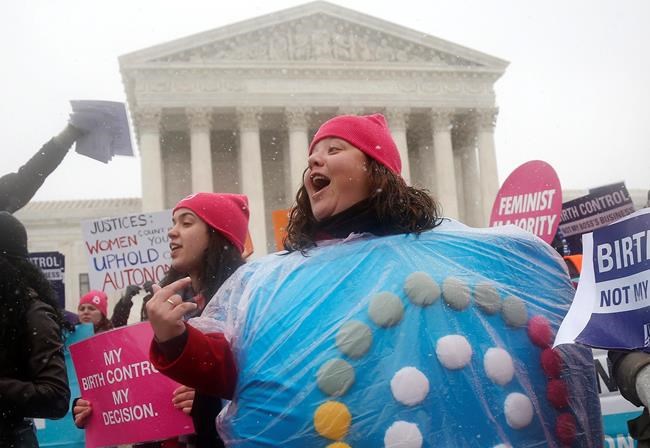
FILE - In this March 25, 2014, file photo, Margot Riphagen of New Orleans, wears a birth control pill costume as she protests in front of the Supreme Court in Washington. Millions of American women are receiving birth control at no cost to them through workplace health plans, the result of the Obama-era Affordable Care Act, which expanded access to contraception. The Trump administration sought to allow more employers to opt out because of religious or moral objections. But its plans were put on hold by two federal judges, one in Pennsylvania and the other in California, in cases that could eventually reach the Supreme Court. (AP Photo/Charles Dharapak, File)

Here’s a look at some of the issues behind the confrontation over birth control, politics and religious beliefs:

A TURNING POINT-THE AFFORDABLE CARE ACT

Well into the 1990s many states did not require health insurance plans to cover birth control for women.

“Plans were covering Viagra, and they weren’t covering birth control,” said Alina Salganicoff, director of women’s health policy with the nonpartisan Kaiser Family Foundation.

By the time President Barack Obama’s health law passed in 2010, employers and insurers largely began covering birth control as an important part of health care for women.

The ACA took that a couple of steps further. It required most insurance plans to cover a broad range of preventive services, including vaccinations and cancer screenings, but also women’s health services. And it also required such preventive services to be offered at no charge.

Employers and insurers were required to cover at least one of each class of birth control approved by the Food and Drug Administration. That included costly long-acting contraceptives, generally more effective than birth control pills.

It’s estimated that 55 million to more than 62 million women now receive birth control at no cost, with only a small share paying for contraception.

“The irony I find about this battle is that in the period of time this policy has been in effect, teen pregnancies have gone way down and the number of abortions has gone way down,” said Kathleen Sebelius, Health and Human Services secretary under Obama.

While those rates were already going down before the health law, the trend does continue.

TRUMP ADMINISTRATION’S RELIGIOUS AND MORAL EXEMPTIONS

The Obama administration originally exempted a narrow group of employers — houses of worship— from the birth control coverage requirement.

Following pushback from religious institutions and social conservatives, the Obama administration created an “accommodation.” Women employees of religious-affiliated social service organizations, universities and hospitals could continue to get birth control as part of their health care coverage but their employer would not have to pay.

The Supreme Court broadened that work-around to include smaller private companies with a religious objection.

That didn’t go far enough for social and religious conservatives, a core component of President Donald Trump’s political base. Some religious organizations see Obama’s “accommodation” as morally objectionable because it facilitates contraception.

“It still forces religious people to provide a health plan that includes things that violate their religion,” said Mark Rienzi, senior lawyer for the Becket Fund for Religious Liberty, which led opposition to the Obama policies.

The Trump administration’s regulations broadened the religious exemption to any employer with an objection based on religious beliefs and created a new exemption for certain employers with moral objections. The administration made Obama’s workaround optional for employers and instituted other changes.

“It’s definitely not a tweak,” Sebelius said. An employer can say “I don’t believe in birth control, and I’m not going to provide it,” she added.

Sebelius explained that Congress through the ACA clearly intended health plans to cover women’s health services. All HHS did was spell out how that would be done. If the Trump administration wants to change that, it would have to repeal the law, she added, not just change a regulation.

Rienzi said the Trump administration hasn’t pulled its policy “out of nowhere.” U.S. laws traditionally have protected people with religious and moral objections to government policies.

WHAT’S NEXT?

The Obama-era policy remains in place for now, with U.S. District Judge Wendy Beetlestone in Philadelphia placing a national hold on the Trump administration rules.

More than a dozen states are trying to reverse Trump’s policy, including California, New York, Pennsylvania and New Jersey.

The Justice Department hasn’t revealed its next move. It could ask federal appeals courts or the Supreme Court to lift the injunctions from lower-court judges and allow the Trump rules to go into effect while the cases continue.

The issue could eventually end up before the Supreme Court, which has become more conservative since the last time it considered the ACA’s birth control coverage requirement.

The Trump administration estimates that up to 126,400 women could be affected, having to find other ways to cover birth control if the rule is put into place.

But women’s rights groups say there’s no real way to know.

“The majority of employers want to cover birth control,” said Mara Gandal-Powers, a senior lawyer with the National Women’s Law Center. “We know that there are dozens of employers and entities that sued the Obama administration. But one of the problems with the (Trump administration) rule is that there is no master list of employers who object to birth control.”


Report Error Submit a Tip

More Stories

Vacant Bay store on road to redevelopment, St. Vital Centre owner says

Gabrielle Piche 6 minute read Preview

Vacant Bay store on road to redevelopment, St. Vital Centre owner says

Gabrielle Piche 6 minute read Friday, Jul. 24, 2026

Entertainment attractions are coming to fill the former Hudson’s Bay space in St. Vital Centre.

Montreal-based real estate firm Leyad, the south Winnipeg mall’s owner, says it is finalizing an agreement for the vacant property. Further details should appear in the next couple months, said president Henry Zavriyev.

“We’re looking at what other types of experiences we can bring to the mall that aren’t just typical retail,” he said during a visit to Winnipeg this week.

“We want to create an experience where you can just come to the mall, hang out here for hours, no matter if you’re a kid, an adult, a retiree.”

Read
Friday, Jul. 24, 2026

Anishinaabe Days tipi poles vandalized

Nicole Buffie 4 minute read Preview

Anishinaabe Days tipi poles vandalized

Nicole Buffie 4 minute read 5:19 PM CDT

An act of vandalism to a tipi at the Treaty One Development Corp’s Anishinaabe Days did not stop the celebrations from continuing over the weekend.

Someone deliberately cut the poles used to erect the site’s tipi before the event began, Treaty One executive director Jason Whitford said Sunday.

The family responsible for overseeing the tipi and its construction at the site, Naawi-Oodenaon on Kenaston Boulevard, went to the site on Friday to erect the tipi when they noticed someone had taken a saw and cut all 15 of its poles in half.

“They were stored in a safe place, and they were stored properly as per protocol,” Whitford said. “They were in an area where there was no construction so they were isolated from any activity.”

Read
5:19 PM CDT

A Life's Story: Beloved matriarch, kindergarten teacher lived a musical life

Gabrielle Piché 5 minute read Preview

A Life's Story: Beloved matriarch, kindergarten teacher lived a musical life

Gabrielle Piché 5 minute read Yesterday at 6:00 AM CDT

Phyllis Dana faced a choice: leave Winnipeg to study opera at a prestigious Philadelphia school, or marry the man she loved.

She chose the latter.

Now, her Juno-winning granddaughter cherishes a Happy Birthday voicemail sung by Phyllis. Three generations of Dana women — Phyllis, her daughter, and granddaughter — would sing in Winnipeg’s prominent Jewish spaces. And hundreds of Manitobans know the matriarch as their kindergarten teacher.

“My mom said, ‘A sheet of music won’t keep you warm at night,’” Karen Dana recalled.

Read
Yesterday at 6:00 AM CDT

Ref ‘dominates’ game in Sea Bears loss to Honey Badgers, says coach

Joshua Frey-Sam 7 minute read Preview

Ref ‘dominates’ game in Sea Bears loss to Honey Badgers, says coach

Joshua Frey-Sam 7 minute read Yesterday at 7:40 PM CDT

Following a festive Christmas-in-July-themed Saturday afternoon inside Canada Life Centre, Winnipeg Sea Bears head coach Mike Raimbault didn’t mince words about who he thought was the Grinch in a hard-fought 88-86 loss to the visiting Brampton Honey Badgers that ended in controversy.

As the Sea Bears owned a one-point lead in Target Score Time, Brampton guard Sean East II was awarded three free throws — all of which he converted — after a questionable foul called on Teddy Allen by official Perry Stothart.

Raimbault, who has been known to bite his tongue on such topics, left nothing to the imagination about where he stood on the game-deciding judgment made in a game that had major post-season implications.

“I just felt like it was a fitting ending to the game where Perry Stothart had dominated the flow of the game from the start,” he said. “For him to call a bit of a guess foul and end the game on the foul, I felt like it’s disappointing that he can come in and dictate how the game’s going to be played and flow, and (that) continues to be a bit of an M.O. for him. So I think we’re disappointed with the fact that the league continues to let that happen.”

Read
Yesterday at 7:40 PM CDT

A 39-year-old woman has been charged after police say a retail theft attempt led to a knife being used against a security guard at a store on Portage Avenue.

The Winnipeg Police Service said Central District General Patrol officers arrested the woman at about 5:30 p.m. on Thursday in connection with a robbery at a retail store in the 300 block of Portage Avenue.

Police said the woman entered the store shortly before 2 p.m. and attempted to steal merchandise before being confronted by store security. Police said the suspect then brandished a knife and assaulted a security guard.

Security was able to gain control of the suspect, and police were contacted.

Brown bombs as Bombers blasted

Taylor Allen 7 minute read Preview

Brown bombs as Bombers blasted

Taylor Allen 7 minute read Updated: Yesterday at 9:15 AM CDT

Winnipeg Blue Bombers quarterback Dru Brown took Friday night's ‘Christmas in July’ theme a little too seriously.

He wasn't carrying around a red sack, but he did gift-wrap four interceptions to the Calgary Stampeders in what ended up being a 52-30 loss for the Blue and Gold in front of a sold-out crowd.

The result dropped the Bombers, now 1-3 at home this season, to 4-3. Calgary improved to 3-4 and now have a chance to win the tiebreaker when the two sides meet for a final time on Oct. 10 at Princess Auto Stadium.

“Yeah, not nearly good enough...You certainly don't want to go get into a track meet against a good offence like that,” said Bombers head coach Mike O’Shea.

Read
Updated: Yesterday at 9:15 AM CDT