Less beef, more beans. Experts say world needs a new diet
Advertisement
Read this article for free:
or
Already have an account? Log in here »
To continue reading, please subscribe:

Digital Subscription
One year of digital access for only $205*
- Enjoy unlimited reading on winnipegfreepress.com
- Read the E-Edition, our digital replica newspaper
- Access News Break, our award-winning app
- Play interactive puzzles
*First annual payment billed as $205.00 + GST for one year. This annual subscription will automatically renew at $233.00 + GST every 52 weeks (10% off the regular annual price of $259.35). Offer available to new and qualified returning subscribers only. Cancel any time.
To continue reading, please subscribe:
Add Free Press access to your Brandon Sun subscription for only an additional
$1 for the first 4 weeks*
- Enjoy unlimited reading on winnipegfreepress.com
- Read the E-Edition, our digital replica newspaper
- Access News Break, our award-winning app
- Play interactive puzzles
*Your next Brandon Sun subscription payment will increase by $1.00 and you will be charged $17.95 plus GST for four weeks. After four weeks, your payment will increase to $24.95 plus GST every four weeks.
Read unlimited articles for free today:
or
Already have an account? Log in here »
Hey there, time traveller!
This article was published 16/01/2019 (2748 days ago), so information in it may no longer be current.
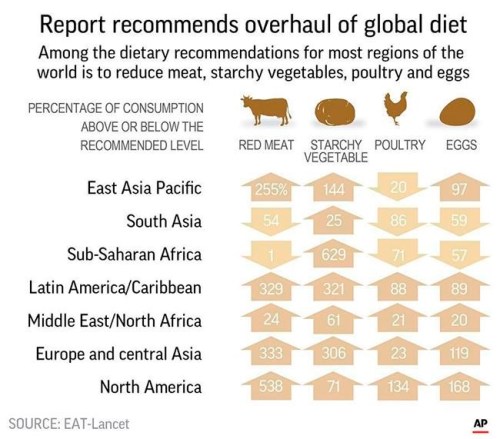
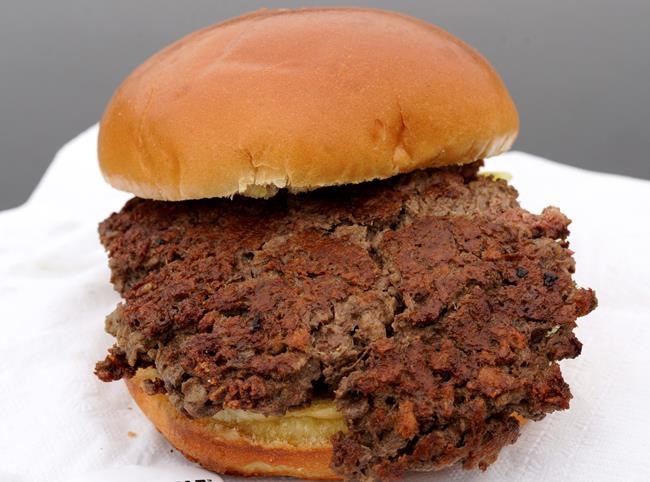
NEW YORK – A hamburger a week, but no more — that’s about as much red meat people should eat to do what’s best for their health and the planet, according to a report seeking to overhaul the world’s diet.
Eggs should be limited to fewer than about four a week, the report says. Dairy foods should be about a serving a day, or less.
The report from a panel of nutrition, agriculture and environmental experts recommends a plant-based diet, based on previously published studies that have linked red meat to increased risk of health problems. It also comes amid recent studies of how eating habits affect the environment. Producing red meat takes up land and feed to raise cattle, which also emit the greenhouse gas methane.
John Ioannidis, chair of disease prevention at Stanford University, said he welcomed the growing attention to how diets affect the environment, but that the report’s recommendations do not reflect the level of scientific uncertainties around nutrition and health.
“The evidence is not as strong as it seems to be,” Ioannidis said.
The report was organized by EAT, a Stockholm-based non-profit seeking to improve the food system, and published Wednesday by the medical journal Lancet. The panel of experts who wrote it says a “Great Food Transformation” is urgently needed by 2050, and that the optimal diet they outline is flexible enough to accommodate food cultures around the world.
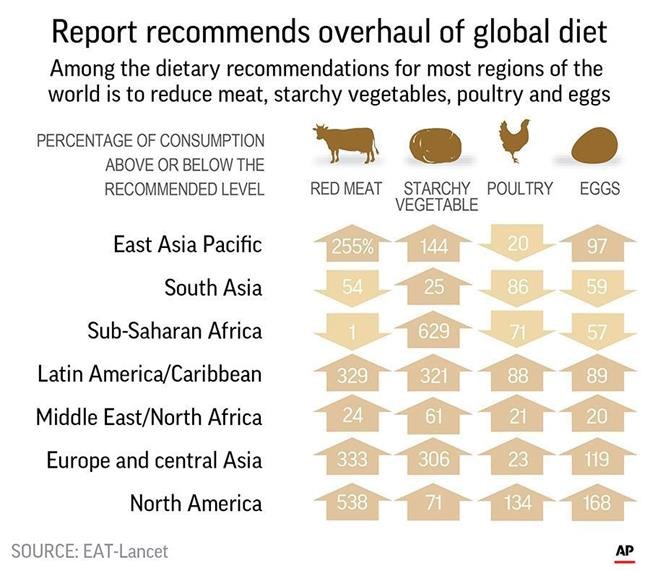
Overall, the diet encourages whole grains, beans, fruits and most vegetables, and says to limit added sugars, refined grains such as white rice and starches like potatoes and cassava. It says red meat consumption on average needs to be slashed by half globally, though the necessary changes vary by region and reductions would need to be more dramatic in richer countries like the United States.
Convincing people to limit meat, cheese and eggs won’t be easy, however, particularly in places where those foods are a notable part of culture.
In Sao Paulo, Brazil, systems analyst Cleberson Bernardes said as he was leaving a barbecue restaurant that limiting himself to just one serving of red meat a week would be “ridiculous.” In Berlin, Germany, craftsman Erik Langguth said there are better ways to reduce greenhouse gas emissions, and dismissed the suggestion that the world needs to cut back on meat.
“If it hasn’t got meat, it’s not a proper meal,” said Langguth, who is from a region known for its bratwurst sausages.
Before even factoring in the environmental implications, the report sought to sketch out what the healthiest diet for people would look like, said Walter Willett, one of its authors and a nutrition researcher at Harvard University. While eggs are no longer thought to increase risk of heart disease, Willett said the report recommends limiting them because studies indicate a breakfast of whole grains, nuts and fruit would be healthier.
He said everybody doesn’t need to become a vegan, and that many are already limiting how much meat they eat.
“Think of it like lobster — something that I really like, but have a few times a year,” Willett said.
Advice to limit red meat is not new, and is tied to its saturated fat content, which is also found in cheese, milk, nuts and packaged foods with coconut and palm kernel oils. The report notes most evidence on diet and health is from Europe and the United States. In Asian countries, a large analysis found eating poultry and red meat (mostly pork) was associated with improved lifespans. That might be in part because people might eat smaller amounts of meat in those countries, the report says.
Ioannidis of Stanford noted nutrition research is often based on observational links between diet and health, and that some past associations have not been validated. Dietary cholesterol, for example, is no longer believed to be strongly linked to blood cholesterol.
The meat and dairy industries also dispute the report’s recommendations, saying their products deliver important nutrients and can be part of healthy diets.
Andrew Mente, a nutrition epidemiology researcher at McMaster University, urged caution before making widespread dietary recommendations, which he said could have unintended consequences.
Still, the EAT-Lancet report’s authors say the overall body of evidence strongly supports reducing red meat for optimal health and shifting toward plant-based diets. They note the recommendations are compatible with the U.S. dietary guidelines, which say to limit saturated fat to 10 per cent of calories.
While people in some poorer counties may benefit from getting more of the nutrients in meat and dairy products, the report says they shouldn’t follow the path of richer countries in how much of those foods they eat in coming years.
Though estimates vary, a report by the United Nations said livestock is responsible for about 15 per cent of the world’s gas emissions that warm the climate.
Robbie Andrew, a senior researcher at CICERO Center for International Climate Research in Norway, said farming practices that make animals grow faster and bigger may help limit emissions. But he said cows and other ruminant animals nevertheless produce a lot of methane, a powerful greenhouse gas.
“It’s very difficult to get down these natural emissions that are part of their biology,” Andrew said.
The environmental benefits of giving up red meat depend on what people eat in its place. Chicken and pork produce far fewer emissions than beef, Andrew said, adding that plants in general have among the smallest carbon footprints.

Brent Loken, an author of the EAT-Lancet report, said the report lays out the parameters of an optimal diet, but acknowledged the challenge in figuring out how to work with policy makers, food companies and others in tailoring and implementing it in different regions.
____
AP reporters Frank Jordans in Berlin and Stan Lehman in Sao Paulo, Brazil, contributed to this article.
___
The Associated Press Health and Science Department receives support from the Howard Hughes Medical Institute’s Department of Science Education. The AP is solely responsible for all content.