How pets handle ‘going’ outside in freezing conditions
Advertisement
Read this article for free:
or
Already have an account? Log in here »
To continue reading, please subscribe:

Digital Subscription
One year of digital access for only $205*
- Enjoy unlimited reading on winnipegfreepress.com
- Read the E-Edition, our digital replica newspaper
- Access News Break, our award-winning app
- Play interactive puzzles
*First annual payment billed as $205.00 + GST for one year. This annual subscription will automatically renew at $233.00 + GST every 52 weeks (10% off the regular annual price of $259.35). Offer available to new and qualified returning subscribers only. Cancel any time.
To continue reading, please subscribe:
Add Free Press access to your Brandon Sun subscription for only an additional
$1 for the first 4 weeks*
- Enjoy unlimited reading on winnipegfreepress.com
- Read the E-Edition, our digital replica newspaper
- Access News Break, our award-winning app
- Play interactive puzzles
*Your next Brandon Sun subscription payment will increase by $1.00 and you will be charged $17.95 plus GST for four weeks. After four weeks, your payment will increase to $24.95 plus GST every four weeks.
Read unlimited articles for free today:
or
Already have an account? Log in here »
Hey there, time traveller!
This article was published 05/02/2019 (2728 days ago), so information in it may no longer be current.
Let’s say the cold wind feels like a hot iron, boiling water instantly turns to snow, a giant lake is so frigid it is emitting “sea smoke,” and officials are exhorting all humans to stay inside.
But you’ve got a dog, and the dog has some urgent needs to take care of. What happens next?
“Honestly, it’s a d— nightmare,” said Chicago resident Bridget Devine, who described a routine that will sound familiar to all parents of small children about to go sledding.
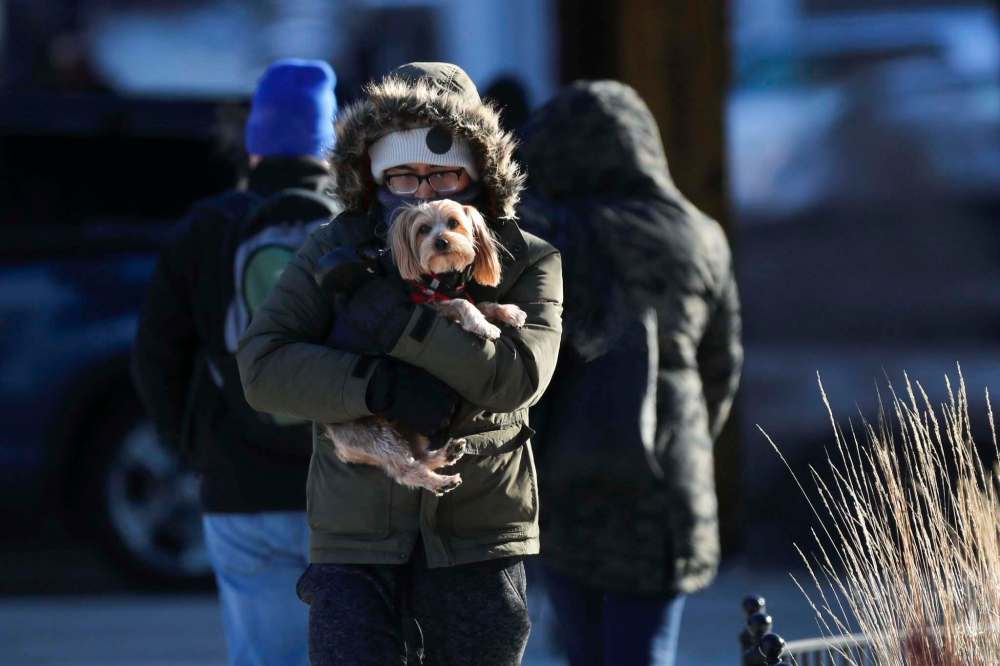
“In order for them to be safe, I have to put these little boots and jackets on them for every single trip outside,” she said. “These boots are basically deflated balloons that I have to force on their feet, and because I have two dogs, this process alone takes like 10 minutes.”
That’s if the dog will wear booties, which many won’t. Or if the dog will even consent to going outside, which some won’t.
Across the deeply frozen U.S. Midwest, owners of dogs, big and small, were confronted a few times a day with the unavoidable prospect of taking their pets out for bathroom breaks — an activity that could be painful for both human and pooch. Some described standing in their warmish doorways while holding onto an extra long leash attached to a dog doing its business outside.
Others told of dogs that chose to urinate on the porch rather than venture beyond, or that resorted to indoor “pee pads” for a few days. One Midwesterner, who did not want to be named, said the family dog stuck its nose out the dog door Thursday morning, backed away and “took a pee on the table leg while looking at me.”
Chicago resident Joseph Berger’s dog, a shepherd-Chow mix named Summer, usually takes three to four walks that last 30 minutes to an hour. This week, they lasted 10 minutes max, or “about nine minutes too long by my count,” said Berger, who works in magazine marketing. Putting on her booties is “a traumatic experience for both of us,” Berger said Thursday. But particularly excruciating was collecting what she had produced (a substance that, several Midwest dog owners attested, froze like a rock within seconds).
“Cleaning up after her was really terrible because I have to remove one glove layer to be able to manage the poop bag,” Berger said, adding that Summer is accustomed to getting a biscuit as a reward when she does something good, such as not barking at other dogs. “Glove off, toss her a biscuit, glove back on. Yesterday and today, that was torture,” he said.
Not all dogs are alike, of course, and some did not mind the sub-zero outdoors. Lucy, a thick-coated border collie mix in Madison, Wis., even frolicked with delight in the deep snow.
“I think I require more preparation than the dog does,” said her owner, illustrator Michael Hirshon, 31, who donned long underwear and multiple layers of shirts, sweaters and jackets for a fleeting excursion Thursday morning in -30 C temperatures. “It took about five minutes, because I knew she had to poop, and she likes to dawdle. So it required a lot of her jumping around. She usually walks around to find the perfect spot.”
The polar vortex-friendly dogs did not include Luna, a thin-coated lab-cattledog-pitbull mix who lives near Minneapolis. After refusing to wear protective socks, she consented to wearing a small hooded sweatshirt belonging to her owner, dental student Andrea Smith. But she only barely agreed to go outside.
“She was just hunched over, like, ‘Nope, forget it,’” said Smith, 26.
“She will keep minimal amounts of paws on the ground, and she runs inside.”
Darren Szrom’s Lab-retriever mix, 13-year-old Diamond, is used to hunting with him in zero-degree weather. But it was “just way too cold for literally man or beast,” Szrom said of the past few days in Chicago, and even Diamond wasn’t having it. Within seconds of being let out into the yard, Diamond “was on the deck, laying down on top of his paws to keep them warm like a wild animal would,” Szrom said. “Apparently, a minute was too long.”
But it was long enough for Szrom to be able to answer a burning question for some of us in balmier parts of the United States: no, he said, dog pee does not freeze midair.
“It definitely hit the ground as a liquid,” Szrom said of Diamond’s No. 1.
“I don’t know how long it was liquid.”
— Washington Post
History
Updated on Tuesday, February 5, 2019 6:13 AM CST: Adds photo