WEATHER ALERT

Tests suggest scientists achieved 1st ‘in body’ gene editing

Advertisement

Advertise with us

Scientists think they have achieved the first gene editing inside the body, altering DNA in adults to try to treat a disease, although it's too soon to know if this will help.

Read this article for free:

or

Already have an account? Log in here »

To continue reading, please subscribe:

Subscribe and receive a limited-edition Free Press branded hat or tote.

Digital Subscription

One year of digital access for only $205*

  • Enjoy unlimited reading on winnipegfreepress.com
  • Read the E-Edition, our digital replica newspaper
  • Access News Break, our award-winning app
  • Play interactive puzzles

*First annual payment billed as $205.00 + GST for one year. This annual subscription will automatically renew at $233.00 + GST every 52 weeks (10% off the regular annual price of $259.35). Offer available to new and qualified returning subscribers only. Cancel any time.

To continue reading, please subscribe:

Add Free Press access to your Brandon Sun subscription for only an additional

$1 for the first 4 weeks*

  • Enjoy unlimited reading on winnipegfreepress.com
  • Read the E-Edition, our digital replica newspaper
  • Access News Break, our award-winning app
  • Play interactive puzzles
Start now

*Your next Brandon Sun subscription payment will increase by $1.00 and you will be charged $17.95 plus GST for four weeks. After four weeks, your payment will increase to $24.95 plus GST every four weeks.

Hey there, time traveller!
This article was published 07/02/2019 (2726 days ago), so information in it may no longer be current.

Scientists think they have achieved the first gene editing inside the body, altering DNA in adults to try to treat a disease, although it’s too soon to know if this will help.

Preliminary results suggest that two men with a rare disorder now have a corrective gene at very low levels, which may not be enough to make the therapy a success.

Still, it’s a scientific milestone toward one day doctoring DNA to treat many diseases caused by faulty genes.
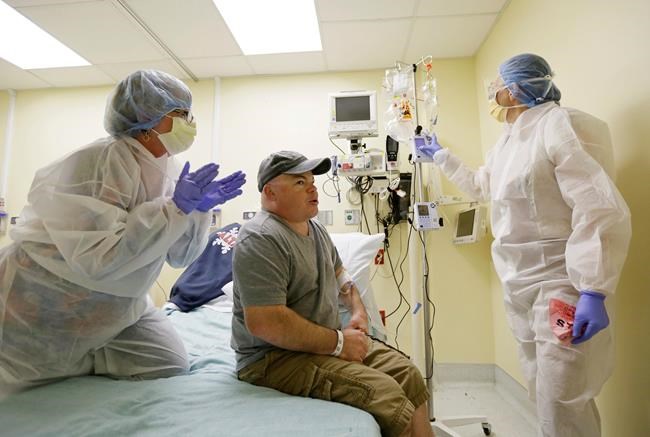
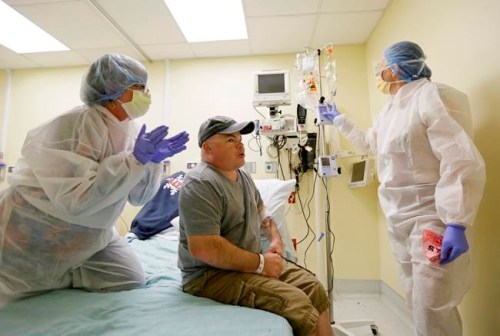
FILE - In this Monday, Nov. 13, 2017 file photo, Brian Madeux, starts to receive the first human gene editing therapy for Hunter syndrome, as his girlfriend, Marcie Humphrey, left, applauds at the UCSF Benioff Children's Hospital in Oakland, Calif. At right is nurse practitioner Jacqueline Madden. On Thursday, Feb. 7, 2019, scientists gave an update on the first effort to edit genes, or permanently change the DNA, of about a dozen adults, including Madeux, with metabolic diseases. (AP Photo/Eric Risberg)

“This is a first step,” said Dr. Joseph Muenzer of the University of North Carolina at Chapel Hill, who helped test the treatment. “It’s just not potent enough.”

He gave the results Thursday at a conference in Orlando, Florida, and has consulted for the therapy’s maker, California-based Sangamo Therapeutics. Researchers are working on a stronger version of the treatment.

Gene editing is intended as a more precise way to do gene therapy, to disable a bad gene or supply a good one that’s missing. Trying it in adults to treat diseases is not controversial and the DNA changes do not pass to future generations, unlike the recent case of a Chinese scientist who claims to have edited twin girls’ genes when they were embryos.

Sangamo’s studies involve men with Hunter or Hurler syndrome, diseases caused by a missing gene that makes an enzyme to break down certain sugar compounds. Without it, sugars build up and damage organs, often killing people in their teens.

In 2017, Brian Madeux of Arizona became the first person to try it. Through an IV, he received many copies of a corrective gene and an editing tool called zinc finger nucleases to insert it into his DNA.

Results on him and seven other Hunter patients, plus three with Hurler syndrome, suggest the treatment is safe, which was the main goal of these early experiments. Three problems — bronchitis, an irregular heartbeat and a hernia — were deemed due to the diseases, not the treatment.

Tissue samples showed evidence of gene editing at very low levels in two Hunter patients who were given a middle dose but not in one given a low dose. Tests are expected later this year on patients who received the highest dose and on Hurler patients.

Blood tests detected slightly higher levels of the missing enzyme in a few of the Hunter patients but none of them reached normal levels. One patient had a larger increase but also showed signs that his immune system might be attacking the therapy. He was treated for that and symptoms resolved.

More encouraging results were seen in Hurler patients — enzyme levels rose to normal in all three after treatment, tests on certain blood cells showed.

“This is very promising” for Hurler patients, said Dr. Paul Harmatz of UCSF Benioff Children’s Hospital Oakland, who presented those results.

None of the patients with either disease showed a sustained decline in urine levels of the troubling sugar compounds, though, and some other tests also did not detect intended effects of the therapy.

The key test will be stopping the patients’ weekly enzyme treatments to see if their bodies can now make enough of it on their own. Three have gone off treatments so far and one was recently advised to resume them because of fatigue and rising levels of the sugar compounds. The others have not been off long enough to know how they will fare.

“It looks like it’s safe … that’s a very positive sign,” said one independent expert, Dr. Kiran Musunuru of the University of Pennsylvania. He called the early results promising but said “it’s hard to be sure it’s doing any good” until patients are studied longer.

“What they’re trying to do with gene editing is very challenging,” he said. “It’s much harder to make a correction or insert a gene” than to disable one.

Dr. Tyler Reimschisel of Vanderbilt University agreed.

“It’s not discouraging, it’s just early and on a small amount of people,” he said. “This is definitely a novel and innovative treatment” but it’s not clear if it’s going to help.

Sangamo’s president, Dr. Sandy Macrae, said a more potent version is being manufactured. Because the treatment seems safe, regulators recently agreed to allow teens with Hunter syndrome to join the study. The ultimate goal is to treat children at a young age, before the disease causes much damage. He said the company will wait for more results on current patients before deciding how to proceed.

“We’ve done something important” by achieving gene editing, he said. “There is a foundation to build on.”

___

Marilynn Marchione can be followed at @MMarchioneAP

___

This Associated Press series was produced in partnership with the Howard Hughes Medical Institute’s Department of Science Education. The AP is solely responsible for all content.


Report Error Submit a Tip

More Stories

Dropping the gloves to make the point

Editorial 4 minute read Preview

Dropping the gloves to make the point

Editorial 4 minute read Yesterday at 2:01 AM CDT

In hockey parlance, it’s called “shedding,” the moment in a game when you are forced to deal with an instigator by dropping (shedding) your gloves for an all-out brawl.

That term is a deep cut from hockey culture that Prime Minister Mark Carney — he of the “elbows up” phenomenon — may need to not only embrace but practise more often in the face of yet another round of overly punitive tariffs imposed by United States President Donald Trump.

To be fair, under Carney’s leadership, Canada has not exactly rolled over in the face of Trump’s bully-boy tactics.

Yes, Canada has made concessions to placate Trump to further a new continental trade agreement: investing more money to combat the cross-border flow of fentanyl that isn’t actually happening, stalling efforts to tax streaming companies as most European countries already do, and — most recently — giving Trump a cut of profits from the Canadian-made, Canadian-paid Gordie Howe bridge between Windsor and Detroit.

Read
Yesterday at 2:01 AM CDT

Longtime Assiniboine Park Zoo resident Blizzard the bison dies

Zoe Pierce 2 minute read Preview

Longtime Assiniboine Park Zoo resident Blizzard the bison dies

Zoe Pierce 2 minute read Friday, Jul. 24, 2026

Blizzard, the white bison that became one of Assiniboine Park Zoo’s most recognizable residents during nearly 20 years at the facility, has died, the zoo announced Friday.

The zoo said Blizzard’s health declined in recent weeks, so a diagnostic exam was recommended to better understand his condition. He died during the procedure.

Blizzard arrived at Assiniboine Park Zoo in 2006 and went on to become a favourite among visitors, inspiring “millions of visitors with his remarkable presence,” the zoo said in a social media post.

“While all animals in our care are deeply valued, Blizzard held a special place in the hearts of many people and carried profound cultural and spiritual significance for many Indigenous peoples,” the post reads.

Read
Friday, Jul. 24, 2026

Tests suggest scientists achieved 1st 'in body' gene editing

Marilynn Marchione, The Associated Press 5 minute read Preview

Tests suggest scientists achieved 1st 'in body' gene editing

Marilynn Marchione, The Associated Press 5 minute read Thursday, Feb. 7, 2019

Scientists think they have achieved the first gene editing inside the body, altering DNA in adults to try to treat a disease, although it's too soon to know if this will help.

Preliminary results suggest that two men with a rare disorder now have a corrective gene at very low levels, which may not be enough to make the therapy a success.

Still, it's a scientific milestone toward one day doctoring DNA to treat many diseases caused by faulty genes.

"This is a first step," said Dr. Joseph Muenzer of the University of North Carolina at Chapel Hill, who helped test the treatment. "It's just not potent enough."

Read
Thursday, Feb. 7, 2019

Winnipeg Fringe Festival: 2026 show reviews

Winnipeg Free Press 1 minute read Preview

Winnipeg Fringe Festival: 2026 show reviews

Winnipeg Free Press 1 minute read Tuesday, Jul. 14, 2026

Not sure what to see at this year's Winnipeg Fringe Theatre Festival? All of the Free Press’s reviews will be published here.  Find a show and click to read its review.

Read
Tuesday, Jul. 14, 2026

Up to the challenge

Zoe Pierce 3 minute read Preview

Up to the challenge

Zoe Pierce 3 minute read Yesterday at 6:13 PM CDT

There may not be another restaurant in Manitoba that can say it has welcomed visitors from as many communities across the province and beyond as the Somerset Food Bar & Lounge has this summer.

In just over a two week span, visitors from more than 100 towns have come out to the family-owned restaurant tucked away in Somerset, a community of roughly 450 people in the Pembina Valley 130 kilometres southwest of Winnipeg.

It started as a challenge, “60 Towns in 60 Days,” where the restaurant wanted to document how many different places they could reach, as it often sees people travelling across Canada stop at the restaurant. The goal was also to encourage people to make a drive they normally wouldn’t.

“The more we started sharing, the more people really started getting behind it, and it turned into this really big thing fairly quickly,” said Jay Friesen, restaurant manager.

Read
Yesterday at 6:13 PM CDT

Men cycling across Canada for charity have bikes stolen in Winnipeg

Chris Kitching 5 minute read Preview

Men cycling across Canada for charity have bikes stolen in Winnipeg

Chris Kitching 5 minute read Friday, Jul. 24, 2026

Thomas Clark and Valentin Duquenne were devastated after their bikes went missing outside CBC Manitoba’s headquarters, but uplifted by the outpouring of support from Manitobans afterward.

Read
Friday, Jul. 24, 2026