Exhibit spotlights 50 years of fab fashion from FIT archives

Advertisement

Advertise with us

NEW YORK - A brilliant green gown in sculptured silk satin by Charles James, the late American master couturier, gleams like a just-polished emerald as you enter the archives of the Museum at the Fashion Institute of Technology — a huge, climate-controlled space that houses more than 50,000 garments and accessories.

Read this article for free:


By clicking the button above, an account will be created and you will begin to receive some of our recommended newsletters. You may opt out of any newsletter by visiting your Email and Communication Preferences page or by clicking "unsubscribe" at the bottom of any email.

or

Already have an account? Log in here »

To continue reading, please subscribe:

Digital Subscription

One year of digital access for only $1.44 a week*

  • Enjoy unlimited reading on winnipegfreepress.com
  • Read the E-Edition, our digital replica newspaper
  • Access News Break, our award-winning app
  • Play interactive puzzles

*Billed as $5.77 plus GST every four weeks. After 52 weeks, price increases to the regular rate of $19.95 plus GST every four weeks. Offer available to new and qualified returning subscribers only. Cancel any time.

To continue reading, please subscribe:

Add Free Press access to your Brandon Sun subscription for only an additional

$1 for the first 4 weeks*

  • Enjoy unlimited reading on winnipegfreepress.com
  • Read the E-Edition, our digital replica newspaper
  • Access News Break, our award-winning app
  • Play interactive puzzles
Start now

*Your next Brandon Sun subscription payment will increase by $1.00 and you will be charged $17.95 plus GST for four weeks. After four weeks, your payment will increase to $24.95 plus GST every four weeks.

Hey there, time traveller!
This article was published 07/02/2019 (2815 days ago), so information in it may no longer be current.

NEW YORK – A brilliant green gown in sculptured silk satin by Charles James, the late American master couturier, gleams like a just-polished emerald as you enter the archives of the Museum at the Fashion Institute of Technology — a huge, climate-controlled space that houses more than 50,000 garments and accessories.

Care for a little Chanel? How about hundreds of delectable vintage suits, hanging closely together in the fantasy closet of a fashionista’s dreams, with tweed jackets in plaids, pastels, or florals?

Nearby are the historical garments, which range from the 18th century onward, including dresses from the Civil War era, “just like ones you’d see in an Impressionist painting,” says Valerie Steele, the museum’s director and chief curator.
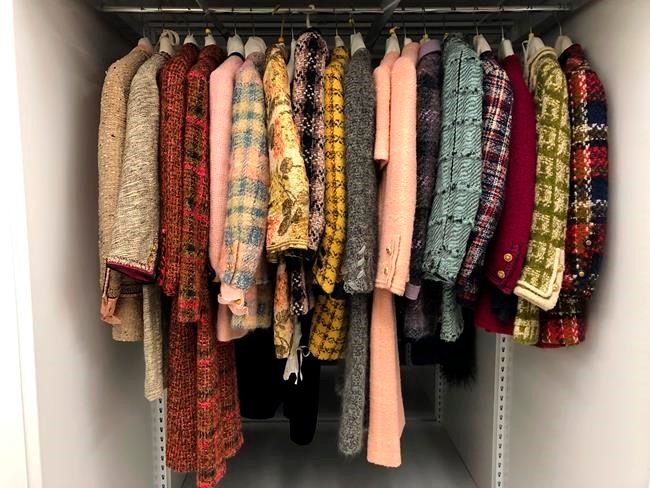
This Jan. 31, 2019 photo shows various Chanel fashion during a tour of the permanent archives at the Fashion Institute of Technology in New York. The outfits are stored in one of two climate-controlled rooms that house more than 50,000 items. (AP Photo/Jocelyn Noveck)

It was Steele who had to cull through this huge permanent collection, and a half-century worth of FIT exhibits, to come up with “Exhibitionism,” a new show that opens Friday and celebrates the museum’s 50th anniversary — just in time for New York Fashion Week.

There wasn’t room enough in the museum to spotlight all of the favourite exhibits from 50 years — there have been more than 200 — so Steele whittled it down to 33, each of which are represented with a vignette.

They include “Fairy Tale Fashion,” a 2016 show that illustrated 15 well-known fairy tales using both clothes — like the iconic red riding hood — or accessories, like the glass slipper. A real red hooded cape from 18th-century England stands next to a more modern one by Rei Kawakubo of Comme des Garcons, featuring a shiny, quilted patent-leather hood.

An eerie sight is Thierry Mugler’s short black vampire dress, worn by a mannequin stepping out of a coffin, from the 2009 show “Gothic: Dark Glamour.” Also featured is “Fashion and Surrealism,” a 1987 show that was one of the museum’s most popular; an eye-catching (literally) suit by Larry Shox features a pattern of huge, disembodied eyeballs.

And if you like corsets, look no further than the waist-cinching examples from the 2000 show aptly named “The Corset,” exploring what the museum calls “the most controversial garment in fashion history.”

The retrospective also touches on social themes, with highlights from “A Queer History of Fashion: From the Closet to the Catwalk,” from 2013. “It was really the first significant exhibition of LGBTQ influence on fashion,” Steele says. “We thought we would just begin with the mid-20th century, but it turns out that gays and lesbians had a big impact on fashion as early as the 18th century, as trendsetters.”

Also represented is “Black Fashion Designers,” a very popular 2017 show that displayed work by more than 60 black designers of different generations. A wide, brilliantly colored cape by Duro Olowu, the Nigerian-born designer, is paired here with a red-and-black wrap-style gown by Scott Barrie.

Over the 50 years of exhibitions, fashion came to be viewed differently, Steele says — as a social barometer rather than just, well, clothes.

“I think in the past there was much more of a kind of male chauvinist view that fashion was something frivolous and feminine … just about hemlines,” she says. “Increasingly over time, younger generations came to accept that fashion is significant.

“It’s a multi-billion dollar business,” Steele adds. “It sometimes has a really bad impact on the environment. But it’s also a way that individuals can express themselves.”

In order to whittle down decades of exhibits for the retrospective, FIT curators say they stuck with those for which garments were available in the permanent collection upstairs.
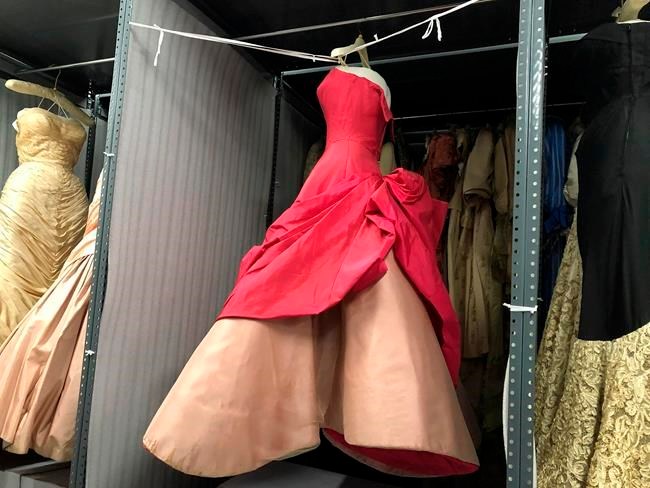
This Jan. 31, 2019 photo shows a red ball gown by American designer Charles James among other pieces during a tour of the permanent archives at the Fashion Institute of Technology in New York. The outfits are stored in one of two climate-controlled rooms that house more than 50,000 items. (AP Photo/Jocelyn Noveck)

That collection, housed in two huge rooms closed to the public, includes garments that are so fragile that “they have to lie down,” in Steele’s words, lying on neat shelves and protected by acid-free paper.

On a brief tour through one of the two rooms last week, staffers watched carefully to make sure no garment was accidentally touched by a bare hand — or a journalist’s camera. Steele pointed out famous dresses like a pink cocktail number with a rose at the waist by Yves Saint Laurent for Dior, featured in the recent exhibit “Pink: The History of a Punk, Pretty, Powerful Color.”

Draped over a specially made artificial body was a two-tone pink-and-red gown by James, the mid-20th century designer who specialized in spectacular, sculptured dresses constructed with intricate draping techniques. “This one can neither lie down nor hang from a hanger,” Steele explained of the fragile ballgown.

Then there was that gleaming green satin dress, also by James. The Museum at FIT has the second biggest collection of James gowns, after the Metropolitan Museum of Art.

“Fabulous,” Steele pronounced. “He was a real architect of shape.”

___

“Exhibitionism: 50 Years of the Museum at FIT” opens Friday and runs through April 20.

Report Error Submit a Tip

More Stories

Chief medical officer quits, cites work environment ‘challenges’

Chris Kitching 6 minute read Preview

Chief medical officer quits, cites work environment ‘challenges’

Chris Kitching 6 minute read Yesterday at 5:47 PM CDT

Manitoba’s provincial chief medical officer is resigning from his position at Shared Health, citing the role’s demands and work environment challenges in an email viewed by the Free Press.

Dr. José François, who’s held the executive position since April 2024, sent an email to provincial medical specialty leads that said his final day will be Jan. 17, 2027, after he submitted his resignation Wednesday. Several other senior leaders have departed the provincial health authority in recent months.

“Serving in this role has been a privilege,” François, a longtime family physician from Ste. Anne, wrote in the email.

He said his “greatest pleasure” was working alongside and supporting an “exceptional group” of provincial medical specialty leads and chief medical officers.

Read
Yesterday at 5:47 PM CDT

WAG-Qaumajuq names first Indigenous director, CEO

Jen Zoratti 4 minute read Preview

WAG-Qaumajuq names first Indigenous director, CEO

Jen Zoratti 4 minute read Yesterday at 5:16 PM CDT

John Mahli Lawa’ Hampton has been selected to take the helm of Canada’s oldest civic art gallery, WAG-Qaumajuq announced Thursday.

Read
Yesterday at 5:16 PM CDT

Rich get richer as NDP policy shifts leave opponents in dust

Dan Lett 5 minute read Preview

Rich get richer as NDP policy shifts leave opponents in dust

Dan Lett 5 minute read Wednesday, Oct. 21, 2026

Last week, Finance Minister Adrien Sala made two announcements that showed why the NDP will remain the party to beat in the next provincial election.

Read
Wednesday, Oct. 21, 2026

Family history, solo sojourns paved path for Patrick deWitt’s latest novel, Dodge City

Ben Sigurdson 6 minute read Preview

Family history, solo sojourns paved path for Patrick deWitt’s latest novel, Dodge City

Ben Sigurdson 6 minute read 2:01 AM CDT

It’s 1967 and Lee Clarke has just been kicked out of UCLA when he receives his draft letter in the mail. Rather than report for basic training, he hops in a car and sets off across America on an amphetamine-fuelled road trip to bid farewell to his fractured, dysfunctional family before crossing the border into Canada.

Such is the premise for B.C.-born, Portland-based Patrick deWitt’s sixth novel Dodge City, published in September by House of Anansi. He’s in Winnipeg tonight at McNally Robinson Booksellers’ Grant Park location to launch the book.

The 51-year-old deWitt came to prominence with his sophomore novel, 2011’s The Sisters Brothers. The book was a critical and commercial success, winning the author the Governor General’s Literary Award for Fiction, the Rogers Writers’ Trust Fiction Prize and the Stephen Leacock Medal for Humour, and was adapted for the big screen in a film starring John C. Reilly and Joaquin Phoenix.

His 2018 novel French Exit was also adapted for cinema, and his 2023 novel The Librarianist won deWitt the Leacock Medal for the second time. Dodge City is deWitt’s fourth novel to make the Giller Prize long list.

Read
2:01 AM CDT

Winnipeg Jets trade Connor Hellebuyck to New Jersey Devils

Free Press staff 1 minute read Preview

Winnipeg Jets trade Connor Hellebuyck to New Jersey Devils

Free Press staff 1 minute read 11:34 AM CDT

Connor Hellebuyck has been traded.

The Winnipeg Jets announced Friday morning they have sent the netminder to the New Jersey Devils for four players and two draft picks.

The Jets are receiving: Dawson Mercer, Alexander Command, Nico Daws and Nick Bjugstad.

More to come.

Read
11:34 AM CDT

Rocky Horror star prepared for a rude reception in all the best ways

Conrad Sweatman 5 minute read Preview

Rocky Horror star prepared for a rude reception in all the best ways

Conrad Sweatman 5 minute read 2:01 AM CDT

While it enjoys the longest theatrical release of any movie in history, The Rocky Horror Picture Show was all but ignored by critics when its revolutionary brand of camp first hit silver screens in 1975.

And before it whipped up a cult following, Rocky was a fringe theatre hit in London whose first run’s final night — which had attracted such luminaries as Mick and Bianca Jagger — was derailed by an unlikely culprit: glitter. According to the late Tim Curry (who died at 80 in August), the shiny stuff ended up where the sun don’t shine.

“Well, Rocky got some glitter down his trunks and it set up an irritation. When we arrived at the theatre, he was standing in the shower and the show couldn’t go on,” he told the press in 1974, after crossing the Atlantic to lead the show’s American theatre debut.

Glitter is one of the things audiences may not throw at the stage at The Rocky Horror Picture Show screening tonight at the Centennial Concert Hall. Unlike in the anarchic midnight screenings at the New York’s Waverly Theater beginning in 1976, where audiences chucked everything but the kitchen sink, a prop bag will be courteously supplied at the door.

Read
2:01 AM CDT